The Ultimate Guide to Affiliate Competitor Analysis

Bottom Line Up Front: Affiliate competitor analysis is your secret weapon for building superior programs, identifying high-performing partners, and uncovering market opportunities that drive measurable growth. This systematic approach to intelligence gathering can transform your affiliate strategy from reactive to proactive, delivering competitive advantages that translate directly to revenue.
Knowledge is power—and competitor intelligence is your competitive edge. Digital marketing is more competitive than ever. With brands fighting for attention across multiple platforms, those that don’t adapt are quickly left behind. The most successful affiliate programs aren’t built in isolation; they’re crafted using strategic intelligence gathered from studying what works (and what doesn’t) in the market.
Whether you’re launching a new affiliate program or scaling an existing one, understanding your competitive landscape isn’t optional—it’s essential for survival and growth in 2025’s increasingly sophisticated affiliate marketing ecosystem.
- What is Affiliate Competitor Analysis?
- Why Affiliate Competitor Analysis is Critical in 2025
- The Strategic Framework: 6-Step Affiliate Competitor Analysis
- Step 1: Identify Your True Competitors
- Step 2: Discover Their Affiliate Partners
- Advanced Google Search Operators Method:
- The Five Strategic Content Types to Target:
- Affiliate Link Detection Method:
- Social Media Investigation:
- Affiliate Network Research:
- Step 3: Analyse Program Structure and Terms
- Step 4: Content and Promotional Strategy Analysis
- Step 5: Technology and Platform Assessment
- Step 6: Performance and Market Position Analysis
- Leveraging Competitor Intelligence for Strategic Advantage
- 1. Build a Superior Value Proposition
- 2. Target High-Opportunity Affiliates
- 3. Develop Differentiated Positioning
- 4. Content Strategy Enhancement
- Essential Tools for Affiliate Competitor Analysis
- Research and Discovery Tools
- Spy and Intelligence Tools
- Social Media Monitoring
- Tracking and Analytics Tools
- Advanced Competitive Intelligence Strategies
- 1. The Three-Tier Competitor Framework
- 2. Quality-Focused Partner Prioritisation
- 3. Seasonal Pattern Analysis
- 4. Partnership Ecosystem Mapping
- 5. Communication Strategy Analysis
- 6. Pricing and Promotion Intelligence
- 7. Technology Evolution Tracking
- Common Pitfalls and How to Avoid Them
- 1. Analysis Paralysis
- 2. Copying Instead of Innovating
- 3. Surface-Level Analysis
- 4. Ignoring Emerging Competitors
- Building Your Competitive Intelligence System
- 1. The Four-Week Implementation Framework
- 2. Monitoring and Documentation Schedule
- 3. Documentation and Tracking Systems
- 4. Team Coordination and Knowledge Sharing
- Measuring the Impact of Competitive Intelligence
- Future-Proofing Your Competitive Analysis
- Conclusion: Turning Intelligence into Action
What is Affiliate Competitor Analysis?
Affiliate competitor analysis is basically the process of discovering, analysing, and gaining insights into the affiliate programs run by your direct competitors. But it’s much more than surface-level observation. It’s about uncovering the strategic decisions, partner relationships, commission structures, and promotional tactics that drive your competitors’ success.
Think of it as reverse-engineering success. Instead of starting from scratch and making costly mistakes, you can learn from established programs, identify market gaps, and build a superior offering that attracts the best affiliates in your space.
Before you start analysing competitors, ensure you have a solid foundation in choosing the right niche for your affiliate marketing efforts. Understanding your niche helps you identify the most relevant competitors and opportunities.
- Partner Intelligence: Identifying who promotes your competitors and why
- Program Intelligence: Understanding commission structures, terms, and incentives
- Performance Intelligence: Analysing what content and promotional strategies drive results
Why Affiliate Competitor Analysis is Critical in 2025
The affiliate marketing landscape has evolved dramatically. As of this year, over 80% of brands make use of affiliate marketing. This saturation means affiliates have countless programs to choose from, making differentiation crucial.
Here’s why competitor analysis has become non-negotiable:
Market Intelligence Drives Strategy
Understanding what competitors are doing—and more importantly, what’s working for them–is now a key part of staying ahead. Rather than guessing what might work, you can build strategies based on proven market data.
Speed to Market
Instead of starting from scratch, you can immediately target affiliates who are already proven performers in your space. This dramatically reduces the time needed to build a profitable affiliate network.
Resource Optimisation
Understanding commission structures and affiliate incentives helps you craft more competitive offers that attract quality partners without overpaying for performance.
Risk Mitigation
You can identify potential conflicts or exclusive partnerships before investing time in recruitment. This prevents wasted effort on unavailable or unsuitable partners.
The Strategic Framework: 6-Step Affiliate Competitor Analysis
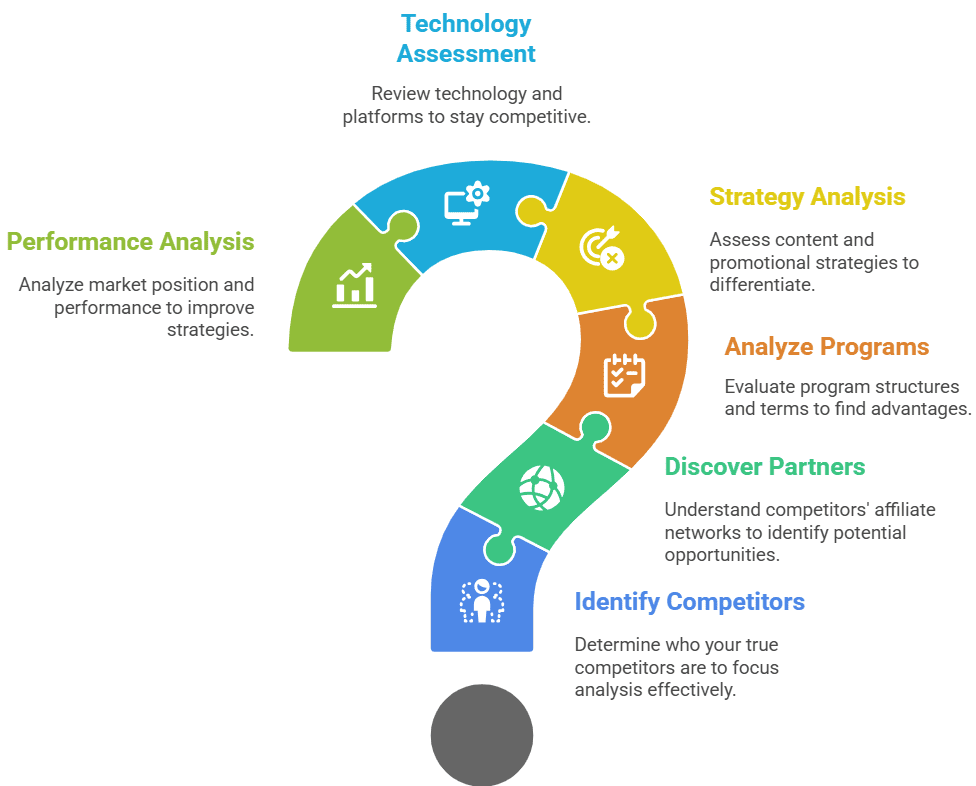
Step 1: Identify Your True Competitors
The first step isn’t always obvious. You need to identify both direct and indirect competitors across multiple dimensions:
Direct Competitors: Companies offering similar products to the same audience Indirect Competitors: Brands targeting your audience with different solutions Aspirational Competitors: Larger programs you want to emulate Emerging Competitors: New entrants gaining traction in your space
Practical Method:
- Use SEMrush or Ahrefs to identify websites ranking for your target keywords
- Enter your target keyword in Ahrefs’ Content Explorer. Ideally, use one of the major keywords you want to rank for and select the “In Title” filter to display pages with that keyword in their title
- Analyse the results to identify affiliate-focused websites vs. general publications
- Create a spreadsheet with 10-15 primary competitors for deep analysis
As we’ve discussed in our competitive analysis insights, sometimes, the biggest disruptors come from outside the expected industry. A brand in a completely different niche might be using a strategy that can be adapted to an entirely new market.
Step 2: Discover Their Affiliate Partners
This is where the real intelligence gathering begins. You need to uncover who’s promoting your competitors and how they’re doing it.
Advanced Google Search Operators Method:
The most effective approach uses sophisticated search strings that reveal affiliate relationships:
The Five Strategic Content Types to Target:
- Listicles: “Top X” articles are usually chock-full of affiliate links. The ability to put multiple affiliate links in one post is what makes bloggers profitable, meaning they’ll likely agree to add you to their list.
- Competitor Mentions: If someone’s talking about a product that isn’t theirs, they’re probably not doing it for free. More often than not, it’s tied to an affiliate link.
- Tutorial and How-To Content: Educational content that references specific tools and solutions often contains affiliate relationships.
Affiliate Link Detection Method:
Use Ahrefs or similar tools to identify affiliate relationships through URL patterns. Look for common affiliate tags:
- ?fp_ref, ?via, ?deal, ?ref=, ?tap=
- utm_source=partnerstack, utm_source=referral
- grsm.io, ?fpr=
Social Media Investigation:
- Search YouTube for “[competitor name] + review”
- Check LinkedIn for partnership announcements
Affiliate Network Research:
Browse networks like ShareASale, CJ Affiliate, and Impact.com for competitor programs and existing partner lists.
Step 3: Analyse Program Structure and Terms
To beat your competitors, you need to know what they’re offering—like their commission rates, cookie duration, and payment terms.
Create a comprehensive comparison matrix including:
Commission Structure Deep-Dive:
- Percentage vs. flat fee structures
- Recurring vs. one-time payments
- Tier-based commission escalation (Do they offer higher payouts as affiliates bring in more customers?)
- Performance bonuses and volume incentives
- Sub-affiliate network opportunities (Do they allow affiliates to earn from recruits?)
Program Terms Analysis:
- Attribution models (first-click, last-click, multi-touch)
- Payment thresholds and frequency
- Approval requirements and traffic restrictions
- Accepted traffic sources vs. blocked traffic types
Marketing Support Evaluation:
- Content creation resources and swipe files
- Landing page optimisation tools
- Promotional calendar and seasonal campaigns
- Training and educational resources
Commission Benchmarking by Industry:
- Physical products: up to 10%
- Digital products: 20% to 40%
- Financial products: up to 50%
- SaaS and subscription services: 20-30% recurring
Pro Tip: Consider signing up as a test affiliate for each of your competitors to see what their affiliate onboarding process looks like behind the curtain. This gives you an inside view of their dashboards, communications, and overall experience.
Step 4: Content and Promotional Strategy Analysis
Understanding how affiliates promote your competitors reveals what resonates with your shared audience.
Content Pattern Analysis:
- What types of content perform best (reviews, comparisons, tutorials)?
- Which promotional angles are most common (price, features, benefits)?
- How do affiliates handle objections and concerns?
- What calls-to-action generate the highest engagement?
Create a swipe file of your competitors’ best-performing content. Look for patterns in their headlines, structure, and promotional angles.
Traffic Source Intelligence: Analyse where competitors are driving traffic:
- Organic search (SEO-focused content)
- Paid advertising (PPC campaigns)
- Email marketing campaigns
- Influencer partnerships and collaborations
Step 5: Technology and Platform Assessment
Your competitors’ technology choices reveal their affiliate program priorities and sophistication level.
Core Technology Stack Investigation:
- Attribution technology: First-party tracking, cross-device attribution capabilities
- Analytics and reporting tools: Advanced performance insights and custom dashboards
- Integration capabilities: CRM systems, email marketing platforms, customer support tools
Advanced Software Analysis:
Lead and Call Management Systems: Larger companies often rely on sophisticated lead management systems to track, route, and analyze web and call leads dynamically. Look for evidence of tools like LMS Sync for web leads or Call Logic for phone call management.
User Behavior Analytics: Analyse whether competitors use specialised user behaviour analytics tools to understand how users interact on their sites, what facilitates conversions, and what creates friction.
Predictive Modeling Software: Advanced programs use predictive modeling to simulate future campaigns based on business data and market trends, reducing risks before committing budgets.
Communication Infrastructure:
- Automated call distribution systems
- Virtual phone numbers and fax-to-email systems
- Video messaging and conference capabilities
Technology Sophistication Indicators:
- Real-time reporting capabilities
- Mobile app availability for affiliates
- API access and custom integrations
- White-label solutions for top affiliates
- Advanced fraud detection systems
Pro Tip: Look at job postings from your competitors. They often reveal the tools and technologies they’re using or planning to implement.
As highlighted in our automation tools guide, technology choices often indicate program sophistication and growth trajectory.
Step 6: Performance and Market Position Analysis
The final step involves understanding how well competitors are executing their strategies.
Traffic Analysis (using tools like SEMrush or SimilarWeb):
- Estimated monthly traffic to affiliate-driven content
- Traffic trends and seasonality patterns
- Top-performing pages and conversion paths
- Mobile vs. desktop performance
Market Share Indicators:
- Number of active affiliates (estimated through partner discovery)
- Geographic reach and international expansion
- Brand mention frequency and sentiment analysis
- Partnership announcements and program growth signals
Leveraging Competitor Intelligence for Strategic Advantage
Once you’ve gathered intelligence, the real work begins: translating insights into actionable strategies that give you a competitive edge.
1. Build a Superior Value Proposition
Use competitor analysis to identify gaps in their offerings:
Commission Optimisation: If competitors offer 20% commissions with 30-day cookies, consider 25% with 60-day cookies for quality affiliates.
Enhanced Support: Where competitors provide basic creative assets, offer comprehensive marketing resources and training.
Technology Advantages: Implement superior tracking and attribution technology that provides affiliates with better insights and tools.
2. Target High-Opportunity Affiliates
Prioritize outreach based on competitor intelligence:
Underserved Partners: Identify affiliates who promote competitors but aren’t receiving adequate support or competitive terms.
Content Gap Affiliates: Find publishers creating content in areas where competitors are weak or absent.
Geographic Expansion: Target affiliates in regions where competitors have limited presence.
3. Develop Differentiated Positioning
By understanding what competitors are doing, you can position yourself uniquely in the market. For instance, if a competitor is primarily using email marketing, you could explore other channels like social media or video marketing to reach your audience.
Unique Selling Points:
- Superior product features or pricing
- Better affiliate support and communication
- More generous terms and faster payments
- Exclusive promotional opportunities
4. Content Strategy Enhancement
Competitor analysis can inspire your content strategy. Look at what content competitors are creating, how their audience responds, and find ways to improve upon it.
Content Opportunities:
- Topics competitors haven’t covered thoroughly
- Updated takes on popular comparison content
- Video content where competitors only offer written reviews
- Interactive tools and calculators
Keyword Research and SEO Analysis: Conduct comprehensive keyword research to identify what your target audience is searching for and which terms competitors are ranking for. Understanding SEO fundamentals and backlink analysis helps you identify content opportunities and potential partnerships.
Audience Research Integration: Understanding your audience is crucial for effective competitor analysis. Use analytics tools, surveys, and social media insights to gather valuable data about your audience personas, then analyse how competitors are serving similar audiences.
Essential Tools for Affiliate Competitor Analysis
The right tools can dramatically accelerate your analysis and provide deeper insights:
Research and Discovery Tools
SEMrush: Comprehensive competitor analysis capabilities including keyword research, backlink analysis, and traffic insights. SEMrush is used by over 7 million marketing professionals and can help affiliate managers perform automated keyword research, find frequently asked questions, and analyse competitor strategies.
Ahrefs: Excellent for backlink analysis and content research. Ahrefs offers comprehensive analysis options including keyword research and generation, page and content analysis, and broken link checking capabilities.
SimilarWeb: Traffic analysis and referral source identification for understanding competitor performance.
Spy and Intelligence Tools
Some of the most effective spy tools for affiliates in 2025 include Adplexity, Anstrex, and WhatRunsWhere. These platforms allow affiliates to see live ads, landing pages, and traffic sources used by competitors across different geographies and networks.
Social Media Monitoring
Brand24 or Mention: Track competitor brand mentions and affiliate partnerships across social platforms.
Social Media Native Search: Utilise platform-specific searches on Instagram, TikTok, YouTube, and LinkedIn.
Impact.com: Partnership management and tracking capabilities with competitive intelligence features.
Everflow: Advanced tracking and attribution analysis.
Phonexa: Comprehensive performance marketing suite with competitor analysis capabilities.
Advanced Competitive Intelligence Strategies
1. The Three-Tier Competitor Framework
Most companies get competitor identification wrong by focusing solely on direct product competitors. Here’s the comprehensive framework:
Direct Product Competitors: Companies offering similar solutions to your target market Content Competitors: Publishers and influencers competing for your audience’s attention
Commission Competitors: Programs offering better terms that could lure away your affiliates
Create separate tracking documents for each competitor type, as you’ll need different metrics and insights for each category.
2. Quality-Focused Partner Prioritisation
After analysing hundreds of successful affiliate programs, the most valuable affiliates aren’t always the ones with the most traffic. Mid-sized review sites often drive more conversions than major publications.
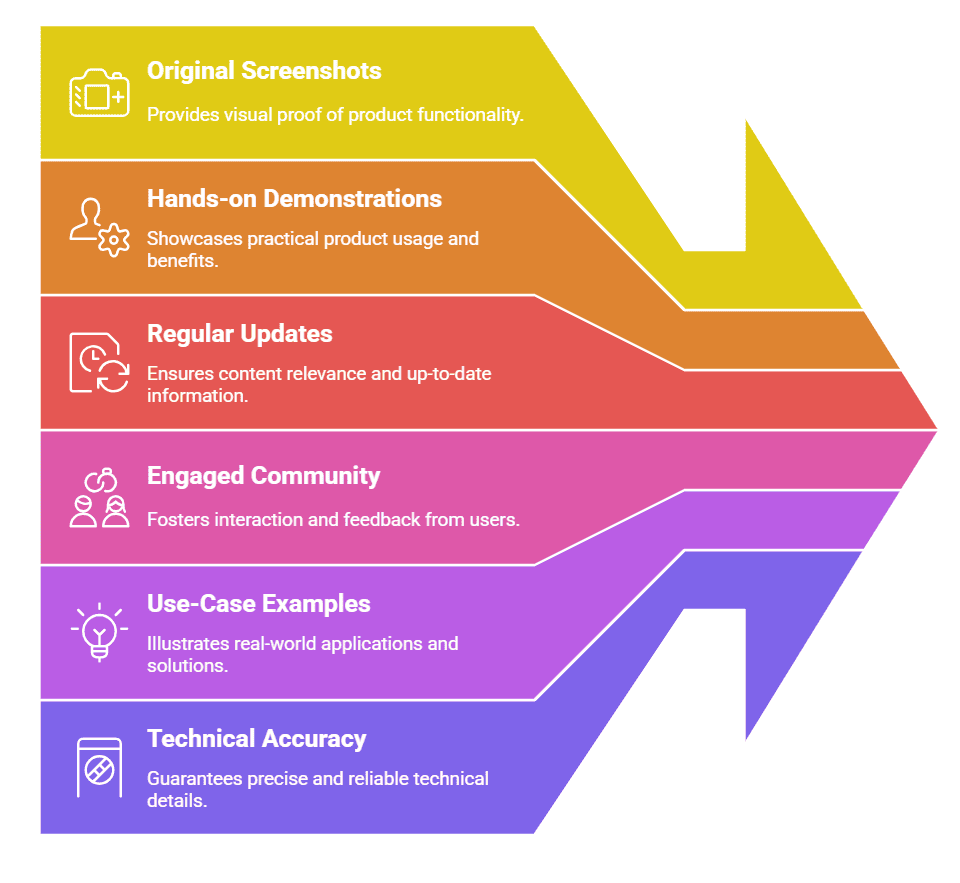
Quality Indicators to Track:
- Original product screenshots and testing evidence
- Hands-on experience demonstrations
- Regular content updates and freshness
- Specific use-case examples and tutorials
- Technical accuracy and depth of analysis
Partner Prioritisation Matrix: Score potential partners on:
- Content quality (update frequency, depth of analysis, original insights)
- Market alignment (audience overlap, niche expertise)
- Competitor presence (exclusive vs. non-exclusive relationships)
3. Seasonal Pattern Analysis
Track competitor promotional calendars:
- Black Friday and holiday campaign strategies
- Product launch coordination with affiliates
- Seasonal content and promotional themes
- Year-over-year campaign evolution
4. Partnership Ecosystem Mapping
Create visual maps of competitor affiliate ecosystems:
- Core vs. peripheral affiliate relationships
- Exclusive vs. non-exclusive partnerships
- Geographic partnership distribution
- Partnership evolution over time
5. Communication Strategy Analysis
One area often overlooked in competitor analysis is how they handle affiliate communication:
Communication Methods to Analyse:
- Automated call distribution systems for customer service
- Virtual communication tools and accessibility features
- Response times and support quality
- Community building and relationship management approaches
6. Pricing and Promotion Intelligence
Monitor competitor promotional strategies:
- Discount frequency and depth analysis
- Exclusive offers for affiliate audiences
- Bundle and upsell coordination strategies
- Promotional timing and market coordination
- Link cloaking and tracking methodologies
7. Technology Evolution Tracking
Monitor for strategic technology changes:
- New platform migrations or integrations
- Team expansions (especially affiliate management roles)
- Technology partnership announcements
- Feature releases and capability enhancements
Common Pitfalls and How to Avoid Them
1. Analysis Paralysis
The Problem: Spending too much time analysing without taking action.
The Solution: Don’t try to analyse everything at once. Focus on one area each week and document your findings systematically. Set specific deadlines for analysis phases and action implementation.
2. Copying Instead of Innovating
The Problem: Many businesses fall into the trap of assuming that if a competitor is running a specific type of ad or promoting a particular product, it must be working.
The Solution: Use competitor insights as a foundation for innovation, not replication. Ask “How can we do this better?” rather than “How can we copy this?”
3. Surface-Level Analysis
The Problem: Most competitor analysis gets it completely wrong. I’m not talking about surface-level metrics like commission rates or network size. I’m talking about the hidden patterns that actually predict affiliate program success.
The Solution: Dig deeper into why certain strategies work, not just what competitors are doing. Focus on understanding the underlying principles and market dynamics.
4. Ignoring Emerging Competitors
The Problem: Focusing only on established players while missing disruptive newcomers.
The Solution: Update your target list monthly. The best affiliate partners are often new to your space but growing quickly. Regular research helps you find them before your competitors do.
Building Your Competitive Intelligence System
1. The Four-Week Implementation Framework
WEEK 1: DISCOVERY
- Run comprehensive search operator analysis across all competitor tiers
- Create detailed tracking spreadsheets with quality scoring matrices
- Identify top 20 priority targets using the prioritisation framework
WEEK 2: ANALYSIS
- Conduct deep-dive content review and pattern analysis
- Score potential partners using the quality indicator system
- Map competitor relationships and exclusive arrangements
- Create personalised outreach templates based on content analysis
WEEK 3: ENGAGEMENT
- Provide valuable comments and insights on relevant content
- Prepare detailed partnership proposals and program benefits
WEEK 4: OUTREACH
- Send personalised partnership proposals
- Track response rates and optimise messaging
- Begin onboarding process for interested partners
- Document learnings and refine approach for next cycle
2. Monitoring and Documentation Schedule
Weekly Tasks:
- Competitor promotional activity monitoring
- New affiliate relationship discoveries
Monthly Reviews:
- Traffic and ranking changes assessment
- New affiliate partner identification
- Commission structure and terms updates
- Technology stack evolution tracking
Quarterly Audits:
- Comprehensive program performance reviews and strategic assessments
- Competitor landscape mapping updates
- Partnership ecosystem analysis
- ROI measurement and strategy optimisation
Annual Strategic Reviews:
- Complete competitive landscape remapping
- Long-term trend analysis and prediction
- Technology infrastructure assessment
- Strategic partnership opportunity evaluation
3. Documentation and Tracking Systems
Maintain organised intelligence files with standardised templates:
Competitor Profile Templates including:
- Basic company and program information
- Commission structures and terms comparison
- Technology stack and platform assessment
- Key affiliate partner relationships
- Content strategy and promotional patterns
- Strengths, weaknesses, and opportunity analysis
Partner Relationship Maps showing:
- Direct competitor affiliate relationships
- Content competitor audience overlap
- Commission competitor pricing pressure
- Geographic and niche-specific partnerships
- Exclusive vs. non-exclusive arrangement indicators
Performance Trend Charts tracking:
- Traffic and ranking evolution over time
- Commission rate changes and market positioning
- Technology adoption and capability expansion
- Partnership growth and affiliate retention rates
Strategic Insights Summary Documents containing:
- Key actionable intelligence discoveries
- Opportunity identification and market gaps
- Competitive advantage development strategies
- Implementation recommendations and timelines
4. Team Coordination and Knowledge Sharing
Ensure your entire organisation leverages competitive intelligence effectively:
Cross-Functional Integration:
- Regular strategy sessions to discuss findings and implications
- Marketing team alignment on competitive positioning
- Product development insights from competitor feature analysis
- Sales team intelligence on competitor strengths and weaknesses
Clear Accountability Measures:
- Assigned ownership for different competitor tracking responsibilities
- Regular reporting schedules and performance metrics
- Action item implementation and progress tracking
- Success measurement and strategy refinement processes
Measuring the Impact of Competitive Intelligence
Track how competitor analysis improves your program:
Partner Acquisition Metrics:
- Time to recruit high-quality affiliates
- Success rate of outreach campaigns
- Partner retention and satisfaction scores
Program Performance Indicators:
- Revenue growth and acceleration
- Competitive differentiation metrics
Strategic Benefits:
- Reduced time-to-market for new initiatives
- Improved negotiation outcomes
- Enhanced strategic decision-making accuracy
Future-Proofing Your Competitive Analysis
The affiliate marketing landscape continues evolving rapidly. Stay ahead by:
1. Embracing AI and Automation
AI changes everything by: Automated Discovery: AI scans thousands of websites, social media profiles, and content pieces to identify affiliate relationships automatically. Pattern Recognition: Machine learning algorithms identify affiliate links, tracking codes, and partnership indicators that humans might miss.
2. Expanding Analysis Scope
Move beyond traditional competitors to include:
- Cross-industry disruptors
- International market leaders
- Emerging technology platforms
- Direct-to-consumer innovators
3. Continuous Learning and Adaptation
The marketing landscape is changing fast. Companies that embrace competitive intelligence and adapt quickly will gain a serious advantage – while those that ignore it will struggle to keep up.
Conclusion: Turning Intelligence into Action
Affiliate competitor analysis isn’t about copying what others do—it’s about understanding what works and why, then building something better. In 2025’s competitive landscape, the brands that succeed will be those that combine thorough market intelligence with innovative execution.
As we’ve seen in our analysis of industry trends, the brands that thrive in 2025 will be those that monitor trends, track competitors, and adjust their strategies faster than the competition.
The key is transforming insights into action: Use competitive intelligence to build superior programs, attract better partners, and create more effective strategies. Your competitors have already done much of the market research for you—now it’s time to use that intelligence to build something remarkable.
Remember: competitive analysis is an ongoing process, not a one-time project. The affiliate marketing landscape shifts rapidly, and maintaining your competitive edge requires continuous monitoring, analysis, and strategic adaptation.
Ready to get started? Begin with Step 1 today: identify your top 10 competitors and start building your intelligence files. The insights you uncover could transform your affiliate program’s trajectory and deliver the competitive advantage you need to dominate your market in 2025 and beyond.
Want to accelerate your affiliate program growth with expert guidance? Discover how Affiverse Agency can help you build and scale a world-class affiliate program that outperforms your competition.
Everflow
Connect
Tradedoubler
Connect
1win Partners
Connect
PIN-UP Partners
Connect
Shopnomix, a Nomix Group Company
Connect
V.Partners
Connect
Huffson Group
Connect
Kawaii Partners
Connect
Share your expertise and expand your reach and become a content contributor with us today!
Contact Us To Find Out More