IAB Europe Launches Publisher Playbook for AI Content Monetization and Access
IAB Europe published its Publisher Playbook for the Agentic Web on November 26, 2026, introducing an interactive framework to help publishers manage AI access to their content, evaluate licensing opportunities, and develop new monetization strategies. The resource examines six content licensing models and provides a 90-day action plan for businesses adapting to AI-driven discovery and commerce.
Developed by IAB Europe’s Publisher Content & AI Task Force and AI Working Group, the playbook addresses a growing commercial challenge for affiliate publishers. As consumers increasingly use AI assistants to research products, compare services, and make purchasing decisions, publishers risk losing direct engagement and revenue even when their content contributes to those decisions.
Key Takeaways From IAB Europe’s Publisher Playbook
- IAB Europe has introduced an interactive framework for managing AI content access and monetization.
- Publishers can evaluate access permissions according to different AI use cases.
- The playbook distinguishes generative engine optimization from commercial content licensing.
- Six licensing models offer different approaches to generating revenue from AI content usage.
- A checklist of 13 due diligence questions supports publishers evaluating licensing agreements.
- The framework includes a 90-day implementation plan without imposing mandatory pricing or contractual requirements.
How the Agentic Web Is Changing Publisher Revenue Models
Traditional affiliate marketing relies heavily on users visiting publisher websites, engaging with content, and following tracked links to advertisers. AI-powered discovery adds intermediaries to this process. IAB Europe identifies three user journeys: people browse websites directly, ask AI interfaces for answers, or delegate tasks to autonomous agents.
For affiliate publishers, the third scenario presents a particularly significant challenge. An AI shopping agent could consult several comparison websites, evaluate products, and recommend a retailer without the consumer visiting any of the original sources.
Our recent coverage of the SEONIQ AI Visibility Study 2026 illustrates this distinction. Affiliate and review websites accounted for 34.9% of citations in AI-generated responses about iGaming providers, demonstrating their influence as information sources without establishing corresponding referral traffic. The commercial challenge is therefore not simply maintaining visibility but ensuring that publishers can capture value when their content contributes to decisions made elsewhere.
Managing AI Access According to Content Usage
The playbook encourages publishers to assess why AI systems access their content, rather than treating all automated traffic the same. A crawler collecting material for model training serves a different purpose from an AI assistant retrieving current product information or an agent completing a transaction on behalf of a consumer.
For comparison websites, this distinction could support different access policies for publicly available product reviews, proprietary pricing databases, and commercially sensitive information. Blocking every automated system could restrict legitimate discovery and interfere with measurement services. Conversely, unrestricted access could allow valuable content to be reused without an agreed commercial return. Publishers must therefore consider technical accessibility, intellectual property rights, infrastructure costs, and existing advertiser relationships when determining which activities to permit.
Six Licensing Models for AI Content Monetization
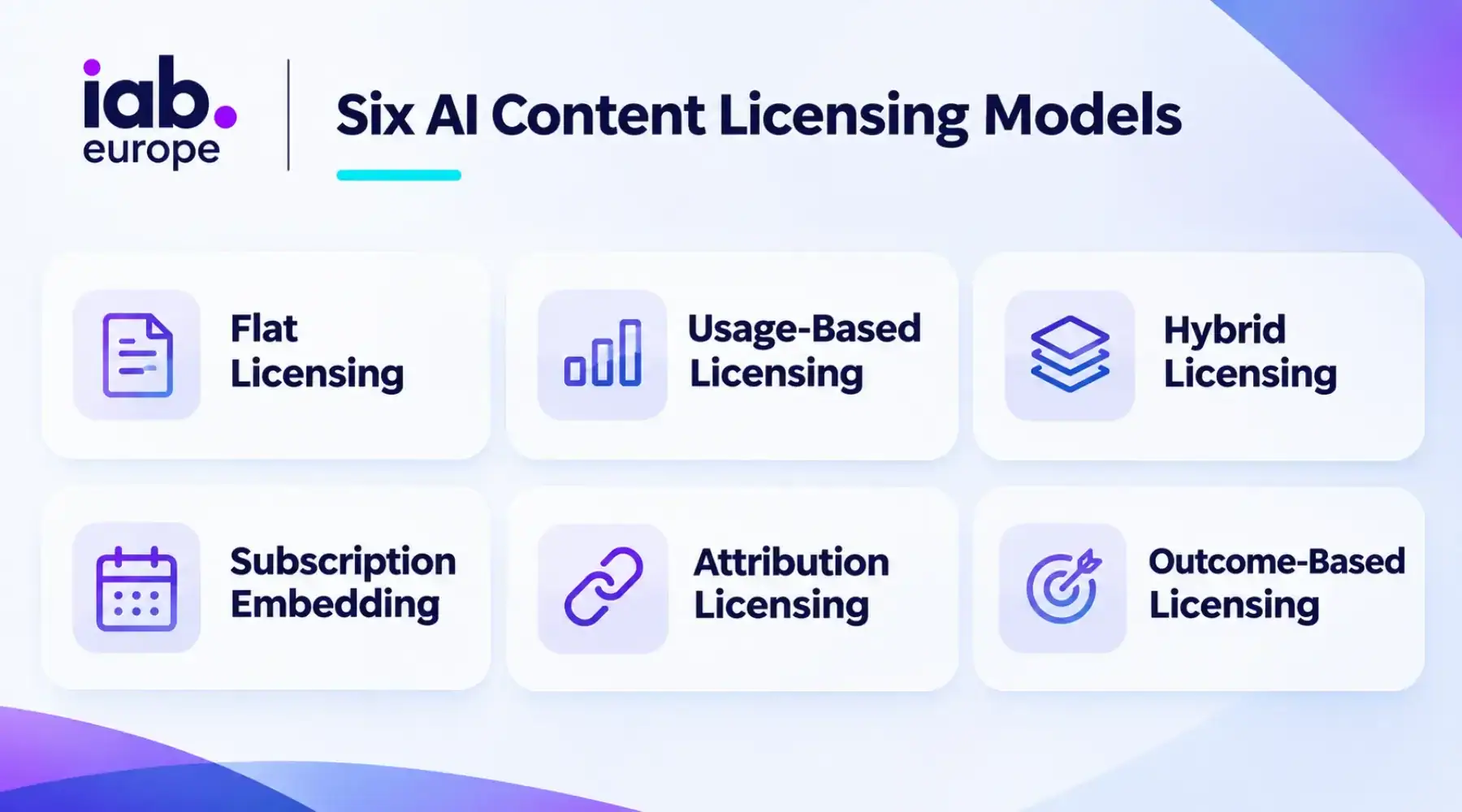
The playbook examines six commercial arrangements through which publishers could license their content to AI platforms.
As detailed in PPC Land’s analysis of the interactive resource, these include:
- Flat licensing, involving a predetermined fee for agreed content rights.
- Usage-based licensing, with charges linked to measurable content retrieval or consumption.
- Hybrid licensing, combining a minimum financial commitment with usage-based payments.
- Subscription embedding, allowing licensed content to be incorporated into subscription products.
- Attribution licensing, linking compensation to observable referrals, citations, or conversions.
- Outcome-based licensing, connecting payments to validated commercial actions.
Attribution and outcome-based licensing are particularly relevant to affiliate businesses because they could extend performance-based compensation into AI-assisted environments. However, their viability depends on reliable reporting, agreed attribution rules, fraud prevention, and mechanisms for validating commercial outcomes.
In its official playbook publication, IAB Europe said:
It sets out options and questions to consider. It does not recommend a single strategy, prices or contract terms.
The framework therefore provides a basis for commercial negotiations rather than establishing an industry-wide payment system.
Why GEO and Content Licensing Serve Different Purposes
Generative engine optimization (GEO) focuses on improving how content appears in AI-generated responses. Licensing, by contrast, concerns the commercial conditions under which that content can be used. A publisher may achieve substantial AI visibility without receiving compensation. Similarly, a licensing agreement may generate revenue without guaranteeing prominent placement in AI recommendations.
This distinction complements our previous reporting on the affiliate attribution gap in AI search, which examined the difficulty of connecting publisher influence with measurable commercial outcomes. Affiliate managers should evaluate AI citations, referral traffic, licensing revenue, and attributable transactions as separate performance indicators rather than combining them into a single measure of success.
A 90-Day Roadmap for Publisher Readiness
IAB Europe’s implementation plan divides the first 90 days into three phases.
Days 1–30: Assess existing traffic, content rights, revenue exposure, and technical access controls.
Days 31–60: Establish access policies, identify potential commercial products, and design controlled tests.
Days 61–90: Run a limited commercial pilot, evaluate incremental revenue, and determine whether to expand or revise the approach.
The roadmap also highlights the need for collaboration between editorial, commercial, legal, and technical teams. For affiliate businesses, this could involve reviewing publisher agreements and testing whether AI-assisted interactions can be recognized within existing tracking infrastructure.
As discussed in our coverage of the IAB’s AI-Era Attribution Blueprint, identifying who contributed to an AI-assisted purchase will remain central to future compensation models. IAB Europe’s playbook offers a practical starting point, but its commercial effectiveness will ultimately depend on adoption, transparent reporting, and the willingness of AI platforms and publishers to establish mutually sustainable agreements.
Everflow
Connect
Tradedoubler
Connect
1win Partners
Connect
Shopnomix, a Nomix Group Company
Connect
Huffson Group
Connect
Kawaii Partners
Connect
Trackdesk
Connect
Share your expertise and expand your reach and become a content contributor with us today!
Contact Us To Find Out More