Google Rank-Tracking Errors Persist as Providers Report Recovery
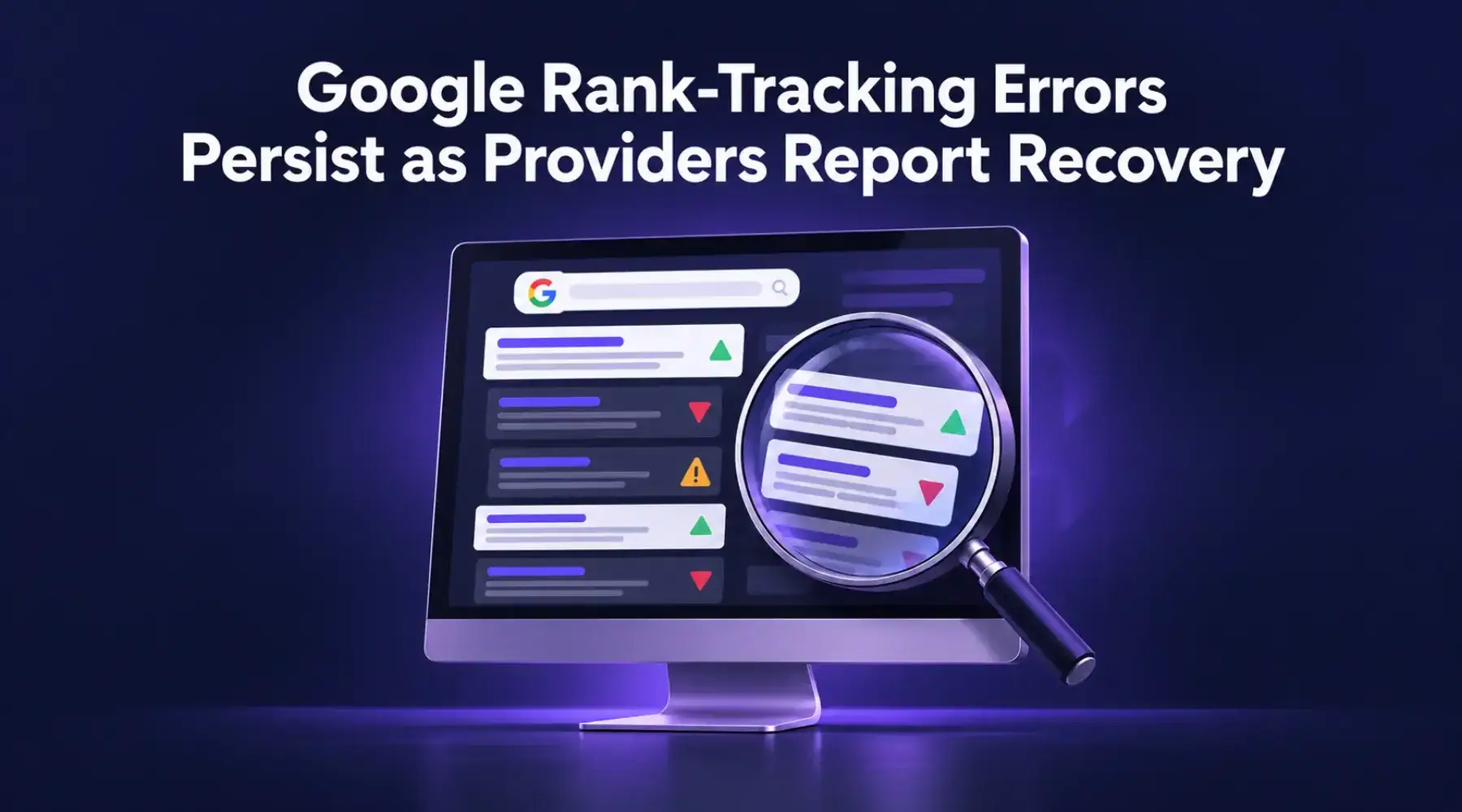
Rank-tracking providers are reporting progress against errors in the Google results they collect, but the latest updates point to an uneven recovery. Reports published on October 19 and 20 describe changes to collection methods and further quality checks. For affiliate publishers, the immediate issue is deciding whether a sudden visibility loss reflects search performance or unreliable tracking data.
Key Takeaways: Google Rank-Tracking Errors and Recovery
- Nozzle flagged 7% of collected results pages as affected on October 18, compared with its earlier baseline of 0.1–0.2%.
- AccuRanker reported affected rates of 0.58% on desktop and 0.47% on mobile on October 17, following changes to its collection process.
- cloro reported returning the expected full results page in 98% of its reference-query checks between October 16 and 18.
- These percentages are not directly comparable: providers use different samples, collection methods, and quality checks.
- Publishers should compare tracker alerts with Search Console, traffic, and affiliate performance before making changes.
Nozzle’s Updated Sample Still Shows Errors
In its October 19 research update, Nozzle said 8.4% of the 27 million search results pages it assessed since September 13 met its definition of “poisoned.” Its sample covered 52 countries.
The term describes pages that appear to load normally but contain an unexpectedly different set of websites. A tracker can interpret a publisher’s absence from those results as a sharp ranking decline.
Nozzle reported a peak of 28.6% on September 29. Its daily rate fell to around 3% on October 14, but rose to 7% on October 18, remaining above its earlier baseline of roughly 0.1–0.2%.
Those figures concern the pages collected in Nozzle’s sample. They do not establish the proportion of ordinary Google users seeing different results.
Providers Report Different Stages of Recovery
AccuRanker’s October 19 update describes another disruption affecting its automated mobile searches after October 15. The company said it changed its mobile collection process overnight.
By October 17, its checks classified 0.58% of desktop results and 0.47% of mobile results as affected. AccuRanker said it was approaching its previous baseline, while acknowledging that the problem had not disappeared.
Its checks compare results with their history and repeat collection when an unusually large share of familiar websites is missing.
In a separate October 20 technical account, cloro said changes shipped on October 13 and 14 improved its results. It reported returning the expected full page in 98% of its reference-query checks between October 16 and 18.
That is a vendor’s assessment of its own service over a short window. It is not a measure of recovery across every rank tracker.
The reports also leave the cause unresolved. Some providers suggest anti-scraping measures are involved, but Google has not confirmed their explanation.
A Tracker Drop Does Not Establish a Traffic Loss
The practical distinction is between a tool collecting an unusual page and a publisher losing visibility among actual search users.
Google’s Search Console documentation explains how publishers can review clicks, impressions, average position, and performance by query, page, country, device, and date. Those dimensions provide another view of an apparent ranking change.
An affiliate team investigating a mobile ranking alert should compare the relevant pages and market over the same period. A site-wide traffic total may conceal a problem affecting one category.
Search Console is not a perfect replica of a rank tracker. Google notes that results vary with factors including location, device, timing, and search history. The newest reporting data can also be preliminary.
Stable traffic would justify further investigation of a tracker alert; it would not prove that every reported position was wrong.
Affiliate Teams Need Evidence Before Changing Pages
There is a cost to treating an unreliable report as a confirmed SEO loss. A publisher could rewrite a useful review, remove internal links, or redirect production resources before establishing what changed.
A sensible review should connect the ranking alert with the affected pages’ search traffic, outbound merchant clicks, and eventual commission performance. Those measures answer different questions and may move at different speeds.
Teams should also ask their provider which collection dates were affected, whether historical records will be corrected, and how suspect results are flagged in exports.
Real search changes can occur during the same period. Affiverse’s coverage of Google’s completed September 2026 spam update provides separate context for reviewing that rollout.
For reporting, keep a record of collection issues alongside confirmed search updates and website changes. That gives editors and commercial teams a clearer basis for deciding which declines need action and which need better data first.
Everflow
Connect
Tradedoubler
Connect
1win Partners
Connect
Shopnomix, a Nomix Group Company
Connect
Huffson Group
Connect
Kawaii Partners
Connect
Trackdesk
Connect
Share your expertise and expand your reach and become a content contributor with us today!
Contact Us To Find Out More