Beyond One GEO: How Market Diversification Creates Stronger Affiliate Partnerships
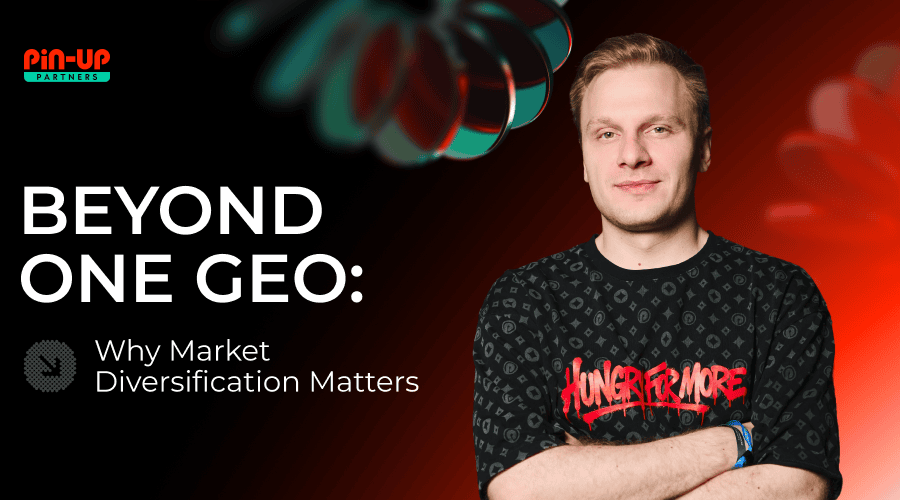
One strong GEO can generate most of a team’s volume and deliver solid ROI for years. But the more a business depends on a single market, the more exposed it becomes to changes in payments, advertising rules, or regulation. At the same time, entering a new GEO is not as simple as taking a setup that already works, moving it to another market, and agreeing on a payout.
We spoke with Tim from PIN-UP Partners about when a team should actually start diversifying, how to choose the next market, why the economics of one GEO rarely transfer directly to another, and why operating across several markets does not always eliminate dependence on a single traffic source.
We also discussed the role of an affiliate program in these launches. PIN-UP Partners is currently expanding its partner network and is open not only to large teams with established volumes, but also to new traffic sources and market hypotheses. If a partner has strong expertise, quality traffic, or an idea for a specific GEO, the team is ready to discuss terms for that particular launch, support the testing stage, and assess together whether the hypothesis can grow into stable volume.
1. What is the first question you ask a partner before discussing payouts?
I usually start with a simple question: “What do you need from us to launch properly in this GEO?”
In my view, it does not make much sense to start discussing payouts without context. First, I want to understand what kind of traffic the team is bringing, what they already know how to do, what experience they have, and what they need from us at the start.
Some teams already have a strong traffic source but need different terms. For others, creatives, feedback, or support during the first stage may be more important. So I would first understand the actual task and only then move on to the numbers.
At PIN-UP Partners, we are currently open to new partners and new hypotheses. For us, a good result is not simply giving a partner an offer. It is helping the team run a proper test and, if the economics make sense, grow the volume from there.
2. When should a partner avoid rushing into a new GEO?
I would first look at how much of the current GEO’s potential the team has already used. Sometimes it feels like the next step for growth has to be a new market, while in reality there may still be more room to grow in a GEO where the partner already knows how to operate.
In that case, it makes sense to review the current funnel, see where there is still room for growth, and test new segments. At the same time, the team can start preparing and testing a new GEO in parallel, without suddenly shifting budget and resources.
That approach makes more sense to me in general. You do not have to abandon a market that already works just to move on to the next one. You can gradually add another direction. This way, the partner keeps a stable base while creating another potential growth opportunity in advance.
3. Can the economics of a deal be transferred from one market to another?
I would not expect something that works well in one GEO to automatically perform the same way in another. Even in similar markets, conversion, retention, and payment behavior can differ, which means the economics can look very different too.
That is why we usually look at each market separately and discuss CPA, RevShare, or a hybrid model based on that specific GEO. The key is to find terms that make sense not only during the testing stage, but also later when the partner wants to scale the volume.
If a team has traffic and a clear hypothesis for a new GEO, we are ready to discuss it and work together to see which model makes the most sense for that particular launch.
4. What traffic data does the partner see, and what remains on the operator’s side?
The partner has their side of the picture. They understand the cost of traffic better and can see how the audience responds to a particular approach. On our side, we see what happens after acquisition: deposits, retention, and cohort quality.
If you only look at one side, the picture is incomplete. That is why data sharing and proper feedback on performance are important to us. When both sides understand what is happening with the traffic at different stages, it becomes much easier to see what needs to change and where there is room to scale.
We want new partners to find working approaches faster, so we are ready to share the data we have on our side and help with optimization.
5. Can the idea for a new GEO come from the partner?
Yes, absolutely. In fact, we want partners to bring us those kinds of ideas. They are often the first to notice growing demand, new traffic sources, or underserved niches.
If a team has a well-founded hypothesis for a specific GEO, we are ready to look at it and test it in practice. From there, we look at the results and decide whether it makes sense to develop that direction further.
For us, that is a normal part of a partnership. New markets and ideas do not always have to come from the operator. A strong partner can also identify a direction that was not originally a priority for us.
6. At what point does dependence on a single GEO become a real risk for a partner?
I would look at how much a change in one market could affect the team’s overall results. It could be regulation, payments, or advertising rules. If any one of those changes can immediately hit a major part of the business, then the level of dependence is already high.
At the same time, I do not think teams need to move large volumes into a new market overnight just for the sake of diversification. You can start with a small test, look at the economics, and gradually develop another direction.
As an affiliate program, we are particularly interested in teams that are ready to test additional markets together with us. This allows both sides to build another potential source of growth before problems appear in the core GEO.
7. Are there situations where it is better to advise a partner not to launch?
Yes, there are. But I would frame it less as “talking a partner out of it” and more as offering them a stronger alternative.
If we see that a particular GEO is not ready from a product or payments perspective, we will say so directly. In that situation, there is no point in simply accepting traffic for the sake of launching. It is better to look at where that team currently has a better chance of getting a solid result and suggest another market.
For us, this is about long-term cooperation. We do not just want a partner to launch. We want them to make money from that launch and see a reason to keep scaling with us.
8. Can a team operate in several GEOs and still remain dependent on one direction?
Yes, of course. The number of GEOs alone does not mean a business is truly diversified. If the team relies on the same channel or platform across all of those markets, the main risk is still there.
That is why we look beyond geography itself and consider traffic sources, products, and partnership models as well. We are especially interested in partners who bring new approaches and audiences. This allows us not only to add another GEO, but also to expand the range of traffic sources and scenarios we can work with.
9. Is it better to enter a new GEO with a traffic source that has already been proven elsewhere?
Yes, I think that is a good starting point. If the source is already familiar and the team knows how to work with it, it is easier to collect the first data quickly and understand how it performs in the new GEO.
From there, the team can expand the testing: look at local channels, try different creatives, and test other formats. On our side, we can support them with analytics, product information, and feedback on the results.
In general, we are more interested in this kind of collaboration, where a partner does not simply take an offer but works with us to understand what else can be tested and where there is potential for further growth.
10. What changes when a partner and an affiliate program develop several markets together?
I think at some point the format of the relationship itself changes. We are no longer discussing every offer in isolation. We start looking at the bigger picture: which GEOs make sense to develop next, what we are testing now, and where we can scale later.
In other words, there is a broader plan for working together. We discuss upcoming tests in advance, review the results, and decide together which directions are worth developing further.
That is exactly the kind of partnership we are working toward at PIN-UP Partners. We are open to new partners, including teams that have quality traffic, strong experience in a particular market, or simply a hypothesis that we can test together.
_________________________________________________________________________________________
This content has been produced for Affiverse by an independent Advertiser and expresses their own views, in their own words. If you would like to feature as an advertiser and be interviewed on Affiverse’s media content platform, please email [email protected].
Everflow
Connect
Tradedoubler
Connect
1win Partners
Connect
PIN-UP Partners
Connect
Shopnomix, a Nomix Group Company
Connect
V.Partners
Connect
Huffson Group
Connect
Kawaii Partners
Connect
Share your expertise and expand your reach and become a content contributor with us today!
Contact Us To Find Out More