World Cup 2026: How to Scale In-App Traffic and Retain Players After the Final
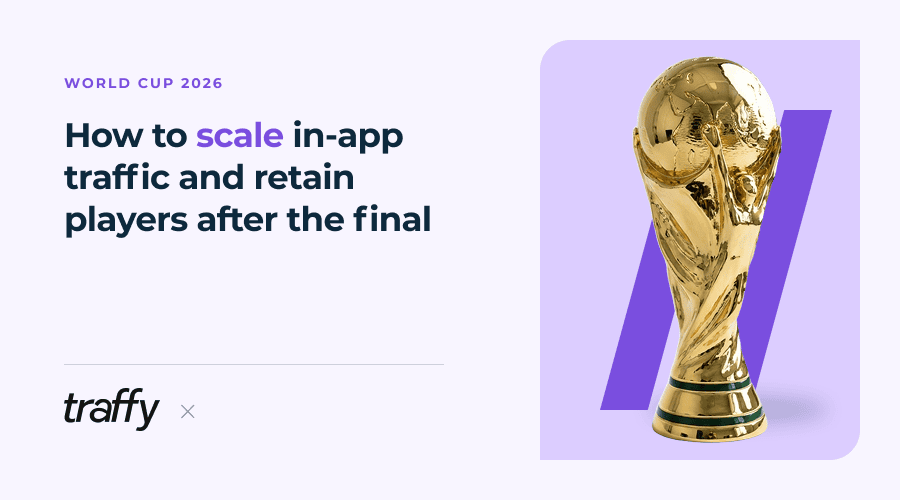
A practical guide to mobile traffic buying from Traffy: what happened to the auction, cost, and user quality before, during, and after the 2026 World Cup.
The 2026 FIFA World Cup in the US, Canada, and Mexico became the largest and most expensive event in the history of mobile performance marketing. For iGaming and Sportsbook brands, it was the main battleground for paying users. While some advertisers hit record ROI, others burned through budgets in overheated auctions and paid for bot traffic.
The Traffy performance marketing agency shares how we bought in-app traffic for the 2026 World Cup — from technical preparation and Playable creatives to fraud filtering and preserving profitability after the final whistle.
Below is the traffic’s journey from warm-up to the days after the final: what happened to the auction at each stage, how we scaled volume without losing quality, and what the advertiser was left with once the last match was played.
Tournament key numbers:
- +380% — install volume growth on peak match days
- 28% → 48–52% — Reg2FTD growth on interactive creatives at the tournament’s peak
- +24% — Day-30 Retention above the market average
- 23% — share of fraud traffic filtered on one campaign ($300,000 budget)
1. Before the World Cup: Why Early Entry Was Critical
Final ROAS on a tournament of this scale isn’t determined by budget size or creative — it’s determined by how early you enter the buy.
Early Start vs. Late Entry
We started preparation and the first test launches 2.5 months before the tournament kicked off.
What the early start gave us: we had time to train the ML algorithms of programmatic networks (Liftoff, Mintegral, Unity) on conversions and deposits at low auction rates, built custom placement white lists (Sub-IDs), accumulated look-alike audience data, and tested MMP integrations.
What teams with a “late” start got: entering 3–5 days before the World Cup opened meant landing straight in an already overheated auction. Their algorithms trained on peak CPMs, and the cost of acquiring an FTD (First Time Deposit) ended up 2.5–3x higher than for teams with “warmed-up” analytics.
Where We Focused Budget: Priority GEOs
Even at the preparation stage, we prioritized certain GEOs. Here’s what those bets delivered:
| GEO | Install growth | FTD growth |
| LatAm — Brazil, Mexico, Colombia | Mexico: +280% | Mexico: +210% |
| West Africa — Nigeria, Ghana | High volume of cheap traffic | +320% |
LatAm was the clear volume leader — largely thanks to the home-field effect: Mexico was one of the tournament’s host countries. West Africa delivered a huge volume of cheap traffic but required precise optimization for local payment systems.
2. During the World Cup: How the Auction Changed
The full dynamic across tournament phases — from warm-up to 30 days after the final:
| Phase | What’s happening | What to do |
| Warm-up (30–14 days before kickoff) | CPM is at its lowest; returns are close to organic | The best time to buy base installs and build your core audience |
| Group stage | Explosive growth in impulse-driven traffic; CPC +40–60% | Rising auction costs are offset by rising Reg2FTD conversion amid high gambling interest — scale up volume |
| Knockout stage | CPM +110–130% above baseline | Buying “cold” traffic on broad targeting becomes unprofitable — shift up to 80% of budget to AEO (event-optimized buying) |
| After the tournament (30 days post-final) | Event traffic usually churns — we rebuilt retargeting toward domestic club leagues ahead of time (EPL, La Liga, Serie A) | Day-30 Retention +24% above the market average — the effect of personalized deep links and retargeting |
On match days for favorite national teams — Brazil, Argentina, and in the finals — inventory volume and cost shifted sharply:
- Daily campaign budgets scaled up 4.5x
- Install volume grew by +380%
- Reg2FTD jumped from a baseline of 28% to 48–52% on interactive creatives
3. Scaling Without Sacrificing Quality
Platforms That Delivered the Best Performance
- Liftoff & Mintegral — the sources behind most of our scaling volume, powered by strong ML: they quickly trained algorithms on the target event (deposit) and automatically reallocated budget to high-converting Sub-IDs.
- Unity Ads — set the record for retention thanks to quality video inventory and interactive Endcards.
- Kwai (in LatAm) — captured a massive volume of cheap viral traffic in Brazil through native UGC formats.
How We Held Target CPA as CPM Rose 100%+
- Micro-bidding by Sub-ID — real-time cutoffs for placements with declining deposit conversion.
- Creative pre-filtering — only traffic that had already passed through the interactive playable moved into the auction; non-target clicks were filtered out before the store redirect.
- Switching the buying model — some campaigns were quickly moved from CPC/CPM to hard tROAS and CPA models.
4. Creative: Why Playable Ads Won
Classic static banners and standard video ads performed poorly at the 2026 World Cup — banner blindness spiked sharply at the tournament’s peak. The main performance driver was Playable Ads — interactive mini-games embedded in the ad unit.
Our best-performing creative worked like this: users were asked to predict the outcome of an upcoming match or take a penalty kick right inside the ad unit — and in return received a personal free bet or in-app bonus. As a result, users downloaded the app already “warmed up,” which explains the jump in Reg2FTD to 48–52% on interactive formats versus a 28% baseline.
5. Anti-Fraud: How Much Budget We Protected
Fraudsters are especially active during major sporting mega-events. Organic search traffic spikes sharply, and fraudsters heavily use Click Spamming and Click Injection to hijack organic installs and pass them off as their own paid traffic.
How Traffy’s Anti-Fraud System Worked
- CTIT (Click-Through Install Time) analysis — filtered out clicks with an abnormally short (<5 seconds, Click Injection) or abnormally long (>24 hours, Click Spamming) interval before install.
- Behavioral audit — bots that completed zero micro-events in the first 3 minutes of a session were instantly banned at the Sub-ID level.
- Cross-linked signals — Protect360 (AppsFlyer) and Adjust Fraud Prevention signals automatically fed suspicious sub-sources into a single global Traffy blacklist.
Case: How Much Budget We Saved
On one campaign with a $300,000 budget for the World Cup period, our system filtered and blocked 23% of fraud traffic — roughly $70,000 of the advertiser’s clean budget that would otherwise have gone to bot networks and hijacked organic traffic.
6. After the Final: What Happened to Users
The World Cup ends with the final whistle. For the advertiser, it doesn’t. The key question isn’t just how many users you can acquire at the peak — it’s what they do after the tournament.
Event-driven traffic traditionally sees high churn (cohort decay) once a tournament ends — we planned for exactly that scenario and built our retention strategy in advance.
In practice, churn came in noticeably lower than expected: Day-30 Retention landed 24% above the market average — thanks to filtering out non-target users as early as the Playable creative stage, and targeted engagement with players we’d already acquired.
- Personalized Deep Links — users who came from an ad for a specific match (e.g., Brazil vs. France) landed on a screen with bonuses tied to those countries’ local leagues.
- Retargeting to domestic leagues — three days before the World Cup final, we rebuilt the push notification and in-app retargeting funnel to shift players’ attention to the upcoming club season (EPL, La Liga, Serie A).
That’s the real result of the campaign: scaling volume at the peak (+380% installs, Reg2FTD up to 48–52%) didn’t come at the cost of quality — deposit conversion and post-tournament retention came in above the market, not below it.
7. What We Learned
Our campaigns showed that standard buying strategies stop working fast at major sporting events. What matters most is early preparation, accumulated data, quality control on placements, and optimizing not just for installs but for downstream events.
Checklist: How to Prepare for the Next Tournament Starting Now
- [ ] Launch tests 60–90 days out — give network algorithms time to learn at low bid rates.
- [ ] Invest in Playable production — interactive creatives remain the only tool that can cut through banner blindness and lower FTD cost.
- [ ] Set up fraud prevention at the Postback/S2S level — don’t rely on raw install numbers alone; analyze the full funnel through to actual deposit.
- [ ] Work with proven performance partners — scaling in-app traffic during peak events requires deep analytical infrastructure and vetted white lists.
Planning to Scale for the Next Major Sporting Event?
The Traffy team is ready to audit your current in-app campaigns and build a transparent, profitable buying strategy.
Get a free audit of your campaigns → traffy.com
This article was prepared by Roman Arustamyan, Head of Performance at Traffy.
Contacts:
- Pavel Kotov, Head of Business Development — [email protected] | Linkedin | Telegram: @Pavel_Traffy
- Roman Arustamyan, Head of Performance — [email protected] | Linkedin | Telegram: @Roman_Traffy
_________________________________________________________________________________________
This content has been produced for Affiverse by an independent Advertiser and expresses their own views, in their own words. If you would like to feature as an advertiser and be interviewed on Affiverse’s media content platform, please email [email protected].
Everflow
Connect
Tradedoubler
Connect
1win Partners
Connect
PIN-UP Partners
Connect
Shopnomix, a Nomix Group Company
Connect
V.Partners
Connect
Huffson Group
Connect
Kawaii Partners
Connect
Share your expertise and expand your reach and become a content contributor with us today!
Contact Us To Find Out More