Six Banks Set Five Trust Principles for AI Shopping Agents
Six banks have proposed five trust principles for AI shopping agents as the technology moves from recommending products toward completing purchases. Their framework covers transparency, safety, privacy and data, choice, and interoperability. For affiliate marketers, its sharpest question is how shoppers and merchants can tell why an agent recommended one product over another.
ASB Bank, Bank of America, Capital One, Commonwealth Bank of Australia, ING and NatWest published the Building Trust in Agentic Commerce paper on September 22. The principles are voluntary and non-binding. The banks say a subsequent paper will explore how they could be put into practice.
Key Takeaways: Five Trust Principles for AI Shopping Agents
- Six banks have proposed principles covering transparency, safety, privacy and data, choice, and interoperability.
- The paper warns that agents could favor products or payment options that generate higher commissions for their providers.
- It calls for clear agent identity, control over purchase authority, auditable transaction records and dispute processes involving the relevant parties.
- The paper does not establish an affiliate attribution standard. Its proposed records could, however, become relevant to measuring agent-influenced sales.
What the Five Principles Cover
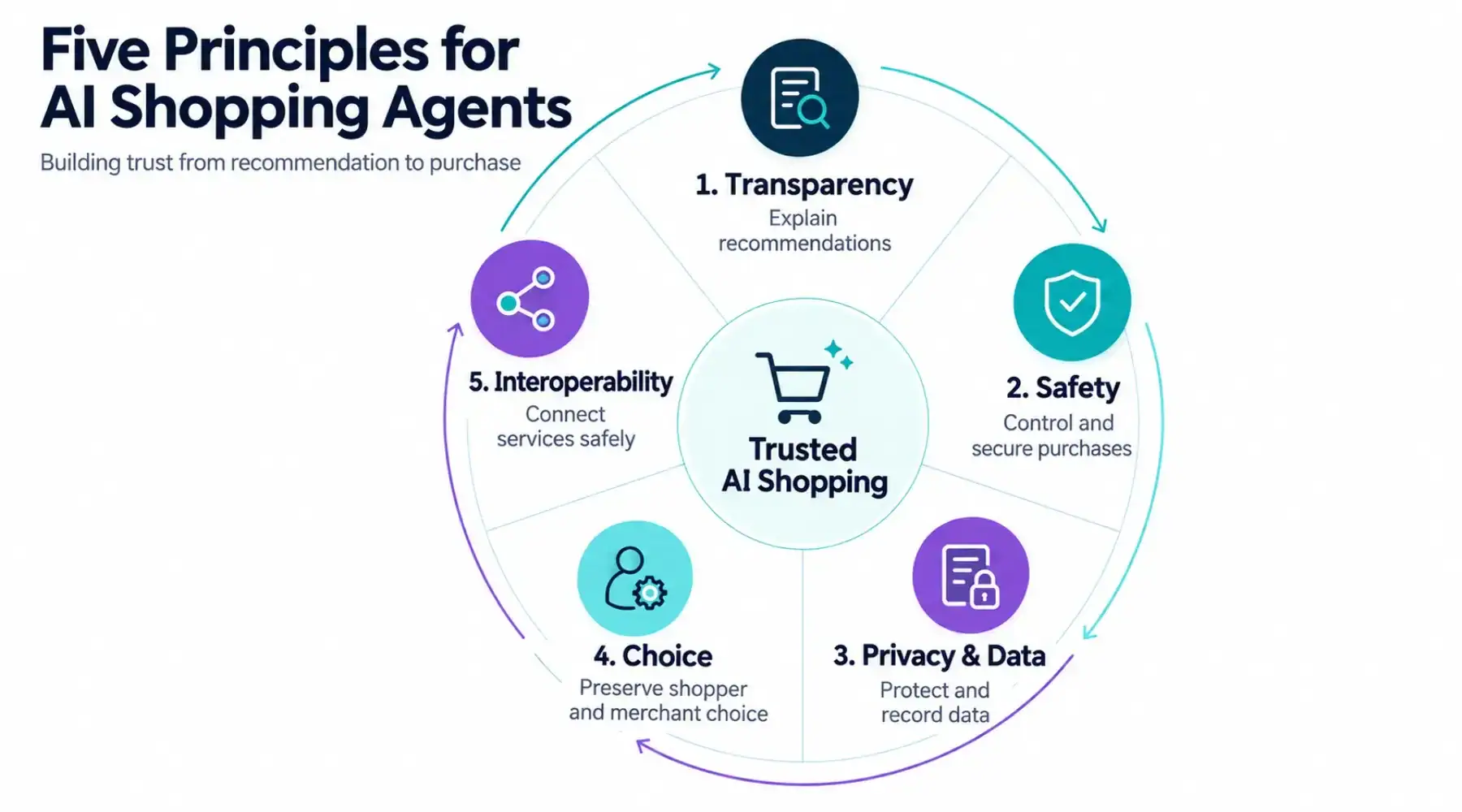
The five principles cover the decisions an AI agent makes before, during and after a purchase. Together, they set out where shoppers and merchants should have visibility, control and a way to resolve problems:
- Transparency means shoppers and merchants should know when an AI agent is involved and whose interests it represents. The paper also calls for visibility into how agents prioritize options, including sponsored recommendations.
- Safety focuses on the agent’s authority to act, secure payment authorization, fraud prevention and dispute resolution. Consumers should be able to view and manage the permissions they give an agent.
- Privacy and data addresses what information agents collect, retain and share. The banks propose auditable records of customer instructions, authentication, purchase intent, decisions and outcomes, alongside limits on data access and additional uses.
- Choice means consumers and merchants should be able to select services without unreasonable restrictions. The paper also says the identity and role of the merchant of record should be clear.
- Interoperability concerns how agents, merchants and payment services connect. The banks favor common approaches for core trust functions while allowing room for different services and features.
Why Product Rankings Matter to Affiliates
The transparency principle reaches directly into a familiar affiliate marketing issue: financial incentives can affect recommendations. The banks warn that an AI agent might prioritize a product, payment method, or service because it produces a better financial outcome for the agent provider, such as a higher commission, even when another option offers better value to the shopper. They say consumers and merchants should be able to understand how agents make these choices, including the role of sponsored options.
That matters as agents take on more of the shopping journey. Meta’s Muse can research products and complete purchases, raising questions about which recommendations a shopper sees and how publisher influence is recorded. Amazon’s decision to block Muse has also shown that a shopper’s instruction does not settle whether a merchant permits an outside agent to access its store. The banks’ paper addresses both sides of that relationship: identifying the agent and preserving meaningful choice for merchants and consumers.
The Record Behind an Agent-Led Purchase
A recommendation is only the beginning of the transaction. An agent may then use customer information, select a seller, choose a payment method, and place an order. If the purchase is wrong or disputed, the parties need to establish what the customer authorized and where an error occurred.
The banks propose records that could show the customer’s instructions, authentication, intent, transaction decisions, and outcome. They also call for disputes to involve the relevant participants, with liability reflecting where risks or errors were introduced. The paper links those records to security, fraud investigations, and customer protection; it does not propose a system for paying affiliate commissions.
There is still a potential attribution implication. If an agent-led transaction can preserve a reliable account of the recommendation, any sponsored influence and the eventual purchase, affiliate programs may have more information to work with than a completed order alone. Whether publishers could access that information, and under what consent and commercial terms, remains unresolved. That question builds on Affiverse’s earlier coverage of AI shopping and affiliate tracking.
For now, the six banks have offered a framework rather than an operating standard. The next paper should provide a clearer test of how these principles might work across agents, merchants, and payment providers—and whether the resulting transaction records can also account for the partners that influenced a sale.
Everflow
Connect
Tradedoubler
Connect
1win Partners
Connect
PIN-UP Partners
Connect
Shopnomix, a Nomix Group Company
Connect
V.Partners
Connect
Huffson Group
Connect
Kawaii Partners
Connect
Share your expertise and expand your reach and become a content contributor with us today!
Contact Us To Find Out More