AI Shoppers Want Creator Input, but Trust Everyday Reviewers Most
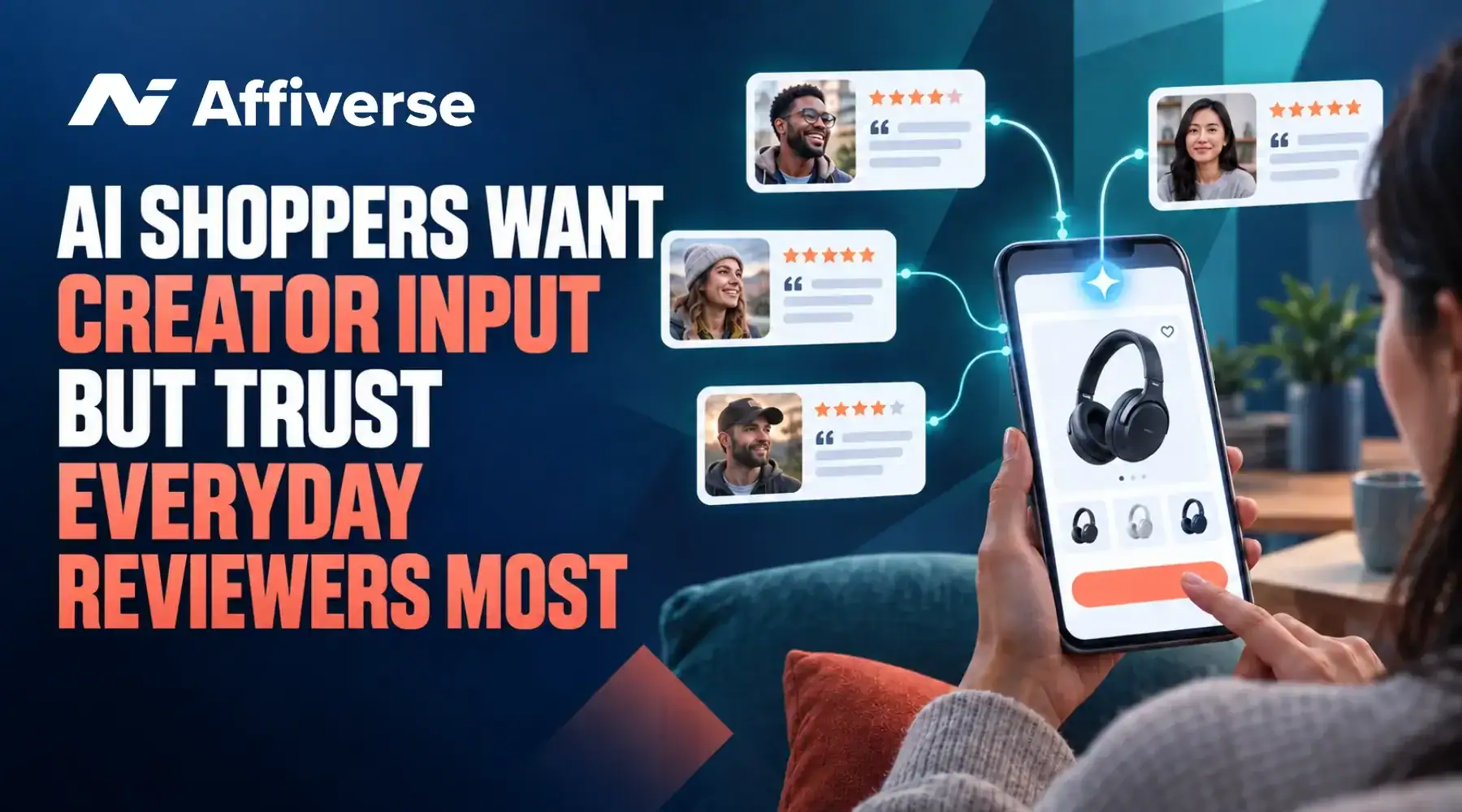
AI shoppers want human perspectives included in product recommendations, but they are not necessarily looking for the biggest influencers. New IAB research found that everyday consumers were the most trusted source of creator input, ahead of professional reviewers and subject-matter experts.
Among recent AI-shopping users, 56% preferred recommendations that incorporated creator or influencer perspectives, while 65% felt more confident when credible creator reviews informed the answer.
The findings suggest that AI shoppers value firsthand experience more than popularity alone. They also raise questions about whether AI platforms can preserve the context, independence, and disclosure information that make those experiences trustworthy.
Key Takeaways: Creator Reviews and AI Shopping
- IAB surveyed 2,200 consumers across five markets who had recently used AI for shopping research.
- 56% preferred AI recommendations incorporating creator or influencer perspectives.
- 65% felt more confident when recommendations were informed by credible creator reviews.
- The preference reached 65% among Gen Z and Millennials, compared with 53% of Gen X and 34% of Boomers.
- Everyday consumers were the most trusted creator type at 52%, ahead of professional reviewers at 43%.
- Credibility, consistency and expertise mattered more than creator popularity.
- Respondents valued creator input most when finding the best price or value.
- The study measured reported preferences and confidence, not purchasing behavior or conversion rates.
What the IAB Study Found
The IAB Creator Signal study was conducted in May 2026 using the IAB Insights Engine, powered by Attest.
The research covered 1,000 consumers in the US and 300 each in the UK, Australia, Mexico, and India. Every participant had used an AI tool for shopping-related research during the previous three months.
That qualification matters. The findings describe people already familiar with AI-assisted shopping rather than the wider consumer population.
| Finding | Share of Respondents |
|---|---|
| Prefer AI recommendations incorporating creator perspectives | 56% |
| Feel more confident when credible creator reviews inform recommendations | 65% |
| Trust everyday consumers as a creator source | 52% |
| Trust professional reviewers | 43% |
| Trust subject-matter experts | 37% |
| Value creator input when finding the best value | 38% |
| Value creator input when discovering products | 32% |
| Value creator input when comparing options | 31% |
| Value creator input when summarizing product information | 31% |
Interest was strongest among younger consumers. Around 65% of Gen Z and Millennials preferred creator-informed AI recommendations, while nearly three in four said creator-backed recommendations increased their confidence in AI shopping advice.
Around half had also discovered creators through AI tools. This suggests AI assistants could become a creator-discovery channel as well as a product-discovery tool, provided the person behind the information remains visible.
Responses also varied by market. Participants in India and Mexico were the most receptive to creator-informed shopping experiences. Among the three Western markets studied, US respondents were the most receptive and those in the UK were the most cautious.
Everyday Experience Matters More Than Influencer Status
The strongest finding is not simply that consumers want influencers inside AI answers. It is that they place the greatest trust in people who appear to have direct, credible experience with a product.
Everyday consumers ranked as the most trusted creator type at 52%. Professional reviewers followed at 43%, with subject-matter experts at 37%.
The qualities respondents associated with trust followed the same pattern:
- Credibility: 46%
- Consistency: 40%
- Expertise: 36%
- Independence from brands or sponsorship transparency: 34%
Follower count did not appear among the leading trust factors highlighted by IAB. The results point toward experience, reliability and openness about commercial relationships rather than reach alone.
This is particularly relevant for affiliate programs choosing creator partners. A smaller creator who repeatedly tests products, explains limitations and discloses brand relationships may provide a stronger trust signal than a larger account offering brief endorsements.
This emphasis on firsthand content also appeared in Affiverse’s webinar on why affiliate partnerships will drive LLM visibility, which examined how product reviews, comparison guides and authentic user experiences can influence AI discovery.
The study also found that creator reviews were almost as influential as brand or advertiser information among Gen Z respondents, at 27% and 29% respectively. Creator content is therefore not replacing product data or brand information, but it may help shoppers assess claims using recognizable human experience.
Preference Is Not Proof of Commercial Influence
The research measured reported preferences rather than purchasing behavior. IAB did not compare conversion rates between recommendations with and without creator input, track subsequent purchases or identify which AI platforms respondents used.
The results therefore show that recent AI shoppers value creator perspectives and report greater confidence in them. They do not prove that creator-informed recommendations increase sales or reveal whether individual creators were visible to shoppers.
AI Summaries Can Change the Creator’s Meaning
AI platforms do not simply transfer a creator’s words from one screen to another. They select, combine and summarize information before presenting it to the shopper.
This introduces the risk that criticism, testing conditions or sponsorship information could disappear from the shortened version.
A 2025 UC San Diego study of LLM-generated content found that the tested models changed the sentiment of source material in 26.42% of evaluated summaries.
In a separate experiment involving 70 accepted participants, products described through positively reframed AI summaries were selected in 83.7% of cases, compared with 52.3% when participants saw the original neutral or negative reviews.
The experiment used selected reviews and a small participant group, so its results should not be applied as a general forecast for AI-shopping conversion. It does show that changes in emphasis can affect how people interpret a review.
Commercial disclosures are particularly important. The FTC’s endorsement guidance says material relationships between creators and brands should be clear and difficult to miss.
A creator may follow that requirement in the original post or video. However, if an AI summary carries over the positive recommendation without the disclosure, the shopper receives a different commercial context from the original audience.
Credible creator input therefore requires more than accurately identifying the product. AI platforms also need to preserve who made the recommendation, what evidence supported it and whether money, free products or another brand relationship was involved.
Why Source Visibility Still Matters
OpenAI says ChatGPT shopping results can use third-party content. Its shopping pages may also display AI-generated summaries based on reviews published across public websites.
That can help users compare large amounts of information quickly. However, summarizing creator content is not the same as directing the shopper to the creator or preserving the original review in full.
A named citation allows the shopper to inspect the source, understand the reviewer’s experience, and check for relevant disclosures. It can also give the creator a referral opportunity. An unattributed summary offers fewer ways to evaluate or reward that contribution.
Affiverse’s podcast on Reddit marketing and AI visibility explores a related example: how authentic community discussions and evergreen content can become trusted sources for AI-driven discovery.
The commercial implications are explored in earlier analysis of why affiliate programs need to reward reliable commerce inputs beyond the last click. The new IAB research adds consumer evidence to that argument: human experience remains valuable even when AI becomes the interface delivering it.
The immediate priority is not to assign a commission to every piece of content mentioned by an AI system. It is to make the source visible enough for shoppers, creators and brands to understand how the recommendation was formed.
Trust Depends on Showing the Human Evidence
The IAB findings do not suggest that shoppers want AI assistants filled with influencer promotions. They suggest that people want efficient recommendations supported by credible human experience.
Everyday consumers, professional reviewers, and subject-matter experts each provide different forms of evidence. AI platforms can make that evidence more useful by identifying the source, preserving criticism, and displaying commercial relationships clearly.
Creators can support that process by publishing durable reviews or transcripts with named authors, testing dates, clear advantages and disadvantages, product identifiers, and disclosures placed beside relevant claims. Brands and affiliate teams should judge this work by its accuracy and usefulness, not audience size alone.
AI can make creator knowledge easier to search and compare. It should not flatten different experiences into anonymous approval.
If creator perspectives are expected to make AI shopping more trustworthy, shoppers must still be able to see who provided that perspective and why it deserves their confidence.
Everflow
Connect
Tradedoubler
Connect
1win Partners
Connect
PIN-UP Partners
Connect
Shopnomix, a Nomix Group Company
Connect
V.Partners
Connect
Huffson Group
Connect
Kawaii Partners
Connect
Share your expertise and expand your reach and become a content contributor with us today!
Contact Us To Find Out More