TikTok Shop’s Amazon Halo Exposes a Cross-Channel Attribution Gap
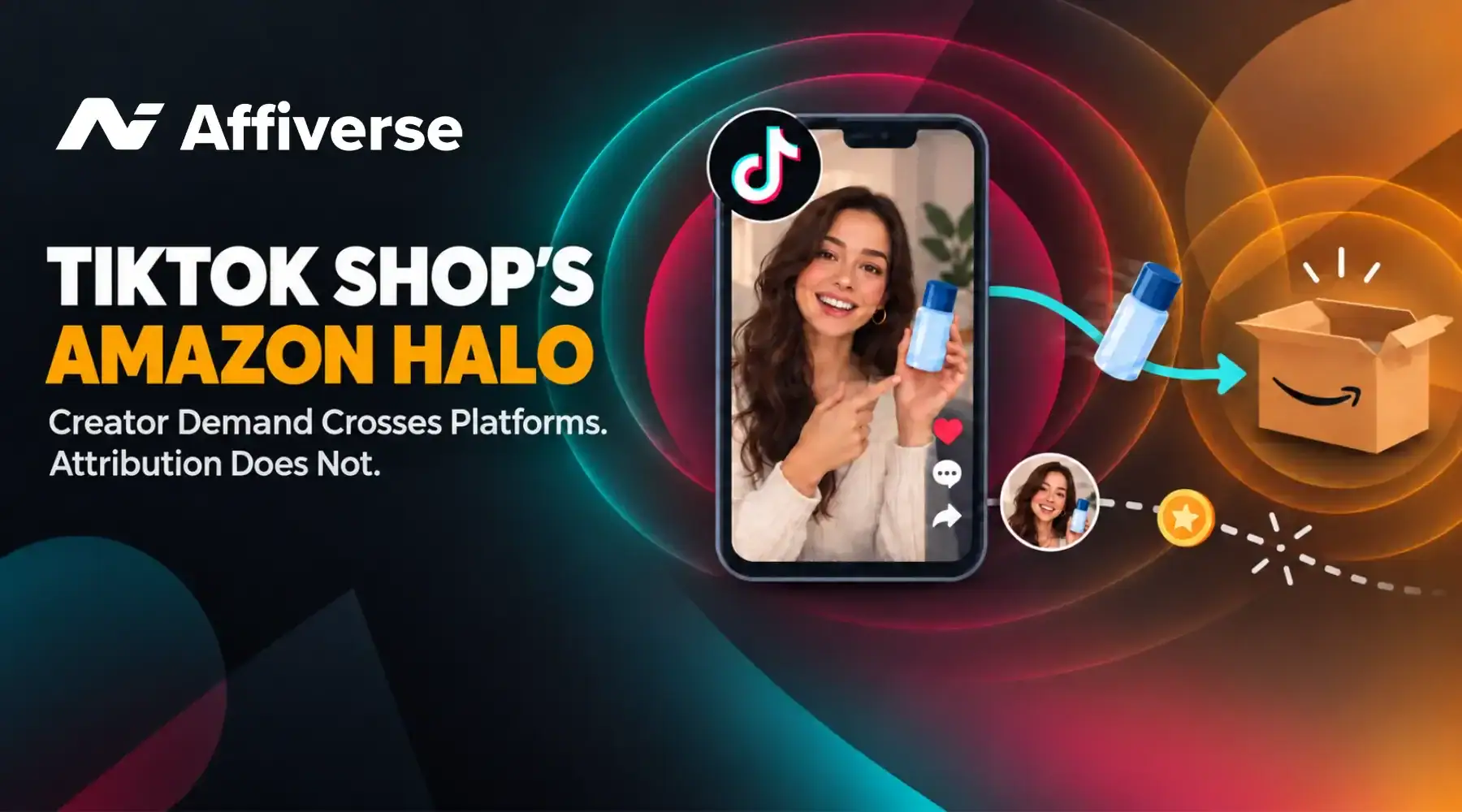
Creator content on TikTok Shop may generate product demand that ultimately converts on Amazon, leaving brands and creators with an incomplete account of what influenced the sale.
Recent brand examples suggest shoppers can discover a product through a TikTok creator before independently searching for it on Amazon. The brand still receives the revenue, but the TikTok Shop dashboard may record no conversion—and the creator responsible for the discovery may receive neither sales credit nor commission.
The evidence currently consists of company interviews, executive estimates and survey findings rather than transaction-level research proving a universal causal effect.
Key Takeaways: TikTok Creates Demand While Amazon Captures Sales
- TikTok creator content can increase product interest even when shoppers complete their purchases on Amazon.
- A study cited by Modern Retail found that 48.8% of respondents preferred Amazon after discovering products through social media, compared with 9.5% who preferred TikTok Shop.
- 36.7% said they left TikTok Shop to compare prices elsewhere, while 35% looked for a better deal.
- AquaSonic and Jool Baby reported Amazon sales increases following periods of TikTok creator activity.
- These company examples show timing and association, not definitive proof that every additional Amazon order came from TikTok.
- Cross-marketplace purchases can cause TikTok Shop reporting to understate creator influence.
- Brands may need to combine platform analytics, product-level sales data, experiments and aggregate measurement to assess the wider effect.
TikTok Discovery Can End in an Amazon Purchase
Brands interviewed by Modern Retail described a recurring pattern: a product gains attention through TikTok, but a portion of the resulting sales appears on Amazon.
Oral-care brand AquaSonic noticed the effect after creator @stacymariekay published a viral video featuring its Electric Pink Vibe Series toothbrush. The post linked directly to the product on TikTok Shop, but AquaSonic also recorded a sharp increase in Amazon orders.
The company said Amazon sales had previously averaged a couple of dozen units per day. Following the video, thousands of units reportedly sold through Amazon, and the available inventory was depleted.
AquaSonic described this as a crossover or “halo” effect. However, the report does not provide customer-level data connecting individual video viewers with subsequent Amazon purchases. The increase coincided with the TikTok activity, but the exact proportion caused by the video remains unknown.
Survey Data Shows Amazon’s Checkout Advantage
A study from ecommerce agency Envision Horizons, cited by Modern Retail, examined where consumers preferred to purchase products after discovering them through social media.
| Reported Shopping Behavior | Share of Respondents |
|---|---|
| Preferred to purchase through Amazon | 48.8% |
| Preferred to purchase through TikTok Shop | 9.5% |
| Left TikTok Shop to compare prices elsewhere | 36.7% |
| Looked elsewhere for a better deal | 35% |
The results indicate that social discovery does not guarantee an in-platform purchase. Consumers may encounter an item through a creator and then compare its price, reviews, delivery time, and available discounts across other retailers.
Amazon also benefits from existing customer accounts, stored payment information, and Prime delivery. Those factors can make it the preferred checkout destination even when another platform generated the initial interest.
The publicly reported findings do not include enough methodological detail to establish how consistently this behavior applies across categories or customer groups. They should be treated as directional evidence rather than a universal shopping pattern.
Brands Report Sales Spikes Beyond TikTok Shop
Baby-products company Jool Baby reported a similar relationship between TikTok visibility and Amazon demand.
Founder Judah Bergman said the company’s On My Own Potty Ladder sold approximately five to 10 units per day on Amazon during 2024. After parents began posting about the product on TikTok, Amazon sales reportedly increased to around 200 units per day.
AquaSonic separately said that approximately three months of inventory sold within 48 hours during one period of TikTok virality.
These examples help illustrate the potential scale of cross-platform demand, but they remain company-reported results. Other factors (including promotions, advertising, seasonality, Amazon rankings and broader social sharing) may also have contributed.
Ecommerce community Million Dollar Sellers estimates that TikTok Shop represents approximately 3% of its members’ aggregate revenue. Its co-founder, Eugene Khayman, told Modern Retail that the wider sales effect could reach between 1.5 and three times the volume recorded directly through TikTok Shop, depending on the category.
That range is an executive estimate rather than an independently validated multiplier.
The Halo Effect Creates an Affiliate Attribution Gap
The commercial benefit for a brand does not necessarily translate into credit for the creator.
TikTok Shop affiliates generally earn commission when an eligible purchase is attributed to their content. If a shopper watches a creator’s video, leaves TikTok, and independently buys the product on Amazon, the TikTok Shop order never occurs. The creator’s influence may therefore disappear from the conversion report.
This distinction matters as brands build programs around the different options covered in Affiverse’s TikTok creator monetization guide. Platform analytics can record views, engagement, product clicks, and in-app orders, but they cannot automatically identify every purchase that happens through another marketplace.
Amazon may instead classify the transaction as organic search, branded search, paid advertising, or direct marketplace activity. Both platforms can report accurately within their own systems while still presenting an incomplete customer journey.
The result is a familiar affiliate measurement problem: the channel that creates demand may not be the channel that receives the sale.
Brands Need Cross-Channel Measurement
No single metric will capture the entire effect, but brands can compare several signals around major creator posts:
- TikTok views, product clicks and in-platform orders.
- Amazon branded-search volume and product-page visits.
- Daily sales and unit changes for the featured SKU.
- Direct-site traffic and retailer demand during the same period.
- Price, promotion, advertising and inventory changes that could explain a sales increase.
- Creator codes or dedicated landing pages where the customer journey allows them.
Time-based and geographic holdout tests can provide stronger evidence when campaigns have sufficient scale. Larger brands may also use marketing mix modeling to estimate aggregate channel contribution, although it cannot assign commission for an individual order. Affiverse’s Google Meridian guide for affiliate marketers explains the distinction between aggregate measurement, incrementality testing, and transaction-level attribution.
Brands should avoid treating a simultaneous Amazon sales increase as automatic proof of TikTok incrementality. Measurement needs to account for other marketing activity and provide a realistic range of possible contribution.
What This Means for Affiliate and Creator Teams
TikTok Shop’s reported Amazon halo presents both an opportunity and a compensation problem.
Brands can benefit when creator content generates demand across TikTok Shop, Amazon, their own websites, and physical retailers. However, a commission-only arrangement can undervalue creators whose content influences purchases that occur outside the tracked checkout.
Hybrid agreements combining content fees with performance payments may be more appropriate when creators are expected to build awareness as well as produce direct conversions. This reflects the wider shift toward creator pricing models that combine reach and performance.
TikTok Shop reporting remains useful for measuring activity that happens within TikTok. It should not be treated as a complete record of the creator’s commercial effect.
The reported halo does not prove that every TikTok view produces additional Amazon revenue. It does show why brands need to distinguish between where demand begins, where a shopper converts and which partner deserves credit for influencing the decision.
Everflow
Connect
Tradedoubler
Connect
1win Partners
Connect
PIN-UP Partners
Connect
Shopnomix, a Nomix Group Company
Connect
V.Partners
Connect
Huffson Group
Connect
Share your expertise and expand your reach and become a content contributor with us today!
Contact Us To Find Out More