The Affiliate Data Stack in 2026

Affiliate programs rely on more than tracking software. A connected affiliate data stack brings tracking, CRM, business intelligence, and finance systems together to create reliable reporting and support smarter decisions. This guide explains how each layer works, where key data should live, and how to eliminate reporting gaps as your affiliate program scales in 2026.
Why Affiliate Programs Need a Connected Data Stack
Your tracking platform says an affiliate generated $48,000 in revenue. The ecommerce system reports $45,500. Finance has approved commission against $43,900, while the CRM still shows the partner as inactive. Which number is right? Potentially, all of them, but only if each system is answering a different, clearly defined question.
Disconnected records do more than create messy dashboards: they undermine partner conversations, delay payments, distort budgets, and make forecasting harder. As an affiliate program grows, the challenge is no longer simply choosing essential affiliate program management tools. It is deciding what each tool owns, how records move between systems, and what happens when the numbers disagree.
A useful affiliate data stack therefore has two jobs. It must support the operational journey from click to commission, and it must give decision-makers a trustworthy view of performance. The best stack is not the one with the most software. It is the one in which every important metric has an agreed definition, source, and owner.
Why Your Affiliate Tracking Platform Is Not the Only Source of Truth
A tracking platform records affiliate interactions: clicks, referrals, conversions, campaign identifiers, and commission rules. For those events, it may be the authoritative source. But an attributed conversion is not automatically a completed sale, an approved commission, or a paid invoice.
Consider a retail order. The tracking platform may record a $100 conversion at checkout. The commerce platform later knows that $20 of the order was returned. Finance knows whether the remaining commission was approved and paid. The CRM knows which commercial agreement, account manager, and partner tier apply. A BI platform can combine those records with margin, customer, and channel data. Each system sees a valid part of the transaction, but none necessarily owns the whole story.
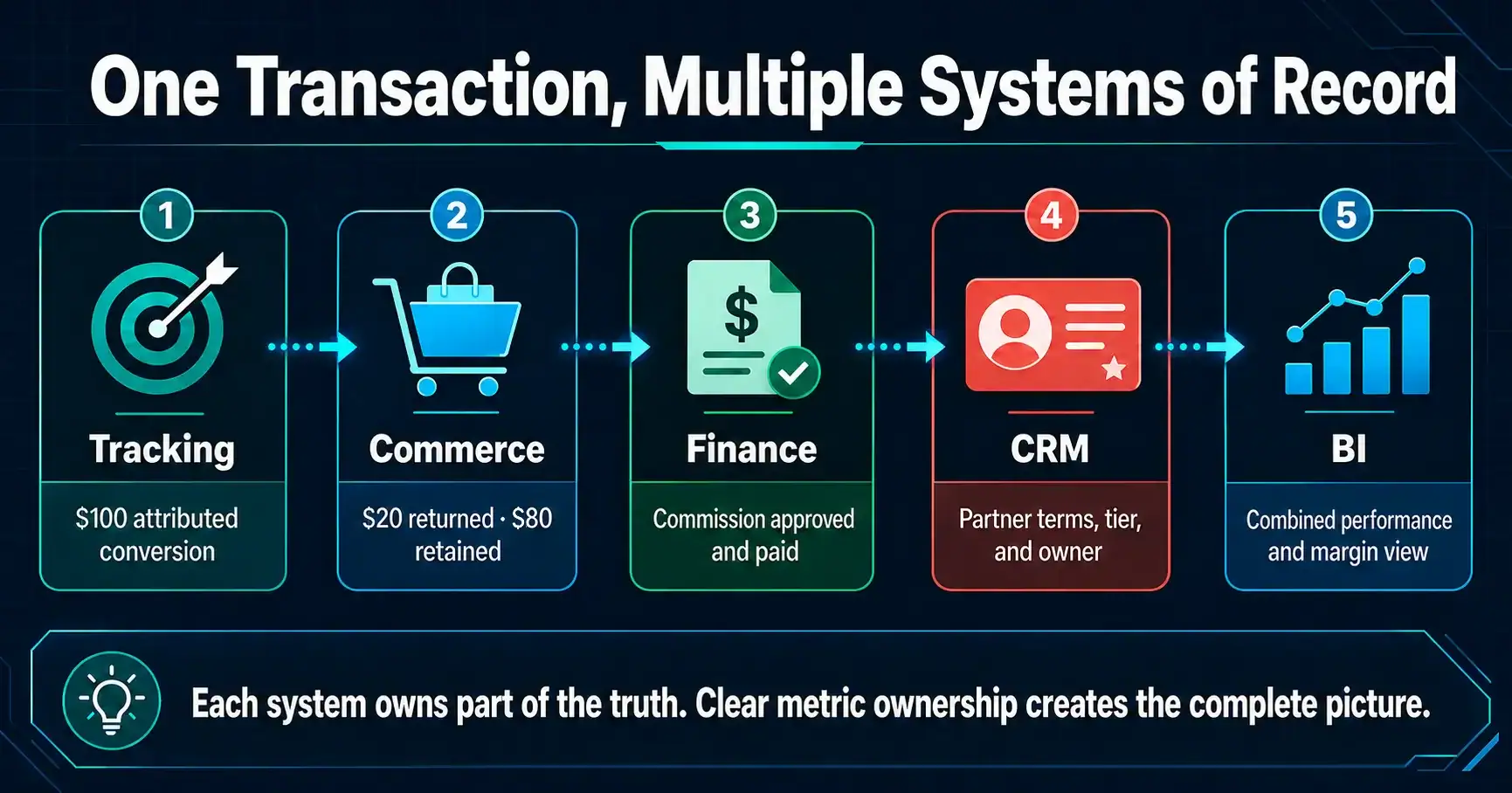
This is why teams should distinguish between three roles:
- Source system: Creates or first captures a record.
- System of record: Acts as the agreed authority for a specific field or business status.
- Reporting layer: Combines information from multiple systems for analysis.
One platform may perform more than one role, especially in a smaller affiliate program. However, those responsibilities should still be clearly defined.
The governing principle: There may be several systems of record, but each metric should have one designated owner—and that owner should define exactly what the metric means.
For example, “revenue” could mean gross order value, net revenue after returns, recognized revenue, or margin. Without a shared definition, even a technically perfect integration will only move ambiguity faster.
The Four Layers of the Affiliate Data Stack
A reliable affiliate data stack consists of four connected layers, each responsible for a different part of the partner and customer journey. Understanding how tracking, relationship management, reporting, and finance work together helps teams maintain accurate records, reduce data gaps, and make better program decisions.
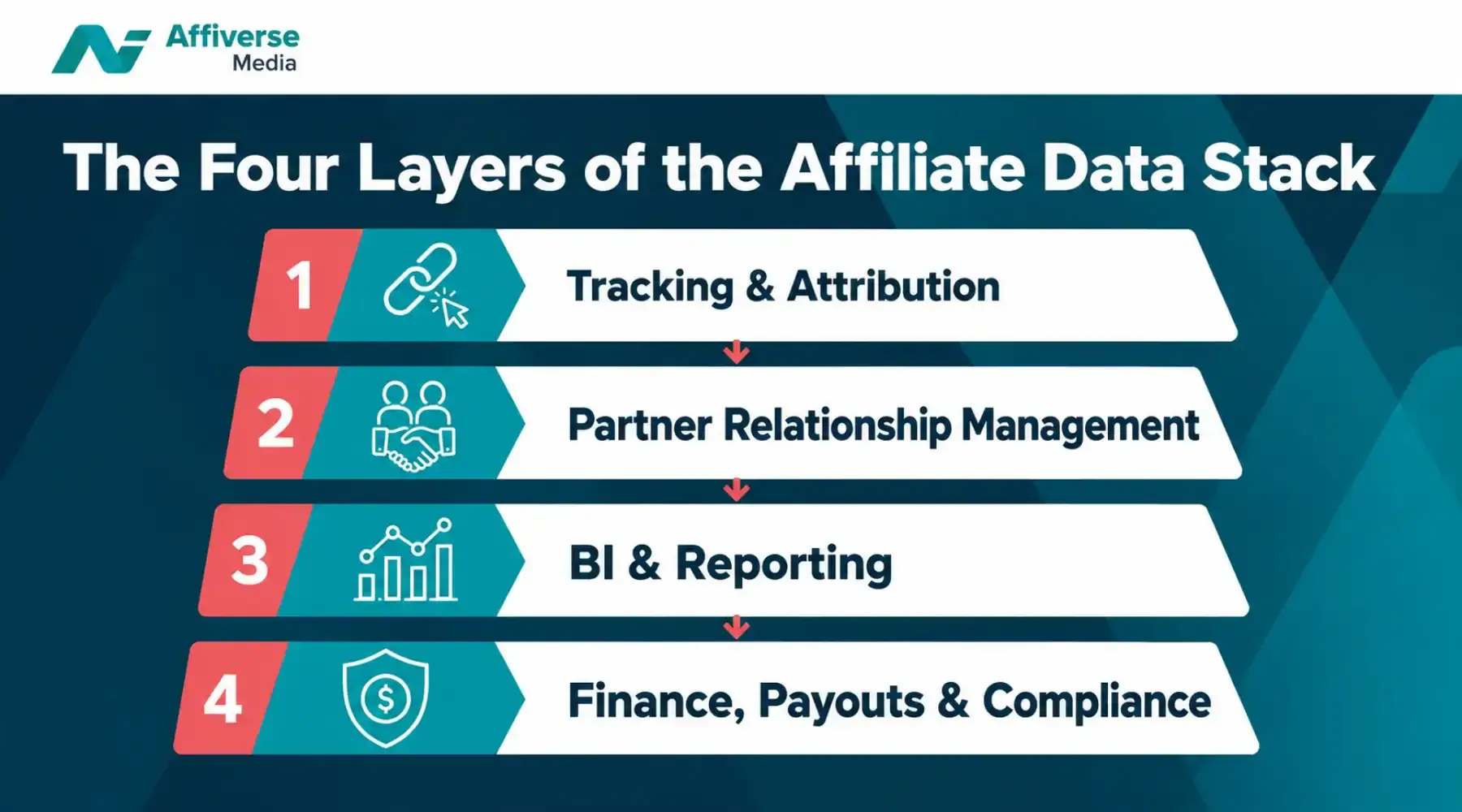
1. Tracking and Attribution
This layer captures the referral: who sent the visit, which campaign or placement was involved, what converted, and which commission rule applied. It should preserve stable identifiers for the partner, click, and transaction so that records can be joined later. Affiverse’s guide to affiliate tracking platforms provides a useful overview of the software category; the architectural question is how that tracking record connects to the rest of the business.
Teams also need to account for cross-device journeys, attribution windows, deduplication, consent, and lost signals. Server-to-server tracking can reduce reliance on browser storage, but it does not remove privacy obligations or guarantee perfect attribution. The ICO’s current guidance on tracking and storage technologies covers cookies, tracking pixels, link decoration, scripts, and related technologies, including the circumstances in which consent or an exception may apply. Build privacy requirements into the data flow before implementation, rather than adding them after launch.
2. Partner Relationship Management
The relationship layer holds information that conversion reports cannot: contacts, recruitment status, onboarding tasks, negotiated terms, communications, partner segments, content plans, and the history of decisions. Many affiliate platforms include a partner profile, and that may be enough at first. As the program scales, however, teams often need a clearer view of the recruitment pipeline and the full relationship across brands, markets, or products.
A CRM or partner-management system should not duplicate every click. Its purpose is to tell the commercial story: who the partner is, what has been agreed, what action comes next, and who owns the relationship. Good identity management matters here. If ‘TravelBlog Ltd’, ‘Travel Blog’ and ‘TB-1048’ are treated as three partners, reporting and communication will fragment quickly.
3. BI and Reporting
Business intelligence brings affiliate data together with sales, margin, customer, product, and channel information. This is where a program can move beyond operational questions such as ‘how many conversions were recorded yesterday?’ toward analytical questions such as ‘which partners bring profitable new customers?’ and ‘what value would have occurred without this activity?’
That distinction is important. Operational reporting supports daily management; analytical reporting supports investment decisions. Start with a documented set of metrics affiliate managers should track, then define the source, calculation, refresh frequency, and owner for each one. BI should make those definitions visible rather than hiding them behind a polished dashboard.
4. Finance, Payouts, and Compliance
The finance layer decides whether a tracked conversion becomes an approved commission and whether that commission was paid. It should account for cancellations, refunds, duplicate orders, thresholds, currencies, taxes, and payment status. A manager should be able to trace the path from referral to approval without relying on a private spreadsheet.
Compliance belongs in the workflow too. Contracts, disclosure checks, permissions, sanctions screening where applicable, and audit evidence need controlled ownership and retention rules. Affiverse has separate guidance on identifying and preventing affiliate fraud and on embedding compliance into program workflows. The data-stack implication is that exceptions, reviews, and decisions should be recorded in a way that is searchable and auditable. OWASP’s logging guidance also distinguishes operational, audit, and security logs, a useful reminder that not every log has the same purpose or retention need.
How Affiliate Data Should Move Between Systems
Return to the $100 retail order. A clean data flow might work as follows:
- An affiliate drives a visit, and the tracking platform creates a click ID.
- The customer completes an order, and the commerce system creates a transaction ID.
- The tracking platform links the transaction to the partner under the agreed attribution rules.
- The commerce system updates the order when part of it is canceled or returned.
- A validation process checks duplicates, fraud indicators, and eligibility, then produces an approved commission amount.
- Finance records the liability and, later, the payment status.
- The partner-facing system receives the approved and paid statuses, while BI combines the records for analysis.
The essential joins are partner ID, click or referral ID, transaction ID, and consistent timestamps. Status changes should be passed as updates, not as silent replacements that erase history. Where possible, store both the original value and the adjusted value so that a $100 conversion, a $20 return, and an $80 validated sale remain explainable.
Automation helps only when the flow is observable. Teams scaling their affiliate program operations with automation should monitor failed imports, late files, rejected records, and schema changes. A successful API response is not proof that the receiving system interpreted every field correctly.
Where Should Affiliate Data Live: CRM vs. Affiliate Platform?
There is no universal product configuration, but there should be a clear ownership map. A practical starting point looks like this:
| Information | Likely Primary Home |
|---|---|
| Clicks and attributed conversions | Tracking platform |
| Commission rules | Affiliate platform |
| Partner contacts and relationship history | CRM or partner-management system |
| Recruitment pipeline | CRM |
| Orders, cancellations and refunds | Commerce or transaction system |
| Approved commission and payment status | Finance or payout system |
| Cross-channel and profitability analysis | BI platform or data warehouse |
| Compliance evidence | Controlled partner record or compliance repository |
A small team may satisfy several of these needs in one platform. That is not a weakness if ownership, access, and export remain clear. The aim is not to buy the largest possible stack; it is to prevent two teams from maintaining conflicting versions of the same business fact.
Why Affiliate Reports Don’t Match and How to Reconcile the Data
Mismatches are not automatically evidence of broken tracking. Even Google documents that its analytics reporting surfaces can display data differently because reports, explorations, the API and BigQuery export process and present information in different ways. The same principle applies across an affiliate stack.
Common causes include:
- Different time zones or reporting cut-offs;
- Click date versus conversion or approval date;
- Gross revenue versus net revenue, margin, or recognized revenue;
- Refunds, cancellations, and partial returns;
- Currency rates and the date on which conversion occurs;
- Duplicate transactions and cross-channel deduplication;
- Different attribution windows or consent-related signal loss;
- Pending, approved, and paid statuses being combined; and
- Data-refresh delays or failed imports.
Reconciliation should therefore begin with definitions, not totals. Agree which system owns each metric, compare the same period and time zone, and match records using stable identifiers. Separate timing differences from missing or duplicated records. Document approved adjustments rather than manually overwriting one total to resemble another.
Then investigate exceptions by type. If 98% of transactions match and 2% are late refunds, the problem is different from a random 2% loss of click IDs. A simple exception table (transaction ID, discrepancy type, amount, owner, and resolution) is often more useful than repeatedly rebuilding the headline dashboard.
Affiliate Data Stack Examples by Program Size and Maturity
The right affiliate data stack depends on a program’s size, complexity, and growth stage. Early-stage teams need dependable foundations, while scaling and enterprise programs require stronger automation, reporting, governance, and compliance. These examples show how your technology can evolve with operational demands—without turning every new challenge into another software purchase.
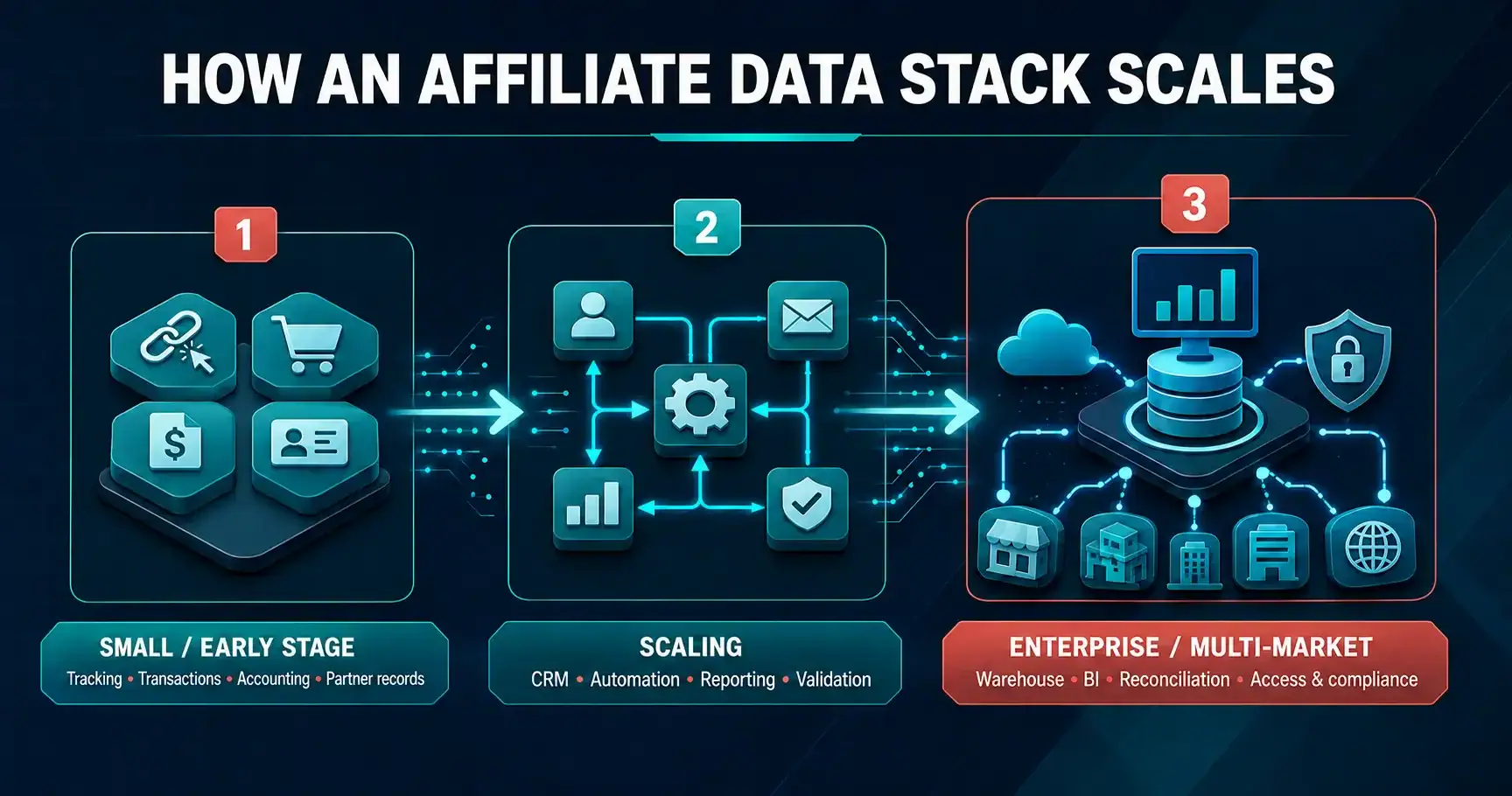
Small or Early-Stage Program
A tracking platform, commerce or transaction system, accounting tool, and structured partner records may be enough. Prioritize reliable attribution, clear payment records, and consistent partner identities. Before adding software, document the process for building and scaling an affiliate program so that technology supports a defined operating model.
Scaling Program
Add a CRM or stronger partner-management layer when recruitment, onboarding, and communications can no longer be managed reliably in one place. Automate routine transfers, centralize reporting, and introduce documented validation. The aim is to remove repeated spreadsheet handling and stop teams creating private versions of the truth.
Enterprise or Multi-Market Program
A data warehouse, BI layer, role-based access, automated reconciliation, and dedicated compliance workflows become more important. Standardize identifiers, currencies, time zones, and definitions across markets while retaining local regulatory controls. Governance matters as much as scale: the UK GDPR principles of data minimization, storage limitation, security, and accountability should shape what the stack collects, who can access it, and how long it is retained.
These are capability maps, not mandatory shopping lists. One platform may supply several capabilities, while a complex organization may need specialist systems. Architecture should follow the program’s risk, volume, and decision needs.
10 Affiliate Data Stack Questions for Vendors and Internal Teams
Use these questions to evaluate data ownership, integration, portability, governance, and long-term access across every vendor and system in your affiliate data stack.
- Which system will own each core metric and status?
- Can complete data be exported automatically and in a documented format?
- Is there a well-documented API, including versioning and rate limits?
- How frequently does data refresh, and how are failed transfers surfaced?
- How are updates, reversals, refunds, and late-arriving records handled?
- Which identifiers connect the partner, click, and transaction records?
- Can historical records, status changes, and relationship notes be migrated?
- How are currencies, timestamps, and time zones standardized?
- Which permissions, audit logs, and retention controls are available?
- What happens to the data, exports, and integrations when the contract ends?
Affiliate Data Stack Audit Checklist
Use this checklist to assess whether your affiliate data stack supports end-to-end traceability, clear metric ownership, reliable reporting, complete records, and profitable growth.
- Trace a commission from click to payment.
- Name the owner and definition of every important metric.
- Explain discrepancies between tracking, commerce, and finance.
- Export complete historical data without a manual copy-and-paste process.
- See the full history of a partner relationship.
- Separate recorded revenue from profitable or incremental growth.
If several answers are ‘no,’ the program has an architecture or governance problem, not merely a reporting problem. This is especially important as customer journeys become harder to observe: the limitations of click-based attribution make connected commercial and customer data more valuable, not less.
Build Your Affiliate Data Map Before Buying New Tools
A good affiliate data stack is defined by connected workflows, clear ownership and trustworthy decisions. It should make a conversion explainable from the first referral through validation, commission approval and payment, while preserving the partner and customer context needed for better analysis.
Before adding another platform, map the program’s five most important metrics. For each one, record its definition, source system, system of record, owner, refresh frequency, and downstream users. The gaps in that map will show whether the next priority is an integration, a process change, a governance decision, or new software.
Everflow
Connect
Tradedoubler
Connect
1win Partners
Connect
PIN-UP Partners
Connect
Shopnomix, a Nomix Group Company
Connect
V.Partners
Connect
Huffson Group
Connect
Kawaii Partners
Connect
Share your expertise and expand your reach and become a content contributor with us today!
Contact Us To Find Out More