IAB Sets AI Visibility Guidelines as Attribution Blueprint Takes Shape
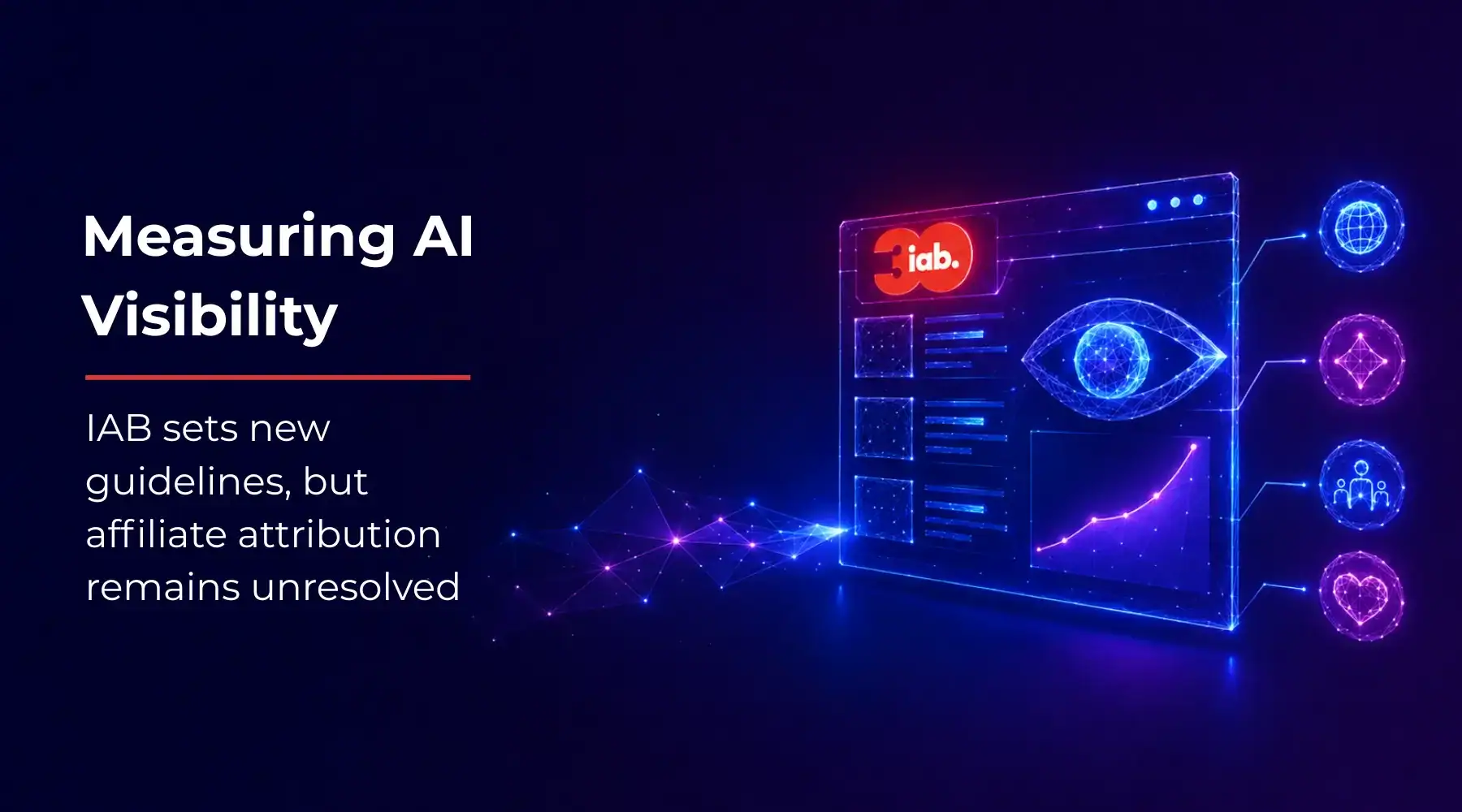
The Interactive Advertising Bureau (IAB) is developing an AI-era attribution blueprint to address how conversions influenced by AI agents should be classified and credited. The initiative follows its AI visibility guidelines, which introduced shared metrics for evaluating how brands and publishers appear in AI-generated answers.
The existing guidelines measure presence, prominence, portrayal and persuasion across AI-powered discovery platforms. However, they do not yet connect publisher influence with transactions or affiliate commissions. The forthcoming blueprint will consider agent-initiated, agent-recommended and signal-triggered conversions, although IAB has not yet published the detailed rules for assigning commercial credit.
What Affiliates Should Know About the IAB Framework
- IAB has organized AI visibility measurement around presence, prominence, portrayal and persuasion.
- The guidelines distinguish early directional signals from data considered reliable enough for budget and strategy decisions.
- More than 20 AI visibility providers currently use methodologies that can produce different results.
- Publishers can use the framework to assess how often their content is cited, how prominently it appears and how it is portrayed by AI platforms.
- IAB is now developing a separate attribution framework for agent-initiated, agent-recommended and signal-triggered conversions.
- The attribution blueprint remains in development, so the current guidelines still do not connect publisher influence with transactions, affiliate commissions or other downstream commercial outcomes.
IAB Begins Work on AI-Era Attribution Framework
The attribution gap identified in IAB’s initial visibility guidelines is now the subject of a separate industry initiative. IAB is developing an AI-Era Attribution Blueprint intended to establish shared definitions for measuring and crediting conversions influenced by AI systems.
Traditional attribution generally relies on identifiable impressions, referrals and clicks. That model becomes less reliable when an AI assistant recommends a product, compares merchants or helps complete a purchase without sending the customer through a conventional trackable journey.
IAB says the forthcoming framework will consider agent-initiated, agent-recommended and signal-triggered conversions. This could help advertisers and measurement providers distinguish between cases where an AI system introduces a product, influences the decision or takes a more active role in the transaction.
However, the blueprint is not yet a completed attribution standard. IAB has not published detailed weighting rules, technical requirements or a method for determining how commercial credit should be divided between publishers, AI platforms, advertisers and other contributors.
For affiliate publishers, the development shows that the attribution problem is now receiving direct industry attention. It does not yet establish how publishers will be compensated when their content informs an AI-generated recommendation without producing a conventional affiliate click.
Editor’s note: This is a developing story. Affiverse will update this article as IAB publishes further details about the attribution blueprint, including its methodology, definitions and proposed approach to crediting AI-influenced conversions.
Why IAB Introduced Shared AI Visibility Metrics
AI platforms are increasingly influencing how consumers research companies, products and services. However, the measurement tools built around this behavior do not yet use a consistent methodology.
According to IAB’s official announcement, more than 20 companies now provide AI visibility measurement tools. Differences in query selection, platform coverage, testing frequency and scoring can cause two providers to return different results for the same company or publisher.
Caroline Giegerich, vice president of AI at IAB, said:
Consumers are increasingly discovering and considering brands and products in AI platforms, but measurement frameworks haven’t kept pace.
The framework does not rank or endorse particular measurement vendors. Instead, it gives buyers a shared vocabulary for examining how a provider collects data and whether its results are suitable for the decisions being made.
The Four Areas of AI Visibility Measurement
IAB’s framework organizes measurement into four connected areas known as the “4 Ps of AI Visibility.”
- Presence measures whether a company appears or a publisher is cited in an AI response. Relevant metrics can include mention rate, citation rate, share of voice and changes in visibility over time.
- Prominence considers where that mention or citation appears. Being presented as the primary recommendation is different from appearing near the end of a longer list of alternatives.
- Portrayal examines the context in which a company or publisher is presented. This includes sentiment, framing, factual accuracy and the frequency of AI-generated errors.
- Persuasion considers whether the response encourages action. Its metrics include recommendation strength and post-citation click-through rate.
Together, these areas provide more detail than a single AI visibility score. An affiliate publisher could, for example, be cited frequently but placed in a weak position or used to support recommendations that generate little referral traffic.
Directional Data Is Not Automatically Decision-Grade
The guidelines also divide AI visibility reporting into two quality levels.
Directional measurement can identify emerging patterns, competitor activity and changes in citation frequency. IAB says this data can support internal monitoring but may not be reliable enough to determine budgets or wider strategy.
Decision-grade measurement requires greater rigor across areas such as sample size, query volume, prompt coverage, testing frequency, reproducibility, validation and platform coverage.
This distinction matters because generative AI responses are not fully consistent. Repeating the same prompt can produce different sources, recommendations or wording. A measurement provider therefore needs to explain how frequently it tests prompts and how it accounts for those variations.
Publisher Visibility Still Does Not Equal Affiliate Attribution
The framework gives affiliate publishers a better way to discuss visibility inside AI-generated answers. Citation frequency and prominence could support conversations with advertisers, affiliate programs and AI platforms about the value of publisher content. However, visibility is not the same as attribution.
A comparison page might influence an AI-generated product recommendation without receiving the final visit or affiliate click. The customer could complete the purchase directly with the retailer, search for the brand elsewhere or continue through another platform. Conventional affiliate tracking would not connect that transaction with the publisher whose content shaped the recommendation.
This reflects the attribution problem identified in the APMA’s AI search roadmap for affiliate marketing, which separates content access, citations and downstream commercial outcomes. IAB states that the current framework concentrates on organic AI visibility rather than paid measurement or commerce attribution. It therefore provides part of the measurement infrastructure affiliates need but does not determine how publishers should be compensated when their influence occurs without a trackable referral.
What Affiliate Publishers Can Measure Now
Publishers can use the framework to compare citation rates, monitor how their content is portrayed and question vendors about their sampling and validation methods. These signals can sit alongside referral data available through tools such as GA4’s AI Assistant channel and Google’s generative AI reporting in Search Console.
None of these systems provides complete attribution individually. Together, however, they can offer a clearer picture of where publisher content appears, whether users click and where influence disappears from the measurable journey.
The next challenge is commercial: connecting AI visibility with transactions and building payment models that recognize publisher influence even when no conventional affiliate click occurs.
Everflow
Connect
Tradedoubler
Connect
1win Partners
Connect
PIN-UP Partners
Connect
Shopnomix, a Nomix Group Company
Connect
V.Partners
Connect
Huffson Group
Connect
Kawaii Partners
Connect
Share your expertise and expand your reach and become a content contributor with us today!
Contact Us To Find Out More