Apple Ads Terms Signal Possible Expansion to Third-Party Platforms
Apple has broadened the language in its advertising terms, giving the company greater contractual scope to distribute campaigns across devices, operating systems, web applications, and other platforms or properties.
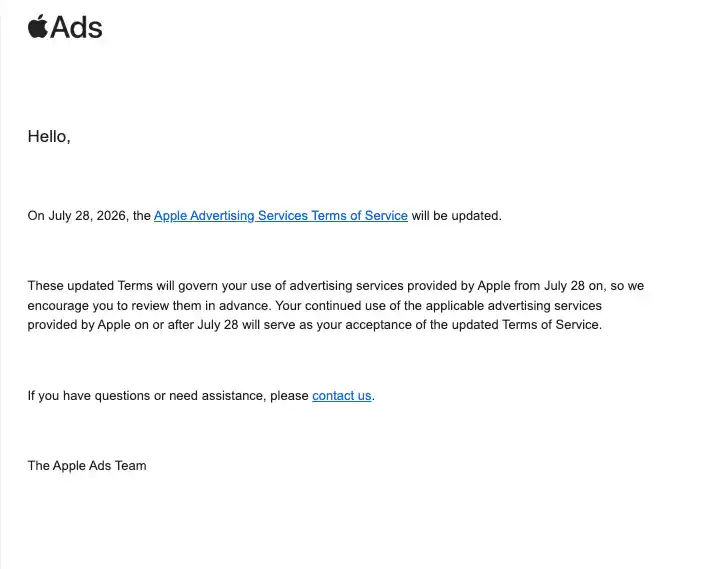
The revised Apple Advertising Services Terms of Service, which take effect on July 28, 2026, do not confirm that Apple is launching a third-party advertising network. However, the wording has raised questions about whether Apple Ads could eventually move beyond inventory controlled directly by the company and begin serving campaigns across external apps, websites, or other publisher properties.
Key Takeaways from Apple’s Advertising Terms Update
- Apple has expanded its definition of where advertising campaigns may be distributed.
- The new terms refer to devices, operating systems, web applications, and “other platforms or properties.”
- The change could support ads on third-party surfaces, although Apple has not announced such a service.
- Any expansion would raise important questions about publisher access, targeting, attribution, and privacy.
Apple Broadens Where Its Ads Can Be Distributed
Under Apple’s current advertising terms, advertisers can pay Apple to deliver campaigns across relevant “Apple software applications or Apple devices.” The wording ties the service closely to Apple-controlled products and environments. The updated version is considerably broader. From July 28, Apple’s terms will cover the distribution of advertising content across relevant devices, operating systems, software or web applications, and “other platforms or properties.”
The removal of the direct reference to Apple applications and devices is significant. It does not prove that Apple Ads will immediately begin appearing on independently operated apps and websites, but it removes language that appeared to restrict the service to Apple-owned environments. It also appears to give Apple more flexibility to add new inventory without rewriting the central definition of its advertising service each time.
Why the Change Could Point Beyond Apple-Owned Inventory
Apple Ads currently focuses on placements within Apple-controlled services, including the App Store, Apple News, Stocks, and Apple TV. It is also expanding into Apple Maps, where businesses will be able to reach users searching for nearby locations.
The revised terms could signal a move into third-party apps and websites, allowing Apple to connect advertisers with inventory from external publishers and developers. However, the broader wording may simply cover Apple services accessed through browsers, smart TVs, and other non-Apple devices. The reference to “other platforms or properties” leaves both possibilities open.
What a Third-Party Apple Ads Network Could Mean for Publishers
A third-party Apple Ads network could give publishers and app developers another source of advertising demand by allowing them to make inventory available through Apple. However, no publisher product has been announced, and key details such as eligibility, revenue sharing, ad formats, and reporting remain unknown.
Publisher control would be central to its appeal, including which advertisers could appear, how ads would be selected, and what performance data would be available. These are also key considerations for newer initiatives such as the European Media Marketplace, which focuses on first-party data, privacy-safe buying, and greater control over publisher inventory.
Advertisers Could Gain Another Media-Buying Channel
A wider Apple Ads network could give advertisers and agencies access to more placements while building on Apple’s strength in app discovery and high-intent searches. Apple Maps ads are also being positioned around contextual relevance rather than tracking users across services.
Whether the same model would extend to third-party inventory is unclear. Its value would depend on reach, pricing, campaign controls, and measurement. As affiliate businesses adopt more multi-channel media-buying strategies, Apple could add a useful new channel but also another reporting platform for teams to manage.
Attribution Would Be One of the Biggest Questions
Any expansion into third-party inventory would require Apple to explain how campaign performance would be measured. Its existing AdServices API is designed for App Store ads, while AdAttributionKit supports privacy-preserving measurement across multiple channels.
Apple could expand one of these systems or introduce a combined reporting framework, but the approach remains unclear. Other platforms are already trying to close similar measurement gaps. Snapchat’s Unified Attribution product for app marketers, for example, brings platform and mobile measurement data into one view. Apple would face similar expectations from advertisers comparing installs, in-app activity and campaign value across channels.
What Apple Has and Has Not Confirmed
Apple has not announced a third-party ad network, publisher program, or timetable for placing ads outside its existing inventory. The July 28 effective date marks a change to its contractual terms rather than the launch of a new advertising product.
Further evidence would likely come through new publisher documentation, inventory policies, registration tools, or attribution updates. For now, the wording gives Apple more flexibility over where campaigns can appear, but whether that leads to a wider network for publishers, app marketers, and advertisers remains unclear.
Everflow
Connect
Tradedoubler
Connect
1win Partners
Connect
Shopnomix, a Nomix Group Company
Connect
Huffson Group
Connect
Kawaii Partners
Connect
Trackdesk
Connect
Share your expertise and expand your reach and become a content contributor with us today!
Contact Us To Find Out More