Amazon Prime Day Shows Why AI Deal Discovery Matters for Affiliate Marketers
Amazon Prime Day 2026 has become a wider test of ecommerce demand, deal discovery and consumer decision-making across U.S. retail.
According to Reuters, U.S. online spending reached $8.3 billion on the first day of Prime Day, up 5.3% year over year, based on Adobe Analytics data. Adobe Digital Insights had previously forecast $26.3 billion in U.S. online spend across the full four-day event.
For affiliate marketers, Prime Day offered a useful signal: major shopping periods are becoming more dependent on product comparison, deal validation and AI-assisted discovery before the customer reaches checkout.
Key Takeaways from Prime Day and AI Shopping Data
- Prime Day 2026 showed how concentrated ecommerce demand has become around major retail events.
- Reuters reported that U.S. online spending reached $8.3 billion on the first day of Prime Day, based on Adobe Analytics data.
- Adobe Digital Insights forecast $26.3 billion in U.S. online spend across the full four-day Prime Day period.
- Adobe’s wider AI traffic research shows that AI-referred retail visits are becoming a stronger commercial signal, with AI-referred retail visitors converting 42% better than non-AI traffic in March 2026.
- For affiliate marketers, the opportunity is in clearer product comparisons, deal validation and content that helps shoppers make decisions faster.
- As AI-assisted discovery becomes more common, affiliates may also need to review how they are tracking AI traffic.
Prime Day Shows the Scale of Deal-Led Ecommerce
Prime Day is a useful case study because it concentrates consumer demand, discounts and purchase intent into a short period. During that window, shoppers are not just searching for products. They are trying to decide which deal is worth acting on.
That creates a clear role for affiliate content. Comparison guides, deal roundups, category explainers and product recommendation pages can help users make faster decisions, especially when the content is specific, current and easy to understand.
The wider shift was already visible in how AI-powered deal discovery moved closer to the shopping decision point during Prime Day. As AI tools become more involved in product research, affiliate content needs to support the moments before checkout: comparison, validation and confidence.
AI-Assisted Shoppers May Be Further Along the Journey
Adobe’s broader ecommerce research points to a change in how shoppers use AI before reaching a retail site. In its Q2 AI traffic report, Adobe found that AI-referred retail visitors converted 42% better than non-AI traffic in March 2026.
The same report found that traffic from AI sources to U.S. retail sites grew 393% year over year in the first quarter of 2026. That does not mean AI has replaced established channels such as search, email or paid media. It does show that AI-assisted discovery is becoming a measurable part of the shopping journey.
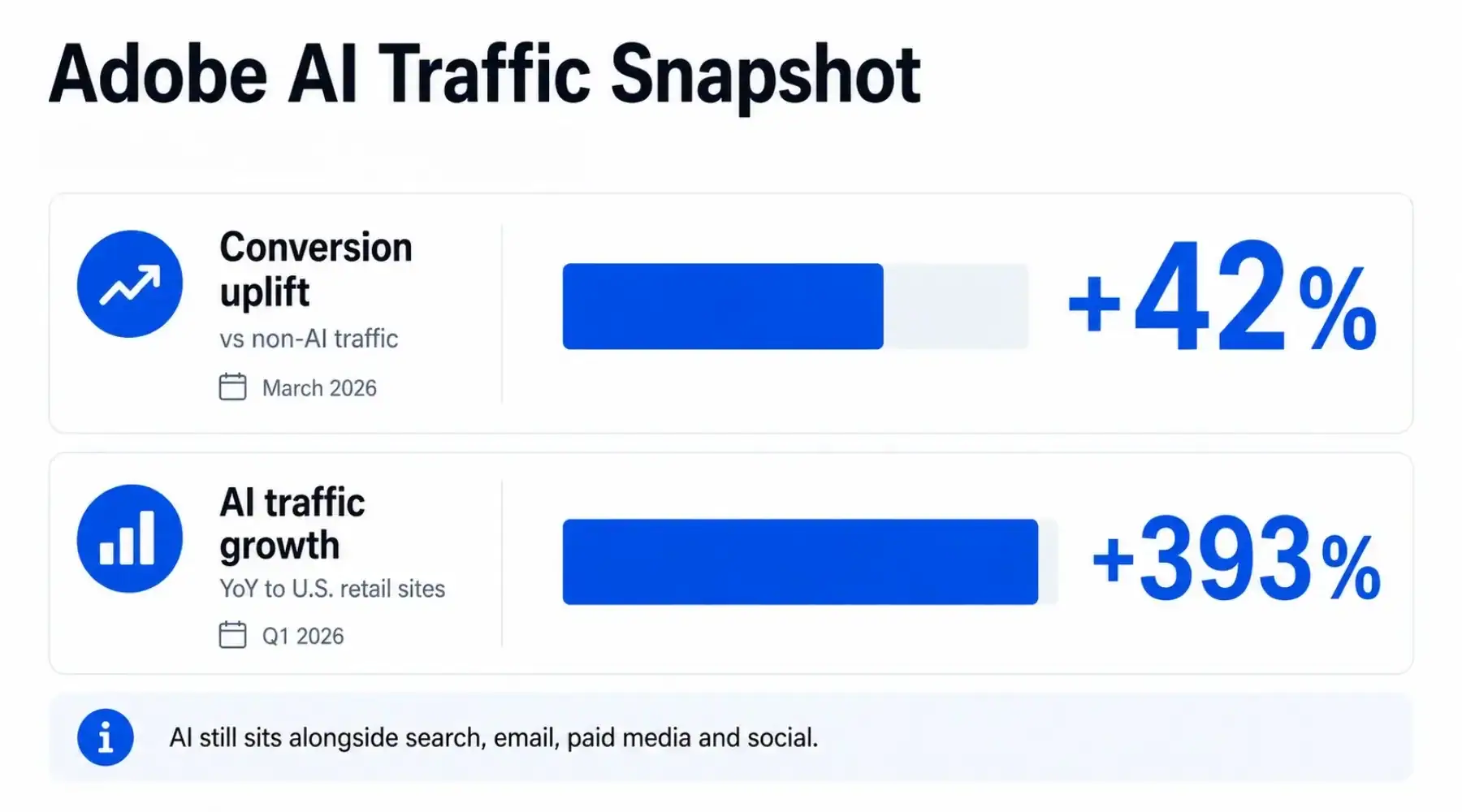
Together, those two figures point to the same shift: AI-referred shoppers are still a developing traffic source, but they are beginning to show stronger intent once they reach retail sites.
For affiliate marketers, the signal is that AI-assisted shoppers may already be closer to a decision by the time they click through. They may have compared products, checked deal options or refined their intent through an AI assistant before reaching a retailer or publisher site. That makes product-led affiliate content more important, not less. Buying guides, comparison pages, deal explainers and FAQs need to help shoppers validate choices quickly, while also being clear enough for AI-led discovery journeys to understand.
Prime Day Highlights the AI Visibility Challenge
The practical challenge is visibility. If product content, buying guides, FAQs and review pages are not structured clearly, they may be less likely to appear in AI-led discovery journeys.
This does not replace SEO. It reinforces many of the same fundamentals: clear page structure, useful product information, original guidance, crawlable content and trust signals. That is especially relevant for affiliates trying to understand Google’s AI search guidelines for affiliates, where useful, accessible and trusted content remains the foundation.
For ecommerce and affiliate publishers, the goal is not to chase AI visibility as a shortcut. The stronger opportunity is to make product-led content easier for both users and machines to interpret.
What This Means for Affiliate Marketers
Major shopping events are becoming less linear. A user might compare products in an AI assistant, check a creator recommendation, read an affiliate guide and then convert through a retailer. That matters because discovery, evaluation and conversion do not always happen in the same place. This is one reason AI is reshaping influence and attribution in affiliate marketing, especially when traditional reporting models struggle to capture earlier decision-making moments.
The rise of AI-assisted product research also gives affiliate teams a reason to review how traffic is categorized inside analytics tools. AI-driven visits may not always behave like traditional organic search, paid search, social or email traffic. For teams reviewing this inside reporting dashboards, tracking AI traffic in GA4 can help separate recognized AI assistant traffic from other referral sources, while still accounting for gaps such as stripped referrers and direct traffic.
A New Layer in Product Discovery
Amazon Prime Day 2026 showed that major retail events are no longer only about discounts and checkout activity. They are also shaped by how shoppers research, compare and validate products before buying.
For affiliate marketers, the takeaway is clear: product-led content needs to be useful earlier in the journey. Deal pages, comparisons, buying guides and category explainers should help users understand what matters, which offers are relevant and why one option may be stronger than another. As AI tools become more common in shopping research, the marketers best placed for that journey will be the ones whose content can be found, understood and trusted at each stage.
Everflow
Connect
Tradedoubler
Connect
1win Partners
Connect
PIN-UP Partners
Connect
Shopnomix, a Nomix Group Company
Connect
V.Partners
Connect
Huffson Group
Connect
Kawaii Partners
Connect
Share your expertise and expand your reach and become a content contributor with us today!
Contact Us To Find Out More