Google’s AI Search Ads Put Shopping Visibility Up for Grabs
Google’s latest AI search updates show how commercial discovery keeps moving deeper into AI-led experiences. Alongside new ad formats for AI Mode and AI Overviews, Google is adding Merchant Center insights that help retailers track how their products appear across AI shopping surfaces. For marketers and affiliates, the question now feels sharper: who owns visibility when search becomes more conversational, sponsored, and transaction-led?
Google Moves Ads Deeper Into AI Search
In its official Google Marketing Live shopping announcement, Google outlined new AI and commerce tools designed to bring product discovery, sponsored answers, offers and checkout closer together across Search and AI-led shopping experiences.
Two formats stand out: Conversational Discovery and Highlighted Answers.
Conversational Discovery
Conversational Discovery aims to place sponsored recommendations inside longer AI Mode sessions. These sessions don’t always behave like classic search, especially as query fan-out changes how AI Mode breaks one prompt into related searches before deciding what to surface. A user may start with a broad question, refine it several times, compare products, ask for trade-offs, and then move closer to a buying decision. Google wants ads to appear inside that process with more context. For advertisers, that means paid placements can follow a more detailed user journey. For affiliates and publishers, it also means sponsored results may appear before the user reaches an external review, guide, or comparison page.
Highlighted Answers
Highlighted Answers follows a similar logic. Rather than pushing a standard ad block beside a query, Google can use the format to surface sponsored information that responds to the user’s question more directly. The ad sits closer to the answer itself, which makes it feel more integrated into the search experience. That shift matters. Search ads have always chased intent, but AI Mode gives Google more room to read the full conversation around that intent. For advertisers, that could mean more relevant placements. For publishers and affiliates, it means paid results may sit closer to the exact moment when a user asks for advice.
AI Search Is Becoming a Campaign Management Environment
Google’s ad updates don’t stop at placement. The company also introduced Ask Advisor, an AI assistant designed to work across Google Ads, Google Analytics, Google Marketing Platform, and Merchant Center. The tool can help marketers create campaigns, pull product information, and produce performance reports across Google’s advertising stack.
That points to a wider change in campaign operations. Google wants marketers to plan, build, analyse, and adjust campaigns with AI assistance inside its own tools. Asset Studio also received Gemini-powered creative upgrades. Marketers can use campaign briefs or natural language prompts to generate text, image, and video assets. Useful, especially for teams running high-volume creative tests across shopping, search, and social-style ad formats.
The commercial direction looks clear enough. Google wants AI to sit in front of the consumer, and behind the marketer. One side gets conversational recommendations. The other gets automated campaign support.
Shopping Ads Are Moving Closer to Product Advice
The shopping side may matter most for affiliates. Google’s new AI-powered Shopping ads go beyond the usual product image, price, and merchant name. They can explain why a product fits a specific query. That makes the ad feel less like a listing and more like buying advice.
That’s where the affiliate angle comes in. Affiliate and comparison publishers usually win traffic by helping users make decisions. They explain products, rank options, compare features, highlight trade-offs, and point readers toward the right merchant.
Google now wants to bring some of that explanation directly into AI Mode. For users, that could make the search experience more useful. They may get product context, recommendations, and buying prompts before opening an external review or comparison page.
For affiliates, it raises the standard. Basic product summaries will have less room to work if Google can already answer simple buying questions inside AI search, which is why Google’s own AI search guidance for affiliates now matters more for review and comparison pages. Pages will need to offer something stronger, such as:
- Original testing
- Clear comparison logic
- Updated pricing context
- Stronger merchant data
- Exclusive offers
- Hands-on product insight
That doesn’t remove the need for affiliate content. It makes weaker content easier to skip. The thin middle gets squeezed first.
Merchant Center Gets AI Shopping Visibility Insights
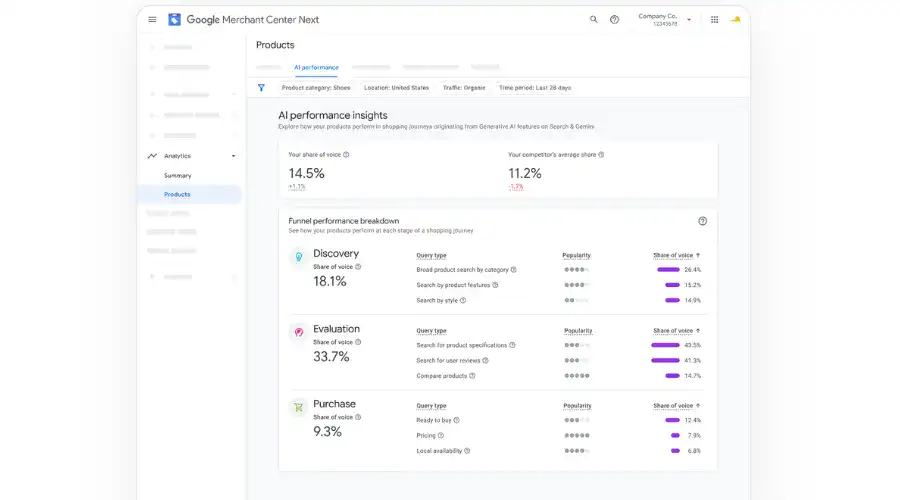
The second part of Google’s update comes through Merchant Center. Google is adding AI shopping visibility insights to help retailers see how their products and brands appear across conversational shopping results. The feature will give retailers new AI visibility metrics in Merchant Center, focused on how products surface in AI-led shopping journeys.
Google’s Merchant Center Help announcement says AI performance insights will help brands understand how their products are discovered across AI Mode, AI Overviews in Search, and the Gemini app. The tool will also compare a brand’s share of voice against similar brands across AI surfaces. That gives merchants a clearer way to measure a part of search that has felt difficult to track.
Classic search reporting usually gives marketers familiar signals:
- Keyword data
- Impression share
- Clicks
- Conversions
- Product feed performance
AI shopping creates a less predictable path. A product might appear inside an AI answer, a shopping recommendation, a conversational comparison, or a follow-up query inside AI Mode. Merchant Center’s new reporting tools give retailers a way to see whether they show up in those moments.
For performance marketers, this matters because AI shopping visibility may become its own optimisation job. Product feeds, attributes, descriptions, images, pricing, availability, and brand In practice, retailers may soon track AI visibility alongside classic paid search and Shopping performance, while affiliates will still need to understand how to track AI traffic in GA4 once those users reach their sites. New dashboard. New questions.
Direct Offers and Checkout Bring Google Closer to the Sale
In its Google Marketing Live ads announcement, Google also outlined Direct Offers, native checkout and the Universal Commerce Protocol as part of a push to bring discovery, offers and transactions closer together in AI-led shopping journeys.
This changes the shape of the funnel. A user might ask AI Mode for a product recommendation, receive an explanation, compare a few options, see a relevant offer, and move toward checkout without travelling through the usual chain of search result, publisher page, merchant page, and cart.
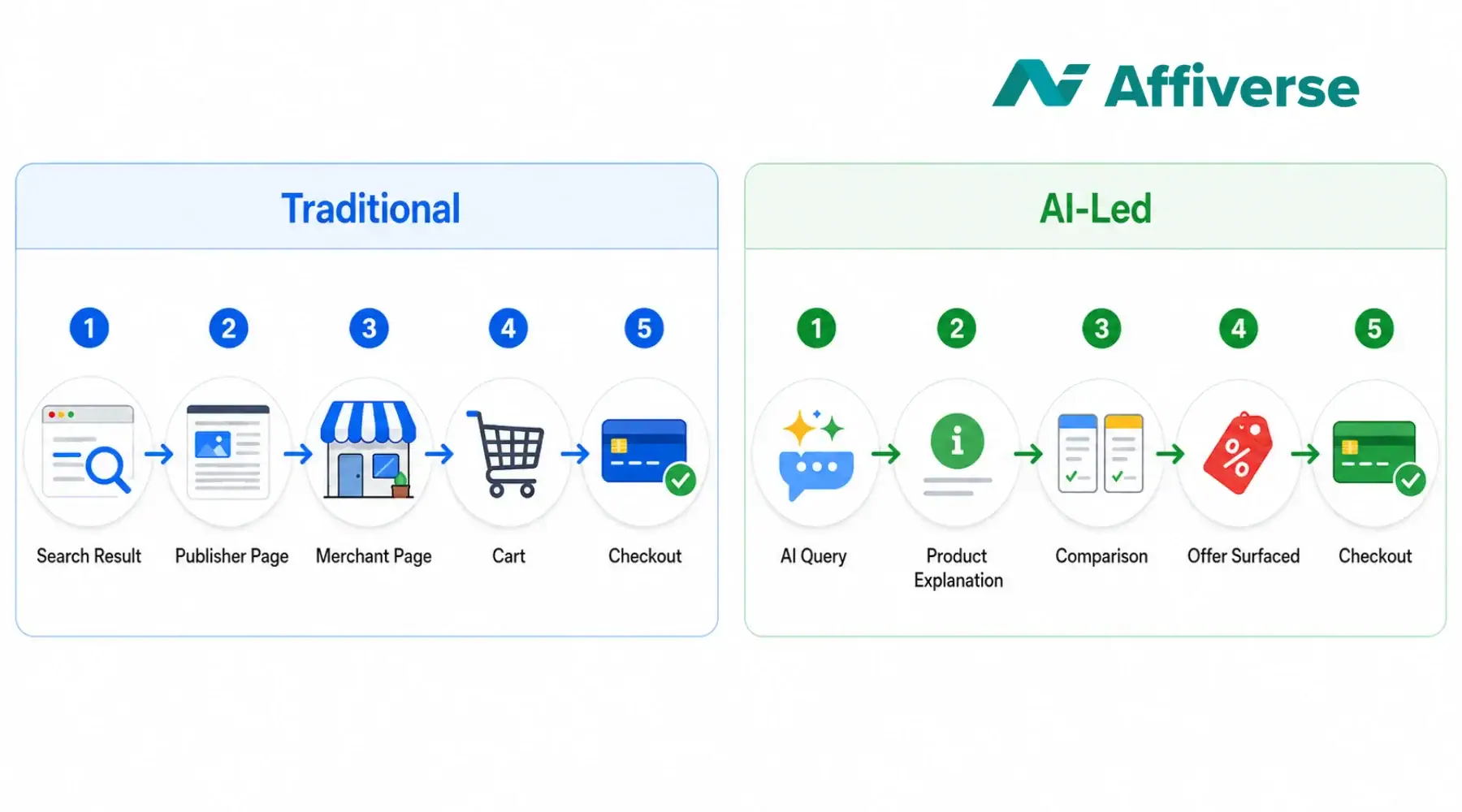
That creates obvious value for retailers and advertisers. Less friction. More control. Cleaner measurement inside Google’s environment. It also gives affiliates less empty space between intent and conversion. If offers and checkout sit inside the search experience, affiliates need a stronger reason to exist in the path. A better coupon page won’t be enough. A thin comparison table won’t be enough either.
Why Affiliates and Performance Marketers Should Watch Closely
For affiliates, the risk isn’t that Google AI search removes every click. The risk comes from more commercial decisions happening before the user reaches an affiliate page, which makes AI attribution in affiliate marketing a harder commercial problem. If AI Mode can surface products, explain recommendations, match discounts, and push users closer to checkout, affiliate content has to work harder. It needs evidence. It needs context Google can’t easily copy from a feed. That may shift the relationship between affiliate managers and partners too.
Affiliate managers will need to give partners better material: cleaner product data, updated offers, market-specific landing pages, exclusive codes, stronger proof points, and assets that explain why one product or merchant deserves attention. Old partner packs with generic banners and dated copy won’t help much in an AI-led search environment.
Retailers face a similar task. Merchant Center visibility may become a new performance signal. If a product has weak attributes, poor descriptions, limited images, or unclear category data, it may lose visibility before bidding strategy even gets a chance to work. For performance marketers, this turns AI search into a paid visibility issue, a data quality issue, and a partner enablement issue at the same time.
Google’s AI Commerce Layer Is Getting More Measurable
Google has spent years pushing Search, Shopping, Merchant Center, and paid media closer together. AI Mode gives that work a new interface. The latest updates show three connected moves.
- Ads sit deeper inside AI search conversations.
- Merchant Center starts reporting visibility across AI shopping surfaces.
- Offers and checkout move nearer to the point of recommendation.
Affiliates don’t need to panic. They do need to pay attention to where Google places commercial answers next. The basic question has changed. Ranking on the results page still matters. So does showing up before the results page becomes a checkout path.
Everflow
Connect
Tradedoubler
Connect
1win Partners
Connect
PIN-UP Partners
Connect
Shopnomix, a Nomix Group Company
Connect
V.Partners
Connect
Huffson Group
Connect
Kawaii Partners
Connect
Share your expertise and expand your reach and become a content contributor with us today!
Contact Us To Find Out More