The Affiliate’s Guide to Pop-Ups: When They Work, When They Backfire, and How to Get Them Right
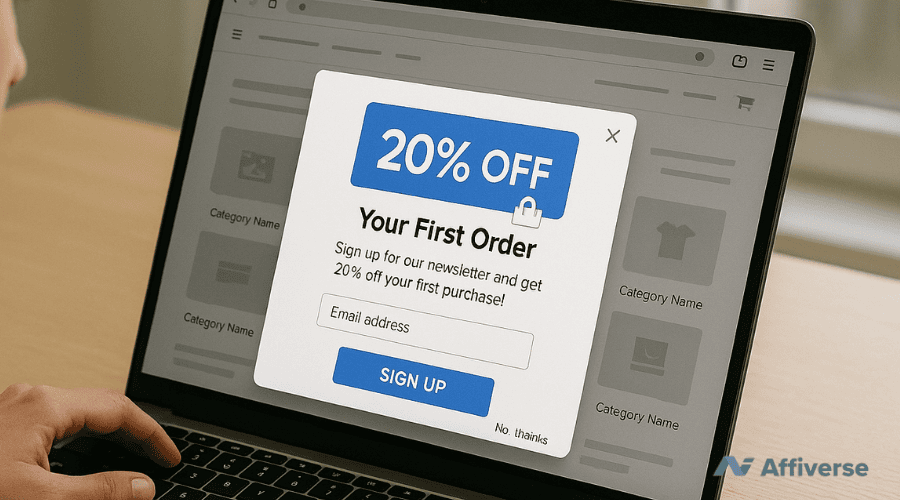
Pop-ups remain one of the most polarising tools in the affiliate marketing toolkit. Done poorly, they annoy visitors and tank your SEO. Done well, they can recover abandoning traffic, grow your email list, and significantly boost conversions. The difference between the two comes down to timing, context, and understanding what your audience actually wants.
This guide breaks down the mechanics of pop-ups from the affiliate’s perspective—covering what current data shows about effectiveness, the SEO implications you need to navigate, and practical strategies for implementation that won’t alienate your audience.
- Why Pop-Ups Still Matter for Affiliates
- Understanding Pop-Up Types and When to Use Them
- The Google Factor: Navigating SEO Implications
- Conversion Optimisation: What the Data Shows
- Images Matter
- Fewer Fields Win
- Countdown Timers Create Urgency
- Gamification Drives Engagement
- Positioning Matters More Than You’d Think
- Strategic Applications for Affiliates
- When Pop-Ups Backfire
- Interrupt Engaged Users
- Provide No Clear Value
- Appear Repeatedly Despite Dismissal
- Conflict with Mobile Experience
- Make Closing Difficult
- Implementation: Tools and Platforms
- Testing and Iteration
- Compliance and Disclosure
- Bringing It Together
Why Pop-Ups Still Matter for Affiliates
The numbers make a compelling case. According to Wisepops’ analysis of over one billion pop-up displays, the average conversion rate sits at 4.65%—up from 4.01% in 2024. OptiMonk reports even stronger performance, with their data showing an average conversion rate of 11.09% across all pop-up types. The top 10% of performing pop-ups convert at rates as high as 42.35%.
For affiliates, this matters because list building represents one of the most defensible traffic strategies available. As we’ve covered in our guide on how to build an email database for affiliate marketing, email subscribers convert at significantly higher rates than social media followers and provide a direct communication channel that algorithm changes can’t disrupt.
Pop-ups serve as one of the most effective mechanisms for capturing those email addresses. The question isn’t whether they work—it’s how to implement them without creating friction that damages your broader affiliate operations.
Understanding Pop-Up Types and When to Use Them
Different pop-up triggers serve different purposes. Matching the right trigger to your goals makes the difference between conversion and irritation.
Exit-Intent Pop-Ups
Exit-intent technology detects when a visitor moves their cursor toward the browser’s close button or back button, triggering a pop-up at the moment they’re about to leave. According to multiple studies, exit-intent pop-ups can convert between 2-4% of abandoning visitors, with top performers reaching conversion rates above 15%.
The psychology here works because you’re not interrupting someone engaged with your content—you’re making a final offer to someone who’s already decided to leave. There’s nothing to lose and everything to gain.
For affiliates, exit-intent pop-ups work particularly well for:
- Offering a discount code or special deal on the product you’re reviewing
- Capturing an email address in exchange for a buying guide or comparison resource
- Presenting an alternative product if someone seems unsatisfied with what they’ve found
The key consideration: exit-intent pop-ups are explicitly exempt from Google’s intrusive interstitial penalties. Google has confirmed through John Mueller that pop-ups triggered by user exit intent don’t fall under their mobile interstitial guidelines because they don’t interrupt the user’s initial attempt to access content.
Timed Pop-Ups
Timed pop-ups appear after a visitor has been on your page for a specific duration. The data on optimal timing is revealing—Wisepops found that campaigns displayed between zero and five seconds performed well, but the safer option that also delivered strong results was the 11-15 second range.
Sleeknote’s research suggests six seconds as the optimal delay for timer-based triggers, which outperformed scroll-based triggers by 67.42%.
For affiliate content, timed pop-ups make sense when you want to capture engaged readers who have demonstrated interest through their time on page. If someone has spent 10-15 seconds reading your review, they’re invested enough that a relevant offer won’t feel like an interruption.
Scroll-Triggered Pop-Ups
These appear when a visitor scrolls to a certain percentage of your page. According to DiviFlash research, the sweet spot falls between 35-50% scroll depth, where conversion rates reach 2.5-3.35%. Triggering at 10% scroll depth produces just 1.99% conversion, while 80% drops to 1.62%.
For affiliate content, scroll-triggered pop-ups align well with natural reading patterns. By the time someone has scrolled through 40% of your review or comparison post, they’ve consumed enough information to understand what you’re offering and may be ready to commit—or need one more incentive to do so.
Click-Triggered Pop-Ups
Click-triggered pop-ups require user action to display, which explains why they deliver the highest conversion rates of any trigger type—22% according to recent research. The user has actively chosen to engage.
This approach works for affiliates promoting exclusive deals or content upgrades. A button labelled “Reveal Your Exclusive Discount” that triggers a pop-up creates a micro-commitment from the user, making them more likely to complete whatever action you’re requesting.
The Google Factor: Navigating SEO Implications
Google’s intrusive interstitial penalty, which rolled out in January 2017 and has been reinforced through subsequent updates, specifically targets pop-ups that obstruct content on mobile devices. Understanding what wass penalised—and what wasn’t—prevents you from inadvertently damaging your search rankings.
What Gets Penalised
Google used to penalise pages that display intrusive interstitials immediately after users click through from search results. Specifically:
- Pop-ups that cover the main content immediately upon page load
- Standalone interstitials that users must dismiss before accessing content
The penalty only applied to the entry page from search results. If someone lands on your homepage from Google and then navigates to an internal page where you display a pop-up, that second-page pop-up didn’t trigger a penalty.
What’s Exempt
Google makes explicit exemptions for:
- Age verification gates for restricted content
- Login dialogs for content behind authentication
- Exit-intent pop-ups, which don’t interrupt initial content access
The 2024 Google API documentation leak confirmed the existence of a violatesMobileInterstitialPolicy attribute that can demote pages, along with an adsDensityInterstitialViolationStrength score from 0-1000 indicating violation severity. This confirms that Google’s approach is nuanced rather than binary—worse violations carry heavier penalties.
Practical Implications for Affiliates
If you rely on organic search traffic, the safest approach involves:
- Using exit-intent exclusively for mobile search traffic — This trigger is explicitly safe
- Implementing page-view counters — Only show pop-ups to returning visitors or those who have viewed multiple pages
For affiliates generating traffic from alternative channels beyond search, the rules are less restrictive since Google’s penalty only applies to search entry pages.
Conversion Optimisation: What the Data Shows
Moving beyond trigger types, specific design and copy elements significantly impact pop-up performance.
Images Matter
Pop-ups with images convert 4.74% of visitors compared to 2.55% for those without—an 86% improvement according to DiviFlash research. For email capture pop-ups specifically, adding images increased conversion from 2.63% to 4.3%, a 63% lift.
For affiliates, this means including product images in pop-ups promoting affiliate offers, or cover mockups when offering lead magnets like buying guides or comparison PDFs.
Fewer Fields Win
Wisepops data shows single-field pop-ups (just email) convert at 4.4%, while adding a second field drops conversion to 2.85%. The trend continues with diminishing returns—three fields hit 3.98%, four fields 3.87%, and five fields 3.36%.
The lesson: ask only for what you need. An email address is enough to begin a relationship. Additional information can come later through progressive profiling.
Countdown Timers Create Urgency
Pop-ups with countdown timers convert 25-112% better than those without, depending on the study. The urgency effect is real and measurable.
For affiliates promoting time-sensitive deals—flash sales, limited coupons, seasonal offers—countdown timers can significantly boost conversion. The key is authenticity: fake urgency damages trust. Use timers only when the deadline is genuine.
Gamification Drives Engagement
Spin-to-win wheels and similar gamified pop-ups achieve average conversion rates around 13%—well above standard pop-ups. The interactive element turns a potential annoyance into entertainment.
This format works particularly well for affiliates in e-commerce niches where discount offers are expected. The “chance” to win something feels more exciting than being handed a standard 10% off code, even when the odds ensure most participants receive the same discount.
Positioning Matters More Than You’d Think
Wisepops’ 2025 data shows bottom-centre positioned pop-ups converting at 12.88%, dramatically outperforming other positions. Centre-right achieves 6.40%, while positions like top-right languish at 0.67%.
Bottom-positioned pop-ups feel less intrusive because they don’t block the content users are trying to read. Slide-ins from corners achieve similar non-intrusive effects while still capturing attention.
Strategic Applications for Affiliates
Theory only matters if it translates to practical application. Here are specific strategies aligned with common affiliate objectives.
Building Your Email List
Email list building should be a priority for every affiliate—it’s one of the few assets you truly own. As we’ve detailed in our coverage of how affiliates can use newsletters to scale growth, newsletters create compounding reach that social and search traffic can’t match.
For list building pop-ups:
- Be specific about what subscribers receive — “5 top deals every Friday, tested by our team” creates clearer expectations than vague promises
- Match the offer to the content — A pop-up on a laptop review should offer a laptop buying guide, not general tech tips
- Consider segmentation from the start — A simple question (“What are you shopping for?”) lets you personalise from day one
Recovering Abandoning Visitors
Exit-intent pop-ups shine for conversion recovery. When someone’s about to leave your review without clicking through to the merchant, you have one last chance to provide value.
Effective approaches include:
- Offering a discount code — If you have an exclusive code for the product being reviewed, this is the moment to surface it
- Addressing common objections — “Still deciding? Here’s what 500+ verified buyers say…” with a link to additional reviews
- Presenting alternatives — “Not quite right? These three alternatives might be a better fit” with comparison links
- Capturing for follow-up — “Get notified when this product goes on sale” collects an email and provides genuine value
Promoting High-Value Offers
For affiliates working with high-commission products or time-sensitive campaigns, pop-ups can highlight offers that might otherwise get lost in content.
The approach here requires restraint. Use pop-ups for genuinely valuable promotions, not standard affiliate links. Reserved use maintains effectiveness—if every page triggers a pop-up, visitors learn to dismiss them reflexively.
Co-branded landing pages, which we’ve covered in our guide to affiliate landing pages, can provide the destination for pop-up traffic, creating a focused conversion environment after the pop-up captures attention.
When Pop-Ups Backfire
Understanding failure modes helps avoid them. Pop-ups damage your affiliate business when they:
Interrupt Engaged Users
The worst time to show a pop-up is when someone is actively reading your content and hasn’t finished. Immediate pop-ups that fire before users can even assess whether your page is relevant create instant friction.
The solution: delay sufficiently (at least 6-15 seconds), use scroll triggers requiring 35%+ page depth, or rely on exit-intent to catch people only when they’re leaving.
Provide No Clear Value
“Sign up for updates” offers nothing specific. Why should a visitor give you their email? Pop-ups must answer “what’s in it for me?” immediately and compellingly.
Affiliate-specific lead magnets—buying guides, comparison charts, exclusive deal compilations—perform dramatically better than generic newsletter offers because they promise specific, relevant value.
Appear Repeatedly Despite Dismissal
Nothing frustrates visitors more than dismissing a pop-up only to see the same offer appear on the next page, or worse, on the same page after a few seconds.
Implement proper cookie tracking to suppress pop-ups for users who have dismissed them or already converted. Session-based suppression is the minimum; 7-30 day suppression based on user preference is better.
Conflict with Mobile Experience
Mobile screens have limited space. A pop-up that works on desktop can completely obscure content on mobile, triggering both user frustration and potential Google penalties.
Always test pop-ups on actual mobile devices. What appears as a reasonable modal on desktop may be an unusable nightmare on a phone. Consider mobile-specific pop-up variants with simplified designs and easy close buttons.
Make Closing Difficult
Dark patterns like hidden close buttons, confusing “No thanks, I hate saving money” decline text, or deliberately small touch targets erode trust. Visitors who feel manipulated won’t trust your affiliate recommendations either.
Clear, prominent close buttons and straightforward decline language show respect for user autonomy—which builds the trust that makes future conversions more likely.
Implementation: Tools and Platforms
The good news for affiliates is that pop-up implementation no longer requires custom development. Numerous platforms offer sophisticated targeting, A/B testing, and analytics out of the box.
Popular Options
OptinMonster remains one of the most widely used platforms, with extensive targeting rules, exit-intent detection, and integration with major email platforms. Their templates provide starting points for various campaign types.
Sleeknote offers strong analytics and A/B testing capabilities, with particular strength in e-commerce integrations.
Wisepops provides detailed performance data and has invested heavily in targeting capabilities, including URL-based personalisation.
Privy focuses on e-commerce with Shopify integration, making it popular among affiliates in retail niches.
Justuno offers AI-powered optimisation alongside traditional targeting options.
For affiliates using WordPress, free options like Popup Maker or OptinMonster’s free tier provide basic functionality sufficient for testing and initial implementation.
Our comprehensive guide to affiliate marketing automation tools covers email platforms and landing page builders that integrate with these pop-up solutions, creating cohesive conversion funnels.
Testing and Iteration
Pop-up optimisation is fundamentally about testing. The data cited throughout this guide represents averages—your specific audience may respond differently.
What to Test
- Timing — Try different delays (0s, 6s, 15s, 30s) and compare conversion rates against bounce rate impact
- Triggers — Compare exit-intent versus scroll-triggered versus timed for your content types
- Offers — Test different lead magnets, discount amounts, or value propositions
- Design — Colours, images, positioning, and size affect both attention and perception
- Frequency — How often should returning visitors see pop-ups?
Metrics That Matter
Track beyond conversion rate alone:
- Submission rate — What percentage of pop-up views result in conversions
- Bounce rate impact — Are pop-ups driving visitors away before they engage with content
- Pages per session — Do pop-ups affect how much content visitors consume
- Affiliate click-through rate — The ultimate metric: do pop-ups help or hurt affiliate conversions
- Email quality — If building lists, track subscriber engagement and eventual conversion
A/B Testing Discipline
Run tests for sufficient duration and sample size to achieve statistical significance. A variant that appears to win after 100 impressions may not hold up over 1,000. Most pop-up platforms include significance calculators—use them.
Test one variable at a time when possible. Testing a new headline alongside a new image alongside a new trigger makes it impossible to determine what drove any performance change.
Compliance and Disclosure
Affiliates using pop-ups must maintain proper disclosure practices. If a pop-up promotes an affiliate offer, the relationship should be clear to users.
This means:
- Including disclosure language in pop-ups promoting affiliate products
- Ensuring landing pages reached via pop-ups contain appropriate affiliate disclaimers
- Maintaining compliance with FTC guidelines on affiliate disclosure
Additionally, any data collection through pop-ups must comply with relevant privacy regulations. GDPR in Europe requires explicit consent for marketing communications. CAN-SPAM in the US requires honest subject lines and clear unsubscribe mechanisms. Cookie consent requirements vary by jurisdiction.
Privacy-compliant pop-up implementation isn’t just legal protection—it’s trust building. Visitors who understand and consent to how their data will be used become better leads.
Bringing It Together
Pop-ups work when they’re deployed strategically with genuine value and respect for user experience. They fail when treated as a catch-all solution for every conversion goal.
For affiliates, the most effective approach combines:
- Selective deployment — Use pop-ups for high-priority goals like email capture or exclusive offer promotion, not everything
- Appropriate triggers — Match trigger types to user behaviour and content context
- Mobile awareness — Understand and work within Google’s interstitial guidelines while optimising for mobile users
- Value-first offers — Give visitors a compelling reason to engage, not just another ask
- Continuous testing — Treat initial implementation as a hypothesis to validate and improve
The affiliates who master pop-ups add a powerful tool to their conversion arsenal without sacrificing the user experience that builds long-term audience trust. Those who deploy them carelessly create friction that undermines everything else they’re trying to accomplish.
Done right, pop-ups bridge the gap between content consumption and conversion action. They give visitors one more chance to engage with offers they might otherwise miss, and they provide affiliates with direct communication channels that survive platform changes and algorithm updates.
The choice isn’t whether to use pop-ups—it’s how to use them in ways that serve both your business objectives and your audience’s needs. Get that balance right, and pop-ups become one of the most effective tools in your affiliate marketing strategy.
Looking to strengthen other aspects of your affiliate operations? Explore our guides on creating high-performing landing pages, avoiding common affiliate marketing mistakes, and actionable strategies to supercharge your affiliate marketing.
Everflow
Connect
Tradedoubler
Connect
1win Partners
Connect
Shopnomix, a Nomix Group Company
Connect
Huffson Group
Connect
Kawaii Partners
Connect
Trackdesk
Connect
Share your expertise and expand your reach and become a content contributor with us today!
Contact Us To Find Out More