The ChatGPT Phenomenon: Key ChatGPT Stats Revealed for 2025

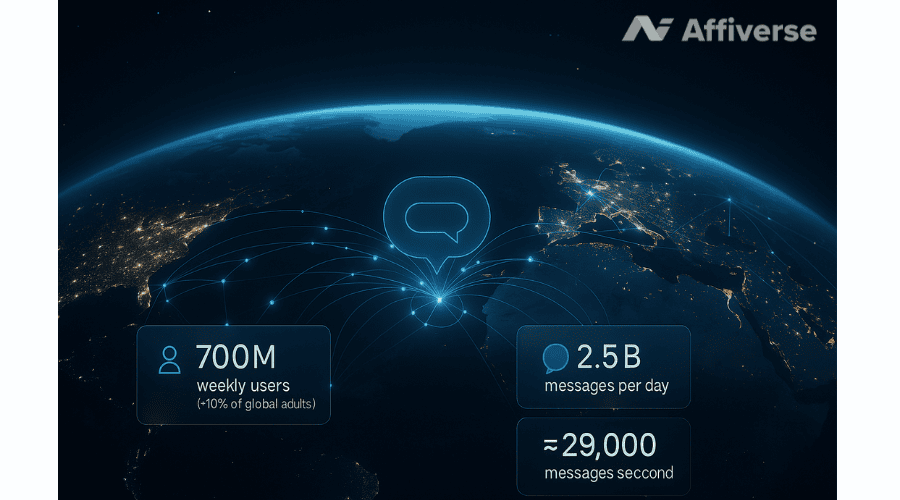
ChatGPT launched as a “research preview” in late 2022. Less than three years later, in July 2025, it has shattered all records for technology adoption. The platform now boasts over 700 million weekly active users, a staggering figure that represents nearly 10% of the world’s adult population. The sheer volume of use is breathtaking, with users sending more than 2.5 billion messages per day, or about 29,000 messages per second. But what’s truly captivating is what people are doing with all that power.
The Unexpected Truth About AI Usage
While many expected this powerful tool to be a workplace revolution, the data reveals a different story. The majority of consumer use is, in fact, not for work. As of July 2025, over 70% of consumer-level queries were unrelated to employment, a share that has grown dramatically from 53% just a year prior.
This suggests that the economic value of generative AI may extend far beyond professional productivity, having a massive impact on personal lives and “home production”. The study also hints at a staggering consumer surplus, with one paper estimating that U.S. users would need to be paid $98 to give up using generative AI for a month, implying a market value of at least $97 billion annually.
Beyond the Hype: What Are People Really Doing?
Forget what you’ve heard about AI being a coder’s tool or a digital therapist. The data shows that the primary use cases are surprisingly mundane, yet immensely powerful. The three most common topics— “Practical Guidance,” “Seeking Information,” and “Writing” —account for a combined 77% of all conversations.

Seeking Information is Exploding: While “Writing” and “Practical Guidance” are popular, “Seeking Information” is the fastest-growing category, increasing from 14% to 24% of all usage between July 2024 and July 2025. This highlights ChatGPT’s growing role as a powerful alternative to traditional search engines, providing customised, conversational answers.
The Writing Revolution Isn’t What You Think: “Writing” is the leading use case for work-related tasks. However, nearly two-thirds of these messages are not requests to write from scratch, but rather to edit, critique, or summarise existing text. This shows that professionals are using AI not as a replacement, but as an indispensable co-pilot for refining their own work.
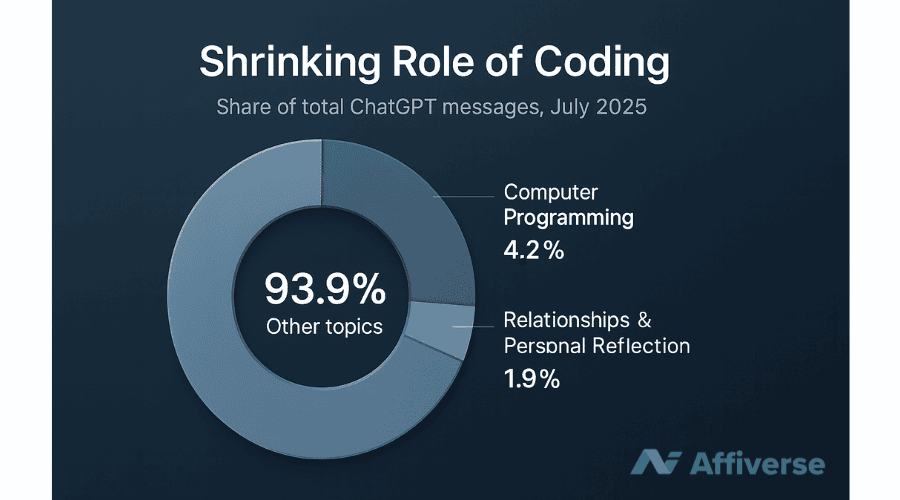
A Niche for Nurture: Contrary to popular belief, “Computer Programming” and “Relationships and Personal Reflection” make up a surprisingly small portion of messages, at just 4.2% and 1.9% respectively.
The Demographics of Disruption
The typical ChatGPT user is rapidly changing.
The Gender Gap is Closing: The early user base was disproportionately male, with about 80% of active users having typically masculine names in the first few months. However, that gap has narrowed dramatically, reaching near-parity by mid-2025, and now with a slight lean towards users with typically feminine names.
A Young and Global Audience: Nearly half of all messages (46%) sent by adults come from users under the age of 26. Furthermore, the fastest adoption growth is happening in low- and middle-income countries, suggesting a democratising effect for this technology.
Educated Users Lead the Way: Users with a bachelor’s degree or higher are significantly more likely to use ChatGPT for work. This trend highlights the technology’s immediate impact on knowledge-intensive jobs.
Marketing Industry Implications
Search & Discovery Disruption: With 24% of usage being “Seeking Information,” ChatGPT is becoming a significant search alternative. Traditional SEO and paid search strategies need adaptation.
Content Marketing Evolution: The dominance of “Practical Guidance” requests suggests consumers want personalised, actionable advice rather than generic content. Brands need more consultative approaches.
Customer Service Transformation: Users clearly prefer AI for information gathering and decision support, indicating potential for AI-powered customer interactions.
Affiliate Marketing Opportunities
Product Research & Recommendations: The 24% seeking information + practical guidance suggests users want purchasing advice. Affiliates could create AI-powered recommendation tools.
Educational Content: With 10.2% of messages being tutoring/teaching requests, there’s opportunity for educational affiliate content in various niches.
Writing & Content Tools: Given the prominence of writing assistance (editing, critiquing, creating), affiliates could promote AI writing tools, courses, or services.
Demographics-Specific Targeting:
- Focus on younger demographics (under 26) who represent nearly half of usage
- Target international markets showing rapid growth
Localisation Opportunities: Rapid growth in lower/middle-income countries suggests untapped affiliate markets with less competition.
Why LLM Citation Matters
Source Attribution: The paper shows ChatGPT users frequently seek “Seeking Information” (24% of usage) and “Practical Guidance” (29%). When LLMs provide this information, they increasingly cite sources, making citation a new traffic channel.
Authority Building: Being referenced by AI systems signals credibility and expertise to users who may never have discovered your content through traditional search.
Scale Amplification: With 2.5+ billion daily ChatGPT interactions, a single piece of well-cited content could reach exponentially more people than traditional organic reach.
Strategic Implications
Beyond Traditional SEO: While Google optimization remains important, content creators need to optimise for LLM training data and real-time retrieval systems. This means:
- Creating comprehensive, factual content that LLMs can confidently reference
- Building content depth rather than just keyword optimisation
Quality Over Quantity: LLMs tend to cite authoritative, well-researched content. The spray-and-pray content approach becomes less effective than creating definitive resources.
Real-Time Relevance: Unlike traditional SEO which can take months, LLM citation can happen immediately as systems access current web content for responses.
Practical Opportunities
Become the Definitive Source: Create the most comprehensive, accurate resource on specific topics in your niche. LLMs gravitate toward authoritative, complete information.
Structured Knowledge: Present information in clear, factual formats that LLMs can easily parse and cite – think data tables, step-by-step guides, and well-organised reference materials.
Citation Tracking: Monitor when your content gets referenced by various AI systems to understand what type of content gains traction.
Multi-Platform Strategy: Don’t just optimise for one LLM – different systems may have different citation preferences and training data sources.
The research suggests we’re moving toward an information ecosystem where being cited by AI systems becomes as valuable as ranking #1 on Google, potentially more so given the personalised, conversational nature of AI interactions.
ChatGPT usage snapshot — July 2025
Global reach & scale
- 700M weekly active users (~10% of global adults).
- Fastest global diffusion for a new technology.
- 2.5B messages/day (~29,000/sec).
What people are really doing
- Non-work messages: 70% (up from 53% in Jun 2024).
- Top topics (~80%): Practical Guidance • Seeking Information • Writing.
- Computer Programming: 4.2% of messages.
- Relationships & Personal Reflection: 1.9%.
- Education: 10.2% of all messages are tutoring or teaching requests, and 36% of Practical Guidance conversations are educational
Shifts in user intent
- Jul 2024: Asking 50% / Doing 50%.
- Jun 2025: Asking 51.6% (↑) • Doing 34.6% (↓).
Quality & preferences
- Good:Bad interaction ratio improved from ~3:1 (late 2024) to >4:1 (Jul 2025).
- Asking messages are rated higher quality than Doing or Expressing.
Who’s using it?
- Gender gap closed: Early months ~80% masculine first names; by Jun 2025 slightly more feminine.
- Youthquake: 46% of adult messages from users under 26.
- Global democratisation: Faster growth in low- and middle-income countries.
- Education & work: Users with a bachelor’s+ are much more likely to use ChatGPT for work.
Work Activities and Occupational Usage
Everflow
Connect
Tradedoubler
Connect
1win Partners
Connect
Shopnomix, a Nomix Group Company
Connect
Huffson Group
Connect
Kawaii Partners
Connect
Trackdesk
Connect
Share your expertise and expand your reach and become a content contributor with us today!
Contact Us To Find Out More