The $3.1 Billion Marathon: A Strategic Playbook for the 2026 World Cup Affiliate Manager
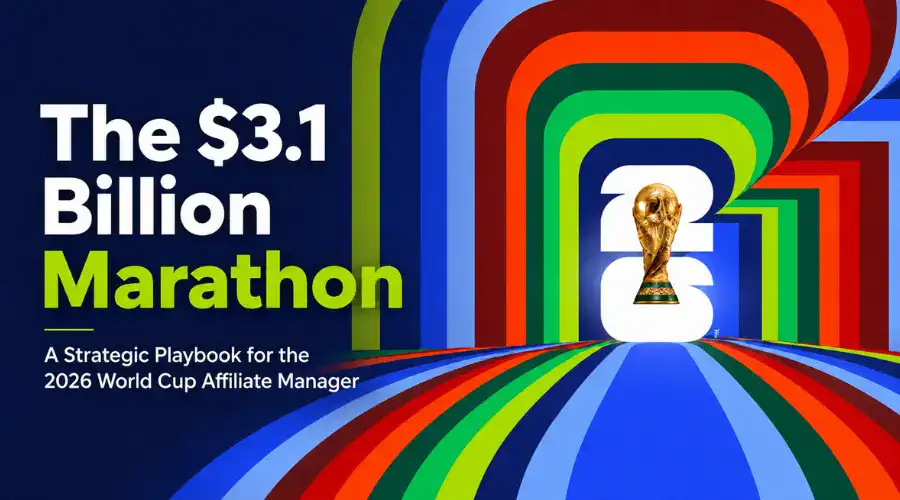
The 2026 World Cup changes the affiliate management playbook. With 48 teams, a 39-day schedule, and a projected $3.1 billion betting handle, generic partner support won’t hold. Affiliate managers will need to guide partners through AI search shifts, SEO volatility, higher media costs, and a North American market that demands sharper localization.
Key Takeaways: How Affiliate Managers Can Prepare Their Programs for Kickoff
- The Pivot to Value: Stop pushing partners toward thin schedule pages and basic match previews. Support niche country hubs, player-focused content, and betting angles that answer specific user intent.
- The Endurance Strategy: Treat the tournament like a 39-day campaign, not a short spike. Build incentives around group-stage waves, knockout rounds, semifinals, and final-week traffic.
- Tracking Precision: Media buyers will need clean data when CPCs jump. S2S postbacks, event-level tracking, and fast feedback loops can separate profitable spend from wasted budget.
- The AI and Reddit Factor: SEO won’t behave like it did in 2018 or 2022. Affiliate managers should help partners spread traffic across Reddit, YouTube, creator content, email, paid search, and owned communities.
Supporting the “Knowledgeable Bettor” with Better Partner Assets
The average World Cup bettor has changed. They don’t just search for fixtures, odds, and free bets. They compare markets, check lineups, understand player props, cards, shots, assists, corners, and bet builders. That creates a clear job for affiliate managers: give partners better raw material before the tournament starts.
Banners still matter, but they won’t carry a World Cup campaign on their own. Partners need country-specific landing pages, player prop angles, match-by-match bet builder ideas, team data, odds movement context, and creative assets that match real search demand.
Speaking during the 4th episode of Revpanda LIVE’s World Cup Series, Fraser Bricknell captured the shift well.
The average punter that’s going to be betting on the World Cup is so much more knowledgeable than they ever were, and people are looking for value now. And, obviously, the rise of player props, bet builders is going to be a completely different World Cup, which, in my opinion, is unlike anything we’ve ever seen before.
That sentence should make every affiliate manager rethink the asset folder. A “Brazil vs Germany” banner won’t help a partner win niche traffic. A hub that breaks down Brazil or Germany player shots, expected lineup changes, and bet builder combinations gives affiliates something they can actually use. Better still, it gives them angles that media buyers, SEO teams, and YouTube creators can repurpose quickly.
The strongest affiliate managers should prepare assets around the following:
- Country hubs for all 48 nations
- Player prop guides for high-profile squads
- Bet builder templates by match type
- Data snippets affiliates can quote in previews
- Market explainers for casual World Cup bettors
- Localized creatives for North America, LATAM, Europe, and key diaspora audiences
Affiliates don’t need another ZIP folder with generic creatives. They need campaign fuel, and the affiliate manager should be the person organizing it.
Managing the 39-Day Endurance Challenge
Qatar ran for 29 days. The 2026 World Cup stretches to 39. That 10-day difference matters. Budgets need more discipline. Content teams need more stamina. Affiliate managers need incentive structures that don’t burn through partner energy before the knockout rounds.
Marcin Kumiega put it plainly:
This event is the biggest, not in the decade, not the biggest World Cup, but in all history… the last one was, I think, the Qatar was twenty-nine days. This is thirty-nine days. So this alone makes the difference. So there will be this longer one, so you need to spread your resources from a media-buying perspective, your budget for a longer period.
That applies directly to affiliate management. A flat one-month promo won’t create enough movement. The tournament needs pacing. Affiliate managers should break the campaign into phases, each with its own incentive logic, content support, reporting cadence, and partner communication.
The group stage will bring volume. Plenty of matches. More countries. More casual traffic. Partners will chase breadth here, especially around national teams and accumulator-style content.
The knockout stage shifts the pressure. Search volume concentrates around fewer matches. Bettors become more selective, and media costs climb. Partners need better conversion assets, sharper offers, and faster operator-side reporting.
The final week becomes a different game again. Fewer fixtures, higher intent, and intense competition for rankings and paid clicks. Affiliate managers should reserve some of their strongest incentives for this window instead of spending everything during the opener.
A practical 39-day plan could look like this:
| Phase | Affiliate Manager Focus |
| Pre-tournament | Early content packs, team hubs, SEO briefs, registration offers, and tracking tests. |
| Group stage | High-volume acquisition pushes, country creatives, match calendars, and daily offer updates. |
| Round of 16 and quarterfinals | Higher CPA boosts, player prop assets, and market-specific landing pages. |
| Semifinals and final | Premium partner incentives, VIP bettor angles, retention pushes, and fast campaign reporting. |
Affiliate burnout kills performance, and so does operator silence. Affiliate managers should schedule partner check-ins, asset drops, and incentive updates before the tournament starts. The middle of peak traffic is the wrong time to improvise.
High-Precision Tracking for a High-CPC Market
Media buyers will face a brutal 2026 environment.
Marcin Kumiega expects CPC pressure to spike hard during peak moments:
Our estimate in volume is that CPC will grow around 40 to 80% during the peak moments.
That range changes the role of affiliate tracking. When clicks cost 40% to 80% more, delayed reporting creates real damage. Partners can’t wait days to understand which creative, keyword, subreddit, YouTube placement, or landing page produced funded accounts. They need faster signals.
Affiliate managers should prioritize S2S postbacks, clean conversion events, and transparent reporting. Moving beyond legacy frameworks is crucial as programs seek new affiliate tracking standards to resolve complex multi-touch attribution dilemmas. Pixel-only setups won’t satisfy serious buyers. Neither will vague dashboard numbers that hide registration quality, first deposit behavior, or GEO-level differences.
The best partners will ask direct questions:
- Can I track registrations and FTDs by campaign ID?
- Can I split performance by source?
- Can I pass sub IDs cleanly?
- Can I measure Reddit, YouTube, TikTok, paid search, and newsletter traffic separately?
- Can I see which GEOs convert after the first deposit?
Affiliate managers who can answer “yes” will have a stronger commercial argument. Those who hesitate may lose budget to programs with cleaner tracking, faster feedback, and better partner visibility.
SEO adds another layer of pressure. John Wright explained why affiliates need more than rankings this time:
SEO has become really unstable in the last two years. So there’s been a ton of planning, and I think the thing that’s kind of like the mystery box right now is AI and agents have got super strong in the last year. That’s changing everyone’s strategy.
That instability pushes affiliates toward mixed traffic models: paid SEO, Reddit threads, YouTube explainers, AI-search-friendly pages, comparison content, Discord communities, email lists, and creator-led match previews. The affiliate manager has to support that shift.
That means giving partners tracking tools that work outside traditional SEO. A Reddit media buyer doesn’t optimize like a blog publisher. A YouTube creator needs different landing pages from a paid search specialist. An email partner may care more about retention offers than registration volume. One dashboard can serve them all only when it captures clean source data.
Capitalizing on the $3.1 Billion North American Shift
The 2026 World Cup takes place across the United States, Canada, and Mexico. That geography changes betting demand, media competition, and localization needs.
Marcin Kumiega highlighted the scale of the betting shift:
In Qatar, it was $1,800,000,000 average value of the betting budgets. Here, it’ll be $3,100,000,000. So it’s 40% more. So there’s nothing to capture. The US is now much more open to betting.
That projected $3.1 billion handle won’t spread evenly across every affiliate funnel. US and Canadian traffic needs localized routing: state-by-state rules, payment expectations, sportsbook availability, odds formats, responsible gambling language, and bonus terms all need careful handling.
This is where affiliate managers can add real value. A partner may understand traffic, but the program should help them avoid lazy North American targeting. “US World Cup betting” works as a top-level theme, but campaigns need much tighter execution.
Think in layers:
- US state pages where betting access exists
- Canada-focused pages with provincial context
- Mexico-focused Spanish-language assets
- Team USA, Canada, and Mexico betting hubs
- Latino audience targeting across US markets
- Diaspora content for nations with strong North American communities
- Local payment and registration guidance
- Mobile-first funnels for match-day traffic
The 48-team format also opens more long-tail country traffic. Smaller nations can bring passionate audiences, especially when the tournament sits closer to home. Affiliate managers should help partners identify these pockets early.
Generic “best World Cup betting sites” content will attract brutal competition. A Costa Rica player prop hub, a Canada group-stage betting guide, or a Mexico match-day offer page may convert better with less noise. That’s where strong affiliate managers can help partners find market gaps before everyone else chases the same keywords.
Affiverse’s Take: The 2026 World Cup Will Test Affiliate Managers Before It Tests Affiliates
Affiliate programs don’t need to guess what 2026 demands will be. The pressure points already look clear: more teams, a longer tournament, higher CPCs, unstable SEO, and a larger North American betting market.
But the real test sits with affiliate managers. Affiliates can build pages, run traffic, test creatives, and chase rankings. They can’t do that properly if the program gives them weak assets, slow reporting, unclear GEO rules, generic incentives, and no campaign structure. That is why programs must transition toward comprehensive affiliate enablement guides and resources that treat publishers as strategic allies rather than generic vendors.
Before the campaign calendar locks, affiliate managers should audit whether their creative assets cover all 48 nations, whether their tracking can support Reddit, YouTube, and paid media buyers through S2S postbacks, and whether their incentive plan can last the full 39-day tournament window. They should also check if partners can access granular player prop and bet builder data before traffic peaks.
Affiverse’s view is simple: the programs that win won’t just hand affiliates links. They’ll give partners timing, data, localized assets, clean tracking, and enough campaign structure to survive 39 days of noise. The first match won’t forgive a messy setup.
Everflow
Connect
Tradedoubler
Connect
1win Partners
Connect
PIN-UP Partners
Connect
Shopnomix, a Nomix Group Company
Connect
V.Partners
Connect
Huffson Group
Connect
Kawaii Partners
Connect
Share your expertise and expand your reach and become a content contributor with us today!
Contact Us To Find Out More