Walmart Extends Shopper Data to Spotify, CTV, and Live TV
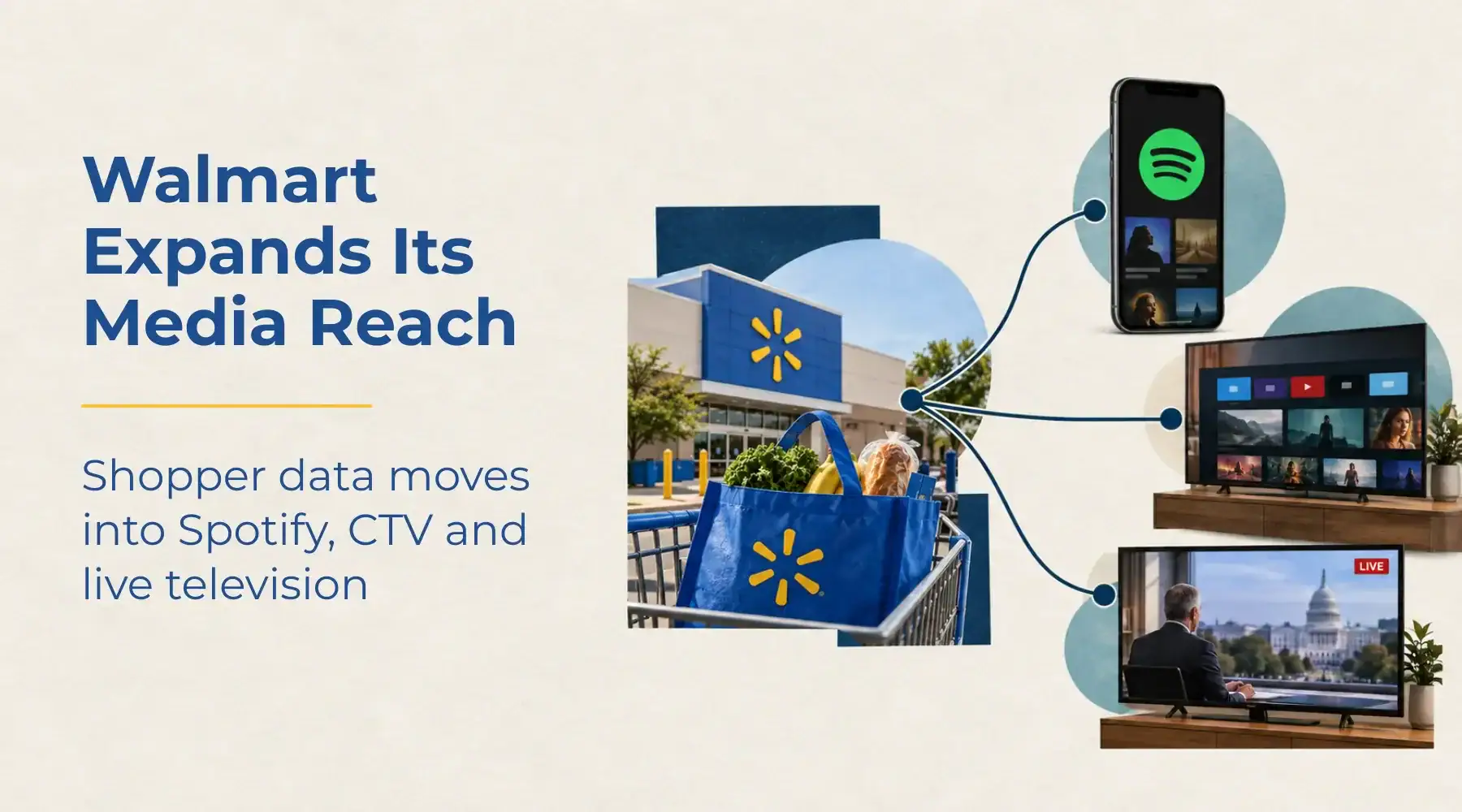
Walmart is extending its shopper audiences and sales measurement across Spotify, connected television, and selected live television inventory.
The Walmart Connect expansion gives US advertisers more ways to use the retailer’s customer signals outside Walmart-owned properties. It also brings retail-media measurement into environments that may already contain affiliate, creator, and other paid-media activity, raising questions about how competing systems divide credit for a sale.
Key Takeaways: Walmart Moves Retail Media Across More Screens
- US advertisers can access Walmart audiences and closed-loop measurement across Spotify audio, video, and display ads.
- The Spotify inventory will be purchased through Walmart DSP.
- Walmart’s integration with Yahoo DSP is moving from a proof of concept into alpha testing.
- The Yahoo DSP integration is expanding beyond VIZIO to connected-TV inventory from more publishers.
- Walmart audiences can now be used across selected live linear television inventory.
- A Hidden Valley Ranch test produced reported improvements in reach, media cost, add-to-cart activity, and brand lift.
- Walmart has not explained how its retail-media attribution will be reconciled with affiliate, creator, or other external conversion claims.
Walmart Connect Moves Beyond Retailer-Owned Media
The new capabilities were announced at Walmart Connect’s Partner Connect event.
In its official media expansion announcement, Walmart said advertisers want to use commerce data across more of their media investment without adopting separate buying and reporting systems for every channel.
The three developments differ in how advertisers access the inventory and how far each has progressed:
| Channel | Buying Route | What Walmart Is Adding | Rollout Stage |
|---|---|---|---|
| Spotify | Walmart DSP | Walmart audience targeting and sales measurement across audio, video, and display | Available to US advertisers |
| Connected TV | Yahoo DSP, supported by Magnite | Walmart audiences and measurement across VIZIO and additional publisher inventory | Alpha |
| Live television | Private marketplace deals through Walmart DSP | Addressable targeting and Walmart sales measurement across selected streaming and linear inventory | Available through selected deals |
These arrangements take the retail-media model beyond sponsored listings and display advertising on a retailer’s website. Walmart’s customer data can now influence which audiences see advertising while they listen to music, watch streaming services, or view live television.
Spotify Campaigns Can Be Connected With Walmart Sales
The Spotify partnership covers audio, video, and display advertising purchased through Walmart DSP.
Advertisers can use Walmart audiences to reach existing or prospective customers on Spotify and then assess whether exposed audiences purchased relevant products through Walmart.
This does not turn Spotify advertisements into directly shoppable affiliate placements. Instead, Walmart is connecting media exposure with purchase information available through its own commerce systems.
The difference matters. Closed-loop reporting can show that an exposed customer later bought from Walmart, but the available announcement does not explain which attribution windows will be applied or how other interactions in the customer journey will be weighted.
A shopper could hear a Spotify ad, watch a creator review, visit an affiliate publisher, and later purchase through Walmart. Each participating platform may hold a different part of that journey.
Yahoo DSP Integration Expands Across Connected TV
Walmart is also expanding a proof of concept developed with Yahoo DSP and Magnite.
The initial arrangement allowed advertisers to activate Walmart audiences across VIZIO connected-TV inventory. It will now move into alpha testing and include inventory from more publishers.
Walmart cited a Hidden Valley Ranch campaign as an early example. According to the company, the test delivered:
- 55% incremental reach beyond linear television
- 27% lower cost per thousand impressions
- A 26% increase in add-to-cart activity
- 3% brand lift
These figures should not be treated as general performance benchmarks. Walmart’s footnotes show that reach, cost, add-to-cart activity, and brand lift were assessed using different providers and data comparisons. Results will also depend on the audience, inventory, product, and campaign design.
Live television is becoming part of the same model. Advertisers can now access selected linear inventory across TBS, TLC, truTV, HLN, and Food Network through private marketplace deals in Walmart DSP. The package combines streaming and linear inventory, with FreeWheel supporting the programmatic delivery.
Walmart Is Building a Unified Measurement View
Walmart is positioning consistent sales measurement as one of the main benefits of extending its data across media channels.
However, its own Partner Connect recap acknowledges the challenge:
More measurement doesn’t necessarily mean better measurement.
Walmart says it is developing unified attribution, incrementality analysis, and data feeds that bring its commerce signals into advertisers’ existing tools. These systems are intended to help advertisers understand how exposure across different channels contributes to Walmart sales.
The announcements do not explain the attribution windows being used or how Walmart will reconcile its reporting with conversions recorded by external affiliate and creator platforms.
Closed-Loop Measurement Does Not Settle Affiliate Credit
Walmart’s closed-loop measurement connects advertising exposure with subsequent purchases made online or in its stores. It can show that an exposed customer later bought a product, but it does not automatically prove that the advertisement caused the sale.
Walmart treats attribution and incrementality as separate measures. Attribution associates a purchase with an advertisement using defined rules, while incrementality estimates what the campaign produced beyond sales that may have occurred anyway.
An affiliate or creator platform may also record the same order as commissionable after a qualifying click, tracked code or another approved interaction. Retail-media reporting and partner tracking therefore answer different questions: one assesses campaign performance, while the other determines eligibility for payment.
As discussed in Affiverse’s guide to retail media networks and affiliate marketing, performance teams should compare these records rather than treat either as the complete customer journey. Attribution windows, exposure criteria, new-to-brand definitions, sales coverage and partner-crediting rules should be documented before results are combined.
Everflow
Connect
Tradedoubler
Connect
1win Partners
Connect
PIN-UP Partners
Connect
Shopnomix, a Nomix Group Company
Connect
V.Partners
Connect
Huffson Group
Connect
Kawaii Partners
Connect
Share your expertise and expand your reach and become a content contributor with us today!
Contact Us To Find Out More