Roblox Opens Restricted Ad Access for Under-13 Audiences
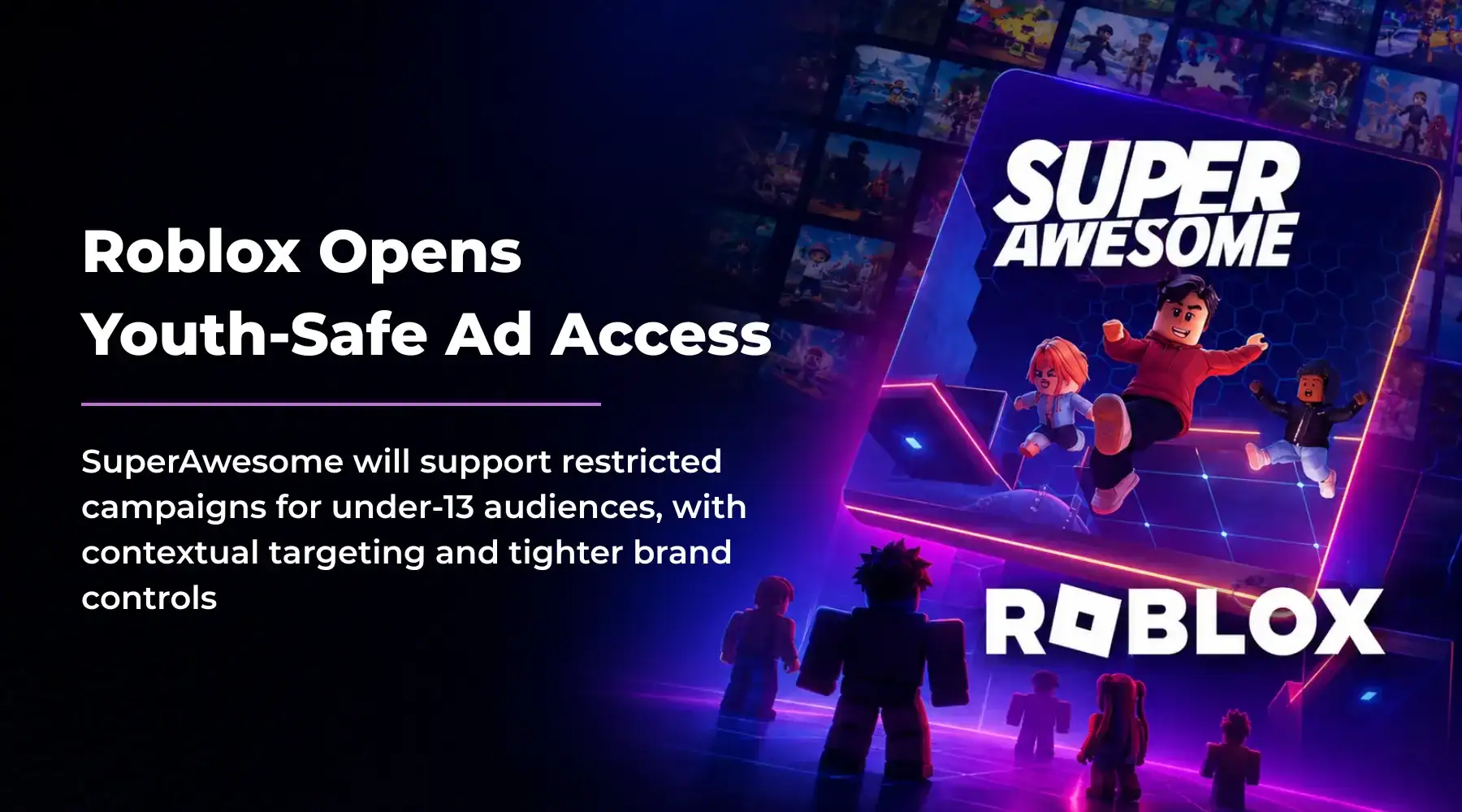
Roblox has opened a new advertising route for brands that want to reach under-13 users, with SuperAwesome named as its exclusive third-party partner for that audience.
The move gives advertisers access to a younger Roblox audience through controlled, contextual ad placements. It also puts stricter rules around how brands enter that space. Under-13 ads won’t run through open programmatic buying, and Roblox’s Advertising Standards say ads can’t be personalized for users under 18.
Key Takeaways: Roblox Adds a Controlled Route for Youth-Safe Advertising
- Roblox has partnered with SuperAwesome for under-13 advertising.
- SuperAwesome will act as Roblox’s exclusive third-party vendor for this audience.
- Ads for users under 18 can’t use personalization under Roblox’s advertising standards.
- Under-13 campaigns will lean on contextual targeting rather than one-to-one behavioral targeting.
- Roblox’s rules prohibit several ad categories, including real-money gambling, sports betting, alcohol, tobacco, political content, and financial services.
Roblox Brings SuperAwesome Into Its Under-13 Ad Setup
SuperAwesome announced the Roblox partnership as a way to bring brand-safe advertising to Gen Alpha audiences. The company also said it will work with Roblox on Blox Aware, a training program for brands entering immersive gaming environments. That program will cover Roblox-specific ad standards, safety protocols, and responsible content practices.
Kate O’Loughlin, CEO of SuperAwesome, said:
We believe in powering a better internet for the next generation wherever they are, and they’ve decisively chosen Roblox as their platform for entertainment, play, and building their fandoms. Together, we have the opportunity to help brands engage with kids and tweens responsibly and transparently, while funding high-quality content and supporting creators with improved ad revenue. We’re proud to be selected as Roblox’s trusted partner to deliver this through our leading intelligence products.
Roblox doesn’t work like a standard social feed. Brands don’t just buy around posts or videos. They enter a world built from user-created games, branded spaces, avatar behavior, social play, and in-game discovery. SuperAwesome’s role sits in that gap. It gives Roblox a partner focused on youth advertising controls, while brands get a clearer path into a platform where younger audiences already spend time.
What Makes This Different From Standard Programmatic Ads
The biggest detail for performance marketers: under-13 advertising on Roblox won’t work like normal programmatic media.
| Area | Standard Programmatic Ads | Roblox Under-13 Ads |
|---|---|---|
| Buying model | Often bought through automated platforms and open exchanges | Sold through direct deals |
| Targeting | Can use behavioral signals, audience segments, and retargeting | Relies mainly on contextual targeting |
| Personalization | Often tailored to individual users | No one-to-one personalized targeting for this audience |
| Data use | Can involve user-level signals, depending on the platform and rules | No collection of behavioral data for targeting |
| Scale | Built for broad reach and automation | More controlled and limited |
| Best fit | Performance campaigns, retargeting, conversion-led activity | Awareness, brand familiarity, product launches, and youth-safe brand presence |
That trade-off matters. Advertisers get access to Roblox’s younger audience, but they don’t get the usual performance stack: behavioral segments, retargeting, deep personalization, and open-market buying. That changes how brands should judge the channel. Roblox under-13 ads may support awareness, brand familiarity, entertainment campaigns, and youth-safe brand presence. Direct-response expectations need more restraint.
Roblox’s Advertising Standards Put Clear Limits on Brands
Roblox’s official Advertising Standards put responsibility on advertisers to follow Roblox policies and applicable laws. The rules also say ads can’t be personalized for users under 18. For brands, the main limits fall into three areas:
1. Targeting Limits: Roblox does not allow personalized ads for users under 18. That means brands can’t rely on individual behavioral targeting for younger users.
2. Creative Limits: Ads aimed at under-18 users need clear disclosures. They also can’t suggest that a product gives users special skills, higher status, popularity, or better performance. Roblox also blocks ads that mimic system buttons, notifications, or platform functions.
3. Category Limits: Some sectors don’t fit this inventory at all. Roblox prohibits ads for real-money gambling, online gambling, sports betting, alcohol, tobacco, cannabis, political content, certain financial products, weapons, and several other categories.
Why Brands Will Still Pay Attention
Roblox gives brands something many channels struggle to offer: attention inside active digital play. That doesn’t mean every brand should rush in. A poorly matched campaign could look intrusive fast. Youth audiences also raise the stakes around disclosures, creative tone, and product fit.
Still, the commercial logic makes sense for certain brands. Entertainment, toys, gaming, family travel, youth fashion, and selected consumer products may see Roblox as a way to reach younger audiences in a controlled space. The platform also separates this ad product from branded Roblox experiences and virtual worlds, which remain a different commercial offering.
That split matters. A brand can buy media around Roblox experiences, build a branded world, work with creators, or combine those pieces. Each route carries different costs, risks, and measurement limits.
What Affiliate and Creator Teams Should Watch
Affiliate teams probably won’t treat Roblox under-13 ads as a classic partner channel. The restrictions point somewhere else. This is more useful as a signal.
Gaming platforms keep turning community attention into formal media products. Minecraft recently launched its first affiliate program with impact.com, giving approved partners tracked links, dashboards, and commission-based rewards for eligible Marketplace products. Roblox now adds a more controlled ad route for younger audiences. Different model. Same wider pattern: gaming platforms want more structure around commercial activity.
Creator teams should watch this, too. Roblox already hosts branded experiences and community-led discovery. As more platforms build official commercial routes, brands may need to compare official placements, managed creator campaigns, branded worlds, and wider gaming platform monetization opportunities before choosing where to spend.
The safest answer depends on the audience. For under-13 users, brand trust matters more than clever targeting.
Affiverse Take: Youth Media Needs Control Before Scale
Roblox’s under-13 ad expansion gives marketers a useful reminder: access doesn’t equal freedom. The platform and SuperAwesome have created a route for brands to reach younger users, but the controls shape the product. No one-to-one personalization. Direct sales. Contextual targeting. Category limits. Clearer disclosures. That makes Roblox interesting but also narrow. Brands that treat it like another performance channel may miss the point. The better use case starts with safety, fit, and creative restraint.
For performance marketers, the lesson travels beyond Roblox. Gaming audiences can turn into media inventory, affiliate programs, creator partnerships, or branded worlds. But when younger users sit inside that audience, the channel has to earn trust before it asks for budget.
Everflow
Connect
Tradedoubler
Connect
1win Partners
Connect
PIN-UP Partners
Connect
Shopnomix, a Nomix Group Company
Connect
V.Partners
Connect
Huffson Group
Connect
Kawaii Partners
Connect
Share your expertise and expand your reach and become a content contributor with us today!
Contact Us To Find Out More