Instagram Lets Brands Add Tagged UGC to Their Profile Grid
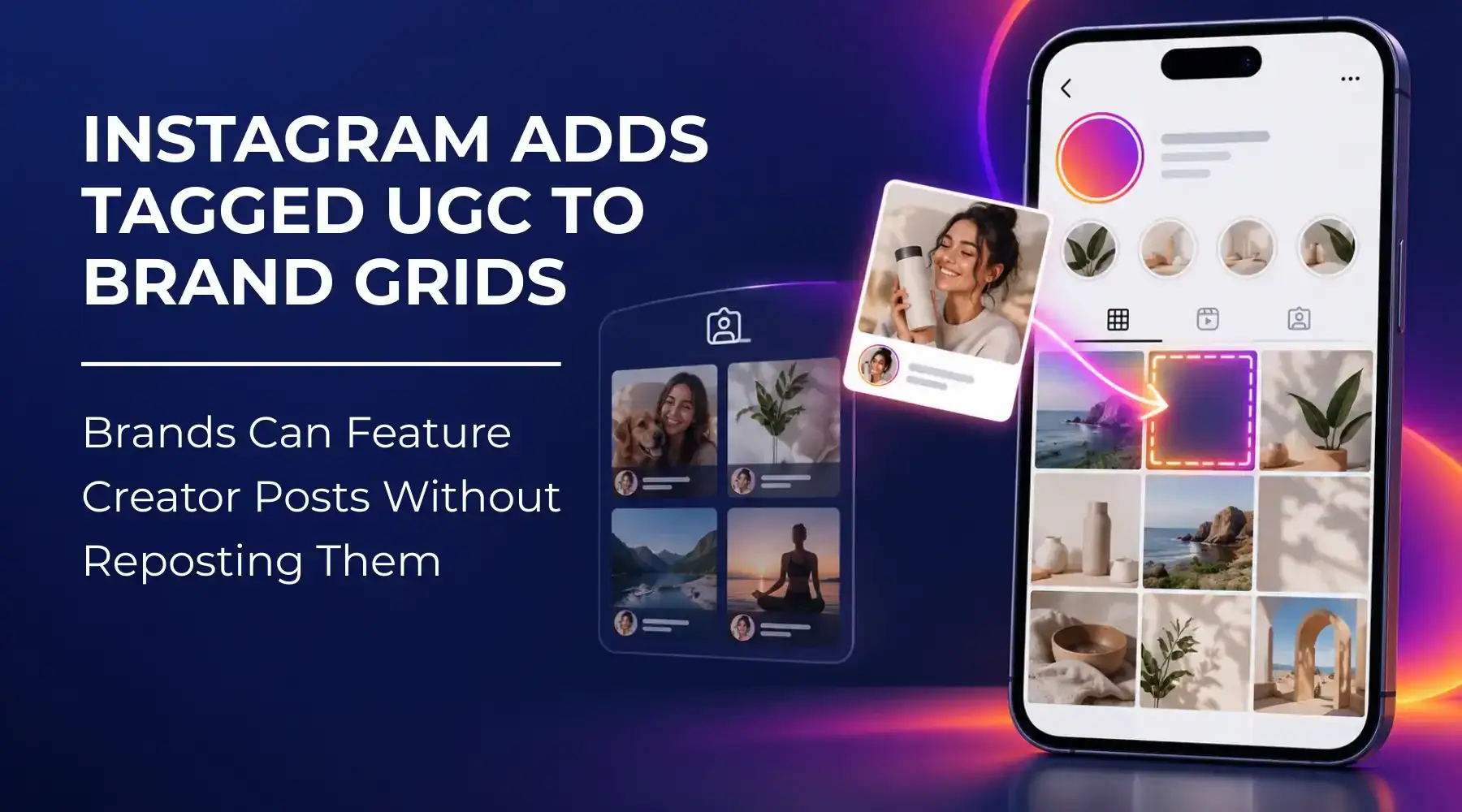
Instagram is rolling out an “Add to Grid” feature that allows users and businesses to place posts they are tagged in directly on their main profile grid. The change gives brands a simpler way to feature customer photos, creator campaigns and other user-generated content without downloading and reposting the original material. However, adding a post to a profile does not turn it into a Collab post, transfer ownership or provide permission to use the content in advertising.
Key Takeaways: Instagram Adds Tagged Posts to Profile Grids
- Instagram began rolling out Add to Grid on September 10.
- Users can place tagged photos and videos on their main profile without creating a duplicate post.
- The original creator remains identified as the author.
- The post continues to follow the original account’s privacy settings.
- Removing it from the grid does not delete the original post or remove the tag.
- Add to Grid does not create a Collab post or automatically distribute the content to both audiences.
- Brands still need appropriate permission before reusing creator content elsewhere or turning it into advertising.
- Instagram has not published performance data for the new placement.
How Instagram’s Add to Grid Feature Works
Instagram Head Adam Mosseri announced the rollout in a Reel, describing it as a “small thing” intended to give users greater control over their profiles.
When an account is tagged in a photo or video, it can now choose to display that post on its main grid rather than leaving it only inside the separate Tagged tab.
The option may appear in the notification sent when the account is tagged, in the post’s menu or when the user presses and holds the content inside their Tagged tab.
The original creator remains responsible for the post. Adding it to another grid does not allow the tagged account to change the caption, edit the media or delete the original upload.
The post can also be removed from the main grid without being deleted or untagged. As Instagram is introducing the feature gradually, availability may differ between accounts and regions during the rollout.
Add to Grid Is Different From an Instagram Collab
The distinction matters because the two features provide different levels of visibility and control.
| Feature | Where the Post Appears | Who Is Identified as the Author | What It Changes |
|---|---|---|---|
| Regular tag | Original profile and the tagged account’s Tagged tab | Original poster | Gives credit or identifies another account |
| Add to Grid | Original profile and the tagged account’s main grid | Original poster | Makes tagged content more prominent on a profile |
| Collab post | Main grids of the original poster and accepted collaborators | Multiple accounts as co-authors | Combines the post’s presentation and engagement across participating profiles |
| Partnership ad | Paid Meta placements | Creator and business partner | Allows approved creator content to receive paid distribution |
Add to Grid is primarily a profile-curation feature. Instagram has not said that placing a tagged post on a brand’s grid will automatically redistribute it to the brand’s followers in the way an accepted Collab post can.
Brands should therefore avoid treating it as a substitute for a Collab campaign or paid amplification.
Brands Can Curate UGC Without Reposting It
The most practical opportunity is the ability to identify useful customer or creator content after it has been published and give it a more visible position on the brand’s profile.
A retailer could feature a customer wearing one of its products, while a travel company could place a tagged visitor video alongside its own destination content. Because the original upload remains intact, viewers can still see who created it and inspect its caption.
This may offer a cleaner form of social proof than downloading somebody else’s content and publishing it through the brand account. It preserves the original source and avoids creating a second post with a separate set of engagement figures.
However, brands will still be making an editorial choice about which customer experiences they feature. A curated grid should not be presented as representative of all customer feedback when it contains only favorable posts.
Instagram has also provided no evidence that adding tagged content increases reach, engagement or sales. The feature may strengthen a profile’s presentation, but commercial impact will need to be measured separately.
Visibility Does Not Replace Permission or Disclosure
Displaying a tagged post is not the same as receiving unrestricted rights to the content.
If a brand wants to edit the material, publish it on another channel or use it in advertising, it should agree those rights with the creator. Instagram’s own copyright guidance recommends obtaining written permission before publishing content created by somebody else.
The distinction should also be reflected in creator agreements. Production, organic publication, profile visibility and paid-media usage are separate forms of value. As Affiverse’s analysis of creator pricing and hybrid campaigns explains, usage rights should not be assumed to be included in a basic posting fee.
Commercial disclosures remain necessary when the original post resulted from payment, a gifted product, affiliate commission or another material connection. Meta requires its paid partnership label for branded content, while the FTC advises creators and advertisers to make those relationships clear.
Adding an existing post to a brand’s grid does not correct a missing disclosure in the original content.
What Affiliate and Performance Teams Should Track
Add to Grid could help brands give successful creator and affiliate posts a longer life on their profiles, but it does not introduce a new commission or attribution system.
Instagram’s existing affiliate links for Reels can connect eligible creator content with tracked purchases. Simply displaying that Reel on a brand’s grid does not change the affiliate agreement, commission rate or attribution window attached to it.
Teams testing the feature should record the post’s performance before it is added to the brand grid, then monitor changes in profile visits, content engagement, product clicks and attributed purchases. Without that baseline, activity generated by the original creator may be confused with any additional value created by the brand placement.
Add to Grid makes tagged UGC easier to display and keeps the original creator visible. Its value lies in curation and social proof, not automatic content ownership, paid distribution or sales attribution.
Everflow
Connect
Tradedoubler
Connect
1win Partners
Connect
PIN-UP Partners
Connect
Shopnomix, a Nomix Group Company
Connect
V.Partners
Connect
Huffson Group
Connect
Kawaii Partners
Connect
Share your expertise and expand your reach and become a content contributor with us today!
Contact Us To Find Out More