Impact.com Removes Honey Paypal, from Platform Following Attribution Investigation

Network CEO, David Yovanno announced suspension of Honey browser extension due to violated platform policies as industry continues it’s debate on attribution integrity
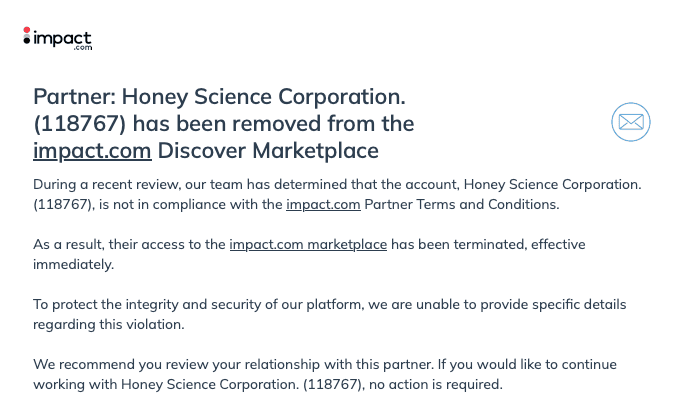
Impact.com issued a statement and removed PayPal’s Honey browser extension from its Discovery Marketplace as it temporarily suspended the affiliate account following what CEO David Yovanno described as a “thorough investigation” that uncovered policy violations related to attribution manipulation.
The action, announced via email to partners on January 16, marks the most significant enforcement response yet to mounting concerns about browser extension practices that have dominated industry conversations since a viral YouTube exposé in late December triggered widespread scrutiny of affiliate attribution integrity.
Platform Enforcement and Technical Safeguards
According to Yovanno’s statement, Impact.com determined that Honey violated the network’s universal stand-down requirements, policies designed to prevent attribution interference and ensure partners receive credit based on genuine contribution to transactions. The platform has temporarily suspended Honey’s account “while we confirm they’ve made the necessary changes to comply with our terms and conditions.”
Beyond individual enforcement, Impact.com announced plans to release a software update that will “programmatically prevent the type of attribution manipulation we’ve uncovered during our investigation.” This technical intervention suggests the platform is moving beyond reactive enforcement toward systemic protections against similar practices.
The announcement comes as PayPal issued its own response to the controversy, with Hello Partner reporting that the payments giant defended Honey’s practices while acknowledging recent removal from Rakuten Advertising’s network. PayPal’s statement attempted to clarify Honey’s attribution methodology amid allegations that the extension manipulates last-click attribution by injecting tracking codes even when users haven’t actively engaged with Honey’s coupon offerings.
Industry Reckoning at Affiliate Summit West
The timing of Impact.com’s announcement coincided with Affiliate Summit West in Las Vegas, where the Honey controversy dominated hallway conversations and formal sessions as Rakuten made the first move to suspend their partnership with this publisher. According to multiple attendees, affiliate networks used the gathering to signal stronger enforcement stances on attribution, publisher integrity and several platforms reportedly reviewing their policies on browser extensions and cookie-stuffing practices and monitoring stances.
Industry sources at the event indicated that networks are facing pressure from both brands and legitimate publishers who argue that attribution manipulation undermines the performance-based economics that differentiate affiliate marketing from other digital channels. Program managers expressed concern that tolerating questionable attribution practices erodes advertiser trust and threatens budget allocations.
The broader debate extends beyond Honey specifically to systemic questions about browser extension business models and whether platforms have adequate technical controls to prevent attribution interference. Several affiliate managers told colleagues at ASW that they’re conducting audits of their publisher rosters to identify extensions employing similar practices.
What This Means for Affiliate Program Managers
This network action and best practice enforcement creates immediate operational considerations for brands running affiliate programs across multiple networks. Program managers should prioritise several tactical responses:
Conduct a comprehensive audit of browser extension partners across all affiliate networks. Review not just current performance data but attribution patterns for irregularities, particularly instances where extensions receive credit for transactions with no documented user interaction. Compare conversion rates and average order values for extension partners against your program baseline to identify potential attribution manipulation.
Verify that your network contracts include explicit stand-down provisions and attribution integrity requirements. Impact.com’s universal stand-down policy prohibits partners from overwriting existing affiliate cookies, but enforcement varies across platforms. Program managers should confirm their networks maintain similar policies and demonstrate willingness to enforce them.
Consider implementing supplemental tracking verification beyond standard affiliate cookies. Some brands are exploring first-party tracking data, post-transaction surveys, or multi-touch attribution models that provide visibility into the customer journey beyond last-click mechanics. While these approaches add complexity, they offer protection against attribution manipulation that exploits cookie-based tracking limitations.
The incident also highlights the value of direct publisher relationships and diversified partnership strategies. Programs overly dependent on browser extensions face heightened risk from both attribution issues and potential platform enforcement actions. Building relationships with content publishers, loyalty platforms, and creator partnerships provides attribution diversity and reduces exposure to any single partner type.
Attribution Integrity as Competitive Advantage
Beyond immediate compliance concerns, this controversy presents an opportunity for affiliate programs to differentiate through transparent attribution practices and publisher quality standards. Brands that proactively communicate their commitment to fair attribution and enforce rigorous partner standards can attract high-quality publishers who’ve grown frustrated competing against questionable extension practices.
Several program managers at ASW indicated they’re reviewing commission structures to ensure legitimate publishers driving genuine consumer value receive appropriate compensation relative to partners capturing transactions through attribution manipulation. This may involve implementing tiered commission structures that reward different partnership types based on documented consumer engagement.
The technical update Impact.com plans to release could establish new industry standards for programmatic attribution protection. Program managers should monitor whether other networks implement similar safeguards and consider platform capabilities around attribution integrity when evaluating network partnerships.
As networks signal stronger enforcement and technical protections, the competitive landscape for browser extensions will likely shift. Extensions demonstrating genuine consumer value through price discovery and shopping assistance may distinguish themselves from those primarily optimizing for attribution capture. Program managers should assess extension partners based on user engagement metrics and documented value delivery rather than solely transaction volume.
Key Takeaways:
Impact.com’s removal of Honey and planned technical safeguards signal that major affiliate networks are moving from reactive enforcement to systemic attribution protection, creating new compliance best practices and setting hard line expectations for all partners to behave responsibly.
Program managers should immediately audit browser extension partners across all networks, reviewing attribution patterns for irregularities and verifying that network contracts include robust stand-down provisions with demonstrated enforcement.
This controversy accelerates the industry shift toward attribution transparency and publisher quality standards, presenting opportunities for programs to differentiate through rigorous partner vetting and diversified partnership strategies that reduce dependence on any single channel or partner type.

Everflow
Connect
Tradedoubler
Connect
1win Partners
Connect
PIN-UP Partners
Connect
Shopnomix, a Nomix Group Company
Connect
V.Partners
Connect
Huffson Group
Connect
Kawaii Partners
Connect
Share your expertise and expand your reach and become a content contributor with us today!
Contact Us To Find Out More