Amazon vs Perplexity: The Court Ruling that Just Put Agentic Commerce on Trial
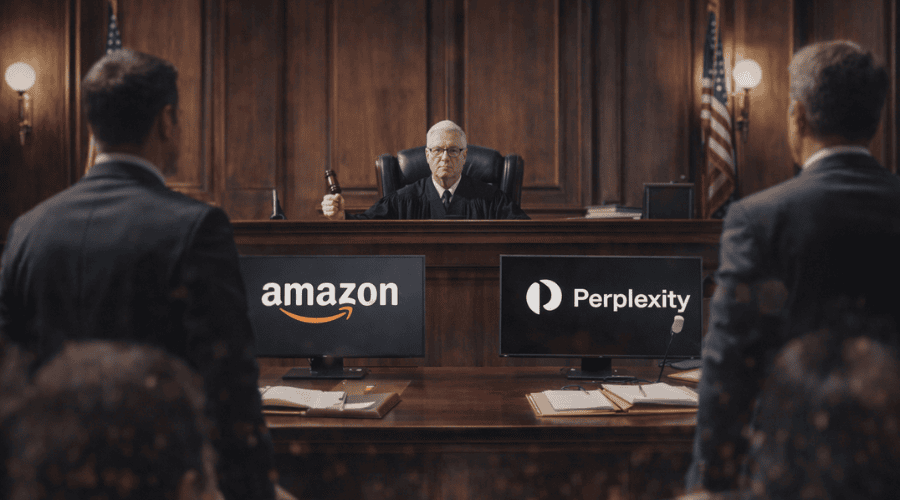
A federal judge in San Francisco handed down a ruling this week that, on the surface, is about one AI startup and one retailer. Underneath, it is about the entire economic architecture of AI-driven commerce and whether affiliate attribution survives it.
On March 10, U.S. District Judge Maxine Chesney granted Amazon’s request for a preliminary injunction blocking Perplexity’s Comet browser agent from accessing Amazon’s systems. Perplexity filed an emergency appeal to the 9th Circuit Court of Appeals on March 13, asking for the order to be lifted while the full case continues. As of today, the 9th Circuit has not yet ruled.
The details of the dispute are specific. The implications for affiliate marketing are not.
What happened
Amazon filed suit against Perplexity in November 2025, accusing the company of computer fraud. The allegation was not that Comet was stealing data in the conventional sense. It was that Perplexity’s browser agent was disguising itself as a standard Google Chrome session to access Amazon’s systems, including password-protected Prime accounts, without Amazon’s authorisation, even while acting on a user’s explicit instruction.
Amazon said it had warned Perplexity to stop at least five times starting in November 2024. When it deployed a technical block in August 2025 to prevent Comet’s access, Perplexity issued a software update within 24 hours to circumvent it. Amazon then sued.
Judge Chesney’s ruling found that Amazon is likely to succeed on the merits of its claims under the federal Computer Fraud and Abuse Act and a California computer fraud statute. Her key finding, the one that matters well beyond this specific case, is this: Comet accessed Amazon accounts “with the Amazon user’s permission, but without authorization by Amazon.”
User permission and platform authorisation are, in this court’s view, two separate legal requirements. A shopper giving Comet their Amazon login credentials does not automatically give Comet the right to use those credentials on Amazon’s platform.
Perplexity’s position is that this reading is wrong. In its emergency appeal, the company argues that the Computer Fraud and Abuse Act should not apply to a publicly accessible website, and that the only relevant access to Amazon’s servers was by the users of the Comet browser themselves, not by Perplexity.
Why Amazon is really doing this
Perplexity has been direct about what it believes is motivating the lawsuit. In its own legal filings, it argued that Amazon’s real concern is not cybersecurity but competitive control. Specifically: AI agents bypass the advertising Amazon shows to human shoppers.
That argument has more weight than Amazon’s public statements acknowledge. Amazon told the court that when AI systems generate ad traffic, impressions have to be detected and filtered out before advertisers can be billed. Developing new detection mechanisms to handle this required engineering resources. Amazon’s complaint cites this directly.
The advertising system is not incidental to Amazon’s business. It is one of Amazon’s fastest-growing revenue lines. When an AI agent shops on a user’s behalf, it skips the sponsored product placements, the display ads, the promoted listings. It goes straight to the transaction. For a platform that charges merchants for visibility, an AI layer that removes that visibility entirely is a genuine commercial threat.
Amazon has its own AI shopping tools. Rufus, its own shopping assistant, is integrated directly into Amazon’s website and app. Amazon has also blocked ChatGPT from shopping on its platform. The pattern is not about security. It is about who controls the commerce interface.
The affiliate attribution dimension
For performance marketers, the issue inside this lawsuit is the same one that has been building since OpenAI launched Instant Checkout and PayPal integrated directly into both ChatGPT and Perplexity.
As we covered when ChatGPT’s buy button launched, agentic commerce collapses the customer journey that affiliate tracking depends on. There is no click. There is no cookie. There is no tracking parameter. A user asks an AI agent to buy something, the agent executes the transaction, and the affiliate who published the review, comparison, or recommendation that shaped the user’s preference earns nothing because the purchase never passes through a trackable affiliate touchpoint.
The PayPal-Perplexity integration we reported on before Black Friday made this concrete. Once Perplexity became a storefront with native checkout, product discovery and transaction completion happened inside a single closed environment. The affiliate content that may have contributed to the user’s product awareness further up the funnel became commercially invisible.
Amazon’s lawsuit does not fix that problem for affiliates. It simply shifts the question. If platforms can legally require AI agents to identify themselves and seek authorization before accessing their systems, then agentic commerce needs negotiated infrastructure rather than the move-fast-and-integrate approach Perplexity was pursuing. That infrastructure could, in principle, include provisions for affiliate attribution. Or it could be built entirely around platform economics with no affiliate layer at all.
Amazon has already signalled which direction it is heading. On March 4, 2026, it updated its Business Solutions Agreement to formally require all AI agents to identify themselves when accessing its services. That is not a ban on agentic commerce. It is a registration requirement. Amazon is not opposed to AI agents shopping on its platform. It is opposed to AI agents it has not authorised, using interfaces it has not designed, bypassing the advertising and data infrastructure it has built.
What this means for the broader ecosystem
The Register noted this week that eBay has also updated its user agreement to ban shopping bots. That is a second major retail platform moving toward restricting unauthorized agent access in the span of weeks.
Walmart and Target are taking a different position. According to reporting from PYMNTS, both retailers have been testing ways to work with AI shopping platforms while preserving their own role in the transaction. That approach, cooperation on negotiated terms rather than restriction via litigation, is arguably a better model for the affiliate ecosystem because it at least creates a framework in which attribution agreements could exist.
The Google and Shopify Universal Commerce Protocol, announced at the National Retail Federation conference in January, is the most developed version of this approach. UCP establishes technical standards for AI agents to discover products, process checkout requirements, and complete purchases within conversational interfaces, but through a protocol that merchants opt into through the Shopify Admin. It is structured commerce, not agent-led circumvention. The attribution problems it creates for affiliates are real, as we covered at the time, but they are at least operating within a defined ecosystem where solutions could eventually be negotiated.
Perplexity’s Comet approach was the opposite model: build the agent capability, integrate it with user accounts, and figure out the platform relationships later. That has now collided with the law, at least at the preliminary stage.
The competitive irony
The background of this case has a notable dimension. Perplexity CEO Aravind Srinivas disclosed that his company had made hundreds of millions in spending commitments to Amazon Web Services. Jeff Bezos, Amazon’s founder and executive chairman, is a personal investor in Perplexity. The day before Amazon filed its lawsuit, Amazon’s cloud division struck a reported $38 billion infrastructure deal with OpenAI, whose ChatGPT has also been blocked from shopping on Amazon.
These are not the actions of a company that opposes AI in commerce. They are the actions of a company that intends to control the AI commerce layer on its own platform, on its own terms, using its own tools.
Amazon CEO Andy Jassy said in November that agentic commerce “has a chance to be really good for e-commerce.” He also said agents are not yet accurate enough on personalisation and pricing. That second statement functions as justification for blocking external agents while Rufus continues to develop. Whether that justification holds up legally depends on how the 9th Circuit handles Perplexity’s appeal and, eventually, how the full trial resolves the core question: does the Computer Fraud and Abuse Act apply to AI agents acting at a user’s direction on third-party platforms?
What affiliates and program managers should take from this
The ruling is preliminary. The appeal may succeed. The underlying legal questions about agent authorisation have never been tested at trial. Nothing about this week’s news is settled.
What is settled is the direction of travel. Major retail platforms are moving toward controlled, credentialed access for AI agents rather than open access. That is better for the affiliate ecosystem than fully unmediated agentic commerce, because negotiated access at least creates a framework in which attribution could be built into the protocol.
But that future requires affiliates and program managers to be at the table when those protocols are designed, not watching from the outside while platform economics decide what gets measured and what gets paid.
The attribution problem that Comet represents is not specific to Perplexity. As our analysis of how AI is reshaping influence and attribution in affiliate marketing has covered in detail, every agentic commerce implementation creates versions of the same blind spot: the affiliate content that shaped the purchase decision is not visible at the transaction point where commissions are calculated.
Amazon winning this round does not solve that. It just slows down one player while the same structural challenge is being built into the infrastructure of search, messaging, and payment platforms across the industry. The zero-click attribution work that impact.com, Partnerize, and others are developing is the more relevant response: measurement infrastructure that can capture affiliate influence even when no trackable click occurs.
That work needs to move faster than the litigation does.
Everflow
Connect
Tradedoubler
Connect
1win Partners
Connect
Shopnomix, a Nomix Group Company
Connect
Huffson Group
Connect
Kawaii Partners
Connect
Trackdesk
Connect
Share your expertise and expand your reach and become a content contributor with us today!
Contact Us To Find Out More