Affiliate Pages Cited in More Than 54% of AI Finance Recommendations
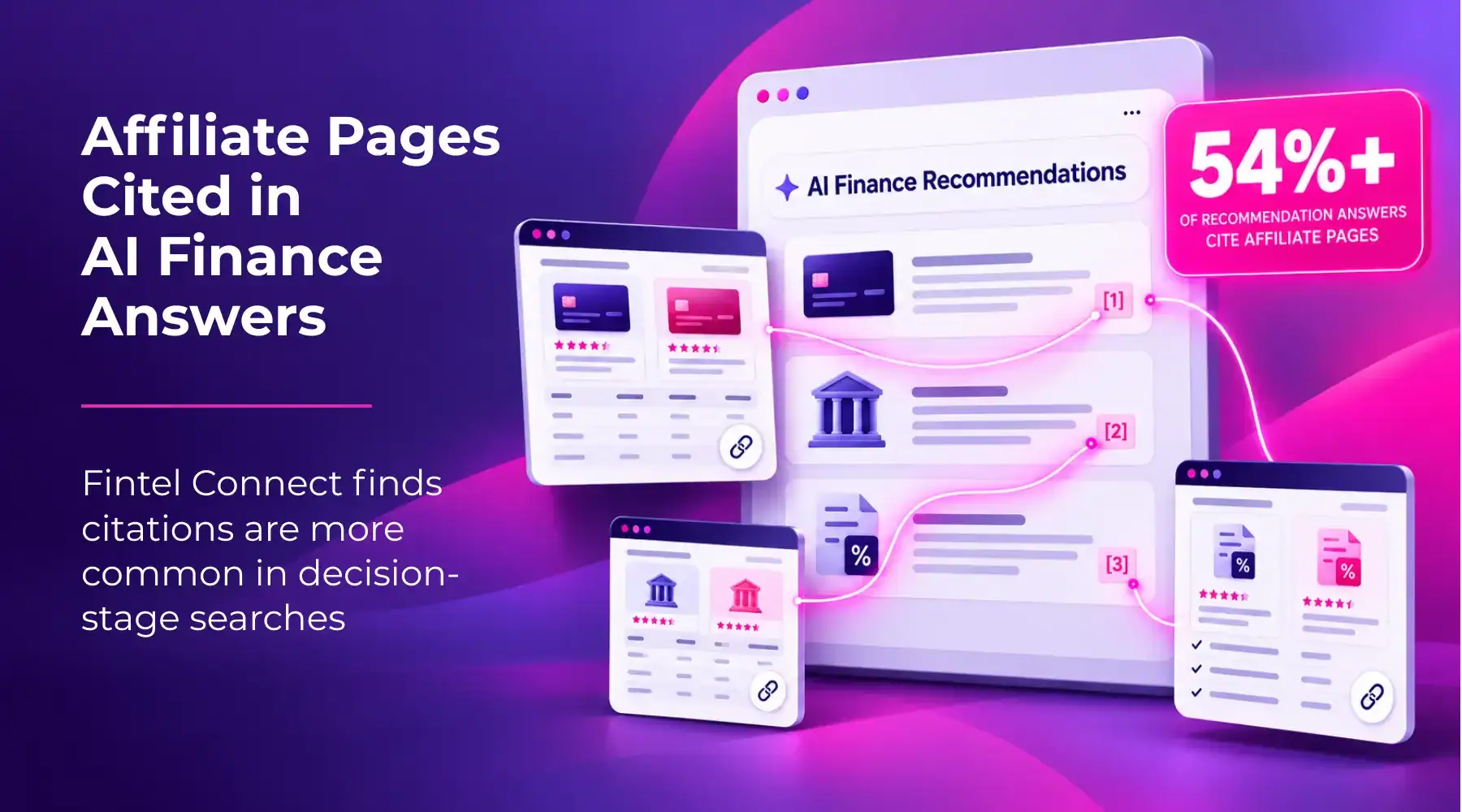
AI platforms were far more likely to cite sources for financial-product questions focused on making a decision, according to new Fintel Connect research released October 7. Affiliate pages appeared in more than 54% of recommendation answers. For financial affiliate programs, the findings raise a practical question: how should publishers’ visibility near product selection be assessed when it may produce no tracked click?
Key Findings From Fintel’s AI Search Research
- The research examined 2,400 AI responses and 7,809 source citations.
- It covered ChatGPT, Claude and Gemini.
- 90% of decision-stage prompts produced a citation, compared with 8.8% of awareness-stage prompts.
- More than 54% of recommendation answers cited an affiliate page.
- Half of all tested responses contained no cited source.
The study covered consumer credit cards, business credit cards, personal lending, and high-yield savings accounts. These percentages describe different response groups and should not be combined into a single customer funnel.
Citations Increase Near a Financial Decision
Fintel also reported an 87% citation rate for prompts using urgency, recency, “best” or “which,” compared with 8%–17% for explainer and advice prompts.
The distinction is useful for affiliate managers. Asking how credit card interest works differs from asking which card suits a particular spending pattern. The first is an explanation; the second calls for a product comparison.
The results suggest that monitoring only broad educational queries could miss where publishers appear during product selection. However, the study compares prompt categories. It does not follow individual consumers from initial research through to an application.
Danielle Lauzon, SVP of Commercial Strategy at Fintel Connect:
AI search is reshaping how consumers discover and compare financial products, and most financial brands are still working out what that means for their strategy.
Affiliate Citation Patterns Differ by Financial Product
More than 54% of recommendation answers in the report cited an affiliate page. The company also reported that the dominant affiliate publishers differed by product category. For brands offering several financial products, this suggests partner visibility should be assessed separately for each product.
A bank marketing both credit cards and high-yield savings accounts, for example, should examine which publishers appear in recommendations for each. A partner’s presence in credit-card comparisons does not establish that it also appears when consumers ask which savings account to choose.
Managers can then inspect what each answer attributes to the cited pages: fees, eligibility requirements, comparisons between offers or reasons for including a product in a shortlist. These details help establish whether the publisher’s content is relevant to the decisions the program wants to reach.
That creates a specific partner-discovery task: identify publishers repeatedly cited in relevant product comparisons, check whether they already belong to the program, and assess their coverage and audience fit.
Visibility Does Not Guarantee Traffic or Commission
Programs need to distinguish four outcomes:
- An AI platform accesses publisher content.
- The publisher’s page appears as a citation.
- The user visits the publisher.
- A later transaction is attributed to that publisher.
Fintel’s reported findings concern citations. They do not establish referral traffic, applications, approved customers, or commission earned.
The distinction connects with the measurement layers discussed in the APMA’s AI search roadmap. Evidence at one stage cannot automatically establish the next.
Affiverse has previously covered the gap between AI publisher visibility and tracked affiliate activity. Fintel’s intent-stage comparison offers a more specific starting point: examine the queries where consumers are choosing between products.
What Financial Affiliate Programs Should Review
Managers can start with a small set of relevant product-comparison prompts across the three tested platforms. Record the wording, test date, cited publishers, and whether the source is clearly visible to users. Repeat the checks to see whether appearances persist.
Compare those observations with partner reporting: do frequently cited pages receive identifiable AI referrals, and can any subsequent applications be tracked? Keep citation counts separate from visits and commercial outcomes.
Alongside citation tracking, review whether partner content clearly explains product terms and commercial relationships. Affiverse’s coverage of finfluencer marketing and affiliate compliance provides useful context on disclosures, partner oversight, and customer-quality measurement.
Affiverse’s Open Attribution podcast explores how source signals might connect with later activity. For now, Fintel’s findings can inform partner discovery and measurement discussions, but they do not provide a basis for assigning commission to an untracked recommendation.
Everflow
Connect
Tradedoubler
Connect
1win Partners
Connect
PIN-UP Partners
Connect
Shopnomix, a Nomix Group Company
Connect
V.Partners
Connect
Huffson Group
Connect
Kawaii Partners
Connect
Share your expertise and expand your reach and become a content contributor with us today!
Contact Us To Find Out More