Beyond English: Why Localization is Your Next Major Affiliate Revenue Driver

Data proves 76% of consumers won’t buy in a second language. Here is why breaking out of the English-only echo chamber is your lowest-hanging revenue fruit.
If you are running your affiliate websites or campaigns exclusively in English, you are fighting a brutal, low-margin war.
Industry estimates put the number of active affiliate marketers worldwide above 12 million. Just because close to 40% of global affiliate revenue originates from North America alone, which is significantly more when adding other core English-speaking hubs, nearly every affiliate pushes their energy into the exact same language. However, by refusing to cross language barriers, you are actively leaving money on the table and ignoring a massive, high-conversion audience.
Barb Tasci, CEO of All-in Global, breaks down the exact data you need to see, and why breaking out of the English-only content loop will provide the affiliates with the scaling opportunity they always looked for.
The Disconnect: Web Content vs. Real Users
Many affiliates assume that since global consumers know some English, an English website is enough to capture international sales. However, a massive statistical gap exists between what is published online and who is actually reading it, as highlighted by Quantumrun:
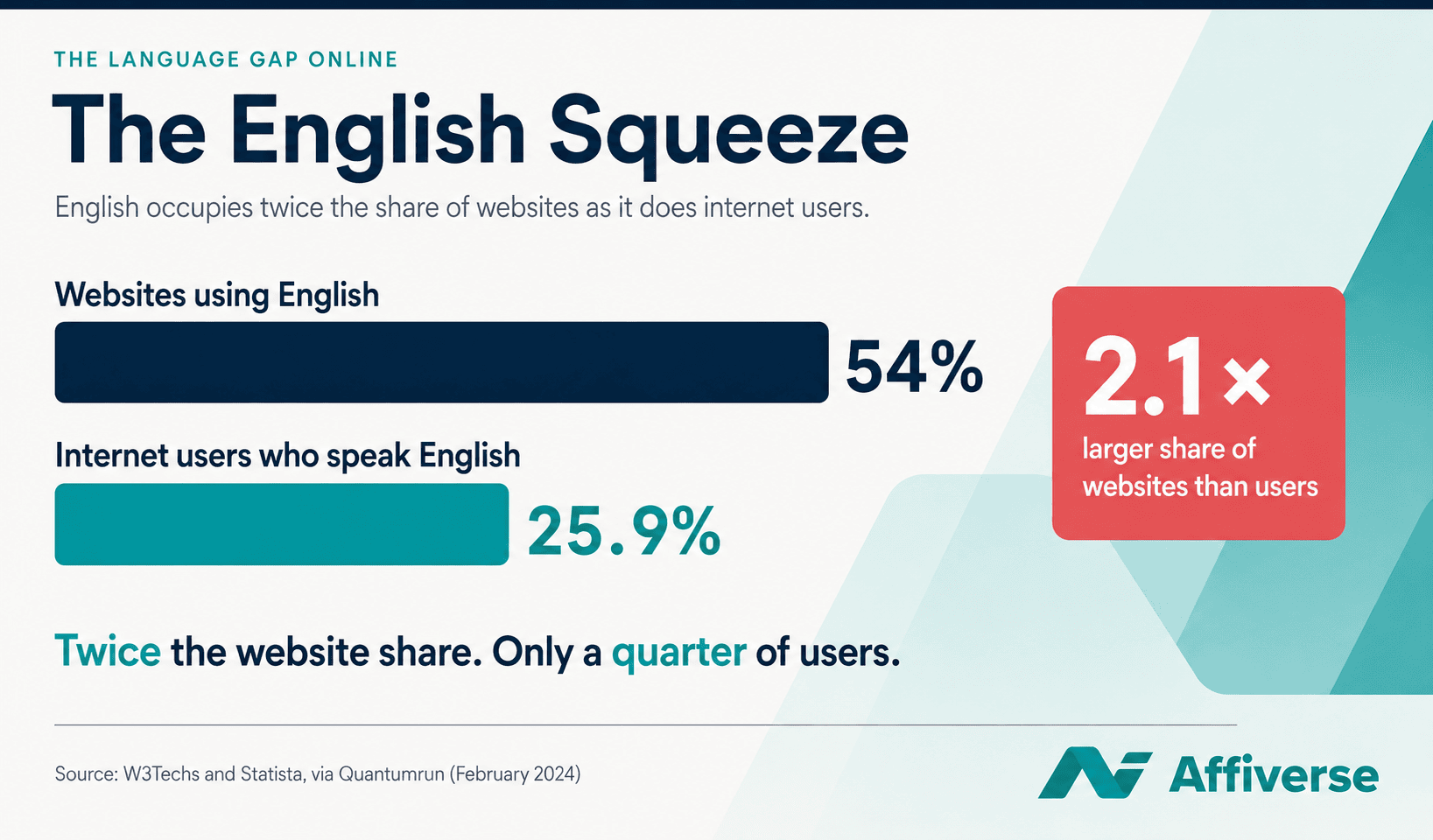
- The Content Overload: English functions as the default publishing language online, accounting for over 50% of all websites on the internet.
- The User Reality: Only roughly 25% of global internet users actually speak or navigate the web in English.
This mismatch creates a massive revenue opportunity. More than half of the world’s affiliate content is aggressively crammed into a space competing for roughly a quarter of the global population. Meanwhile, the other 75% of internet users are heavily underserved and looking for content in their native languages.
The Financial Stakes: Missing Out on a $33 Billion Market
The global affiliate marketing sector is expanding rapidly. Insights from Market Reports World indicate that the industry is on track to grow into a projected $33.34 billion powerhouse by 2035. When you build and rank content exclusively in English, you are structurally capping your business, completely detaching your affiliate funnel from the non-English half of that multi-billion-dollar global pie.
According to extensive global consumer purchasing data from CSA Research, forcing international buyers onto an English-only page breaks down the psychological trust required to finalize a transaction:
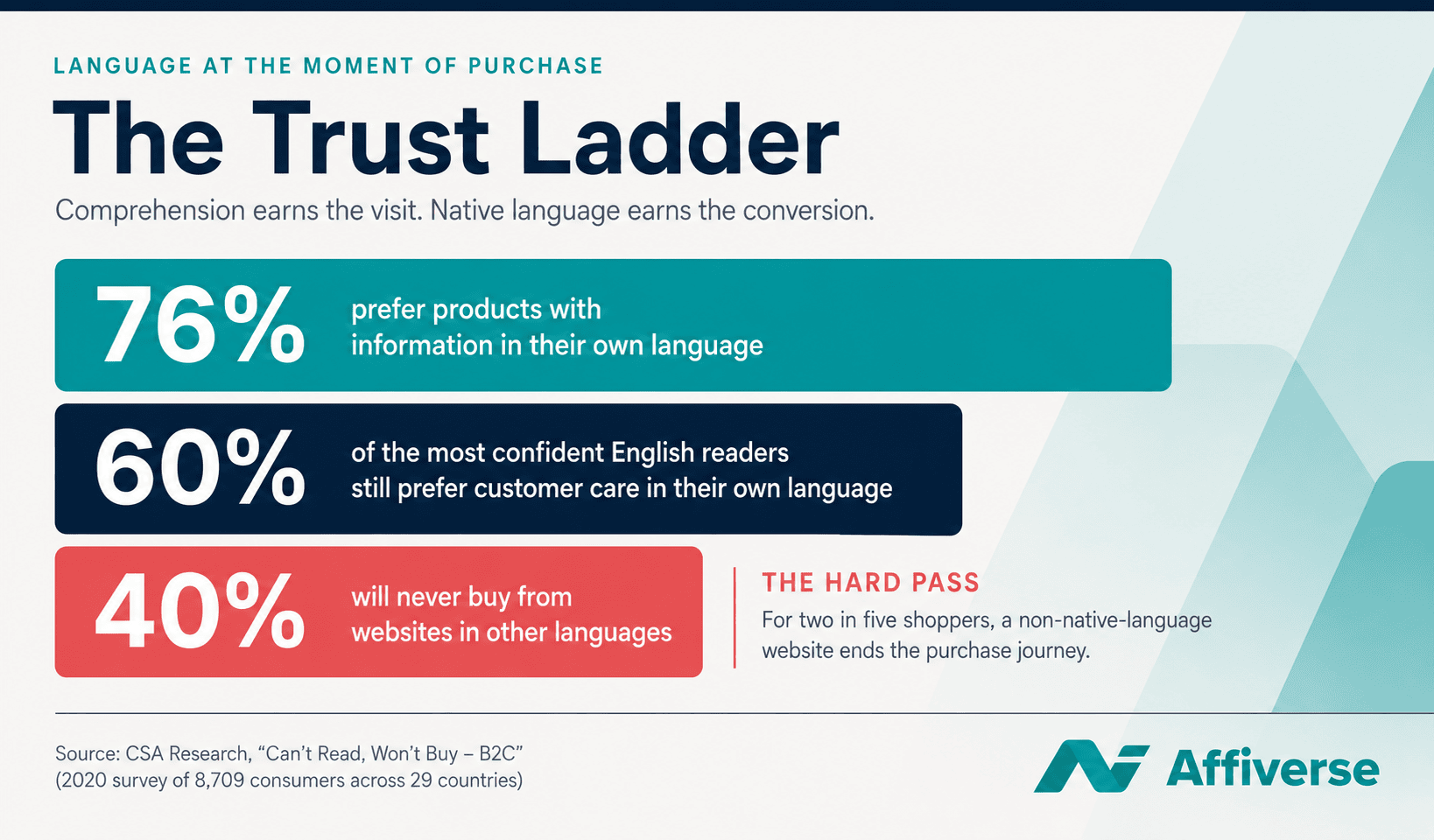
- The Absolute Hard Pass (40%): A strict 40% of global consumers state they will never buy from a website that is not in their native language. Even if their English comprehension is strong, the lack of localization breaks their consumer confidence.
- The High-Preference Majority (76%): A total of 76% of online shoppers strongly prefer to purchase products when the information is fully presented in their own language.
- The “Fluent” Disconnect (66%): Even among international users who possess high English proficiency, 66% still prefer to browse and shop in their own language when given the option.
If you build an affiliate asset exclusively in English, you are limiting your reach to native English speakers and a tiny 24% to 35% cross-border demographic of non-native speakers who tolerate English checkout flows.
Conversely, launching native-language alternatives or translating your existing assets into high-value target languages (such as Spanish, French, Portuguese, German, or Japanese) unlocks the remaining 65% to 76% of regional markets that standard English sites can simply never penetrate.
Why Multi-Language Affiliates Scale Faster
The advantage compounds across three fronts at once:
- SEO competition collapses: Ranking an English review page for commercial keywords takes years and heavy backlink budgets; the same concepts built around localized search queries reach page one in a fraction of the time.
- Conversion rates climb from the same traffic: A page tailored to a visitor’s language, culture, and currency converts far more of the exact same regional traffic, language is a trust signal at the moment of the transactional decision.
- Trust barriers grow with the stakes: People risk small purchases in English, not expensive or sensitive ones. In high-ticket verticals like financial services, SaaS, real-money gambling, native-language content out-converts English most decisively exactly where commissions are highest.
Affiliates do not need to localize an entire website at once. Start with one market and the pages closest to conversion, then compare their performance against the English versions. The goal is not to publish in as many languages as possible. It is to build trust in the markets where the data shows genuine demand
— Barb Tasci, CEO of All-in Global
How to Test Before You Commit
None of this requires a leap of faith. Validate it the way affiliates validate everything else—small, fast, and measured:
- Mine your analytics: Non-English browser languages and geos already landing on your English pages are the demand arriving before you asked for it.
- Run a SERP density check: Search your top money keywords in the target language, from the target market, and see how the competitors are shaped. Are they in the local language? If so, are they localizing into dialects or using the global language?
- Localize the main backbone of the website with native quality, with a small addition of the top low-volume keywords your English page attracts. These could be the main pillars of the website with a few more comparison and review pages that are relevant to the locals.
- Measure against your English baseline over 60-90 days: rankings, CTR, and above all conversion rate. Transactional pages show the language effect fastest. While doing the measurement, also mind doing conversion optimization, trying to list the most convertible products on top of your list.
- Scale what the data confirms: language by language, page type by page type. Two or three languages executed to native quality beat ten done cheaply, every time.
The Bottom Line: Scaling Is Not an Operational and Financial Question Anymore
The numbers tell one consistent story. Over 12 million affiliates are crowded into a language that only a quarter of internet users are fluent in, while 76% of online shoppers—and 40% who won’t buy any other way—are waiting to be addressed in their own language. The market heading toward $33 billion will reward the affiliates who go where the content isn’t.
The old objection was operational and financial: producing native-quality content in five or eight languages meant choosing between cost and quality. That equation has changed. Specialized AI translation trained on industry-specific content, with native linguists reviewing the output, now makes native-quality localization genuinely scalable; it’s the approach taken when building CRAIG at All-in Global.
Now, affiliates can stop fighting over the same 25% of the web, speak their market’s language, and get rewarded with high-converting traffic.
Resources
_________________________________________________________________________________________
This content has been produced for Affiverse by an independent Advertiser and expresses their own views, in their own words. If you would like to feature as an advertiser and be interviewed on Affiverse’s media content platform, please email [email protected].
Everflow
Connect
Tradedoubler
Connect
1win Partners
Connect
Shopnomix, a Nomix Group Company
Connect
Huffson Group
Connect
Kawaii Partners
Connect
Trackdesk
Connect
Share your expertise and expand your reach and become a content contributor with us today!
Contact Us To Find Out More