AI Visibility Study Finds Affiliate and Review Sites Account for 34.9% of iGaming Citations
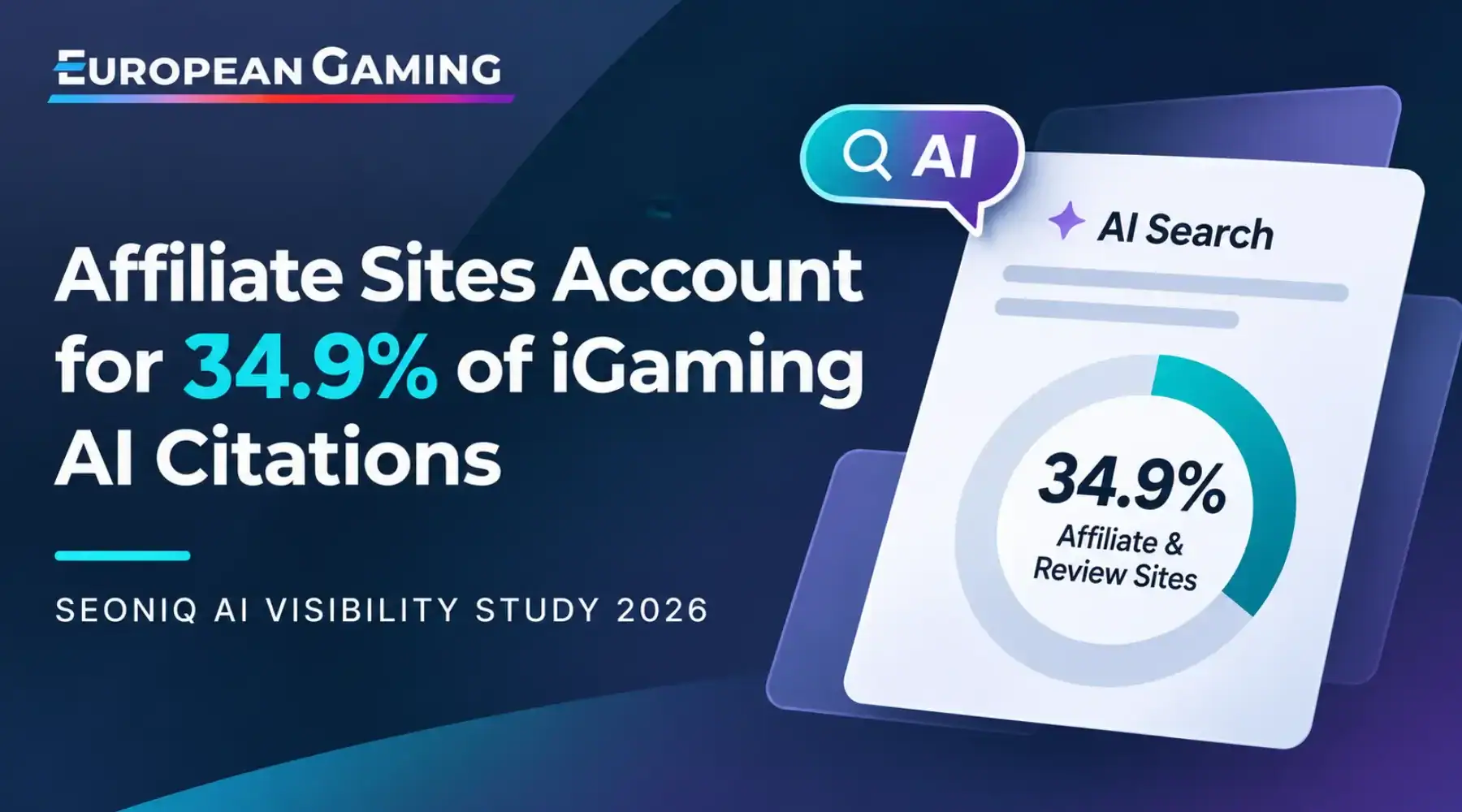
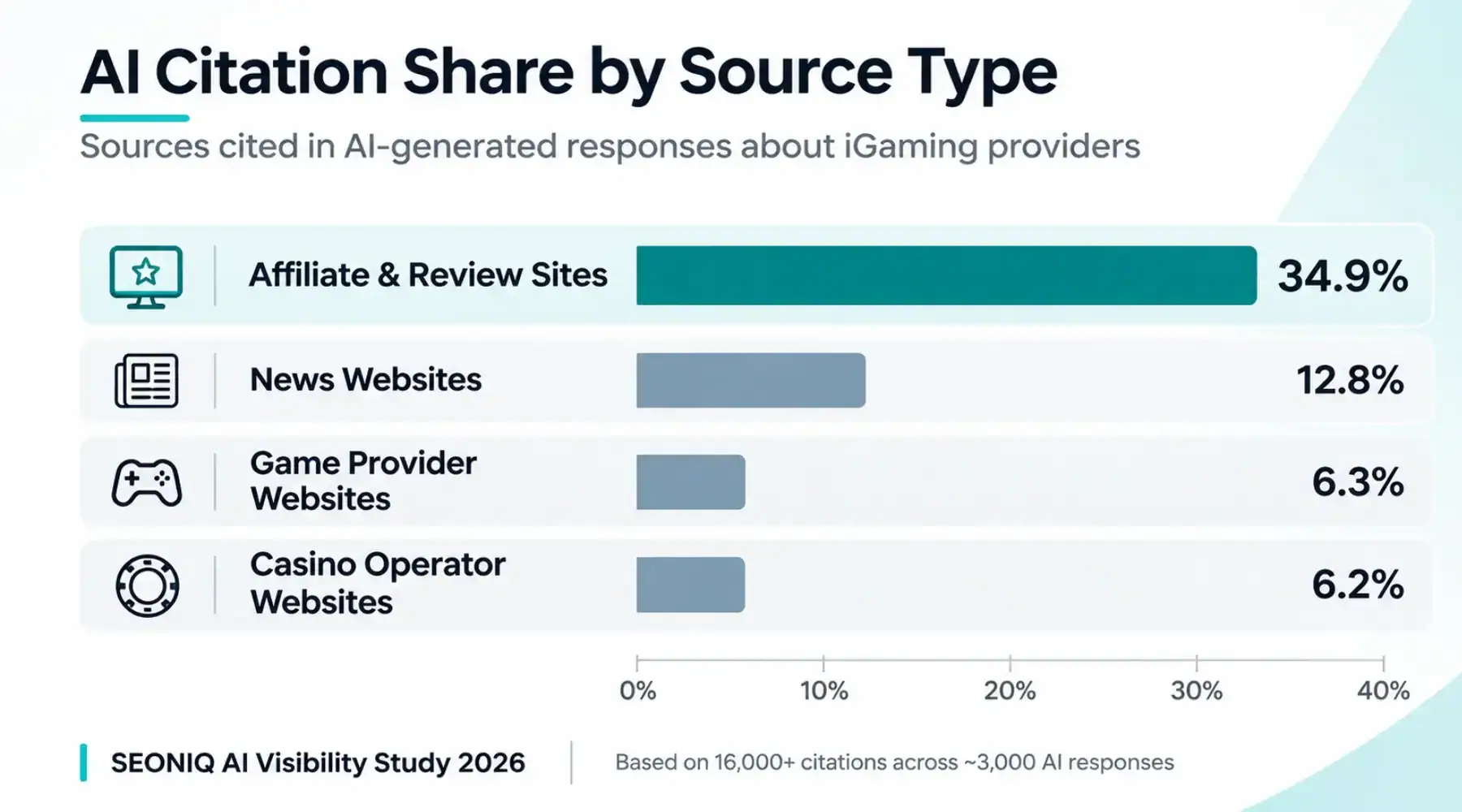
Affiliate and review websites account for 34.9% of sources cited in AI-generated responses about iGaming providers, according to SEONIQ’s AI Visibility Study 2026. Game providers’ own websites, by comparison, represent just 6.3% of citations, highlighting the role of third-party publishers in shaping how suppliers are presented across AI-powered search platforms.
The research, conducted between October and November 2026, examined approximately 3,000 AI-generated responses to 210 B2B questions. Its findings provide new insights into the relationship between affiliate content, organic search performance, and generative engine optimization (GEO). For affiliate marketers, the results raise an increasingly important commercial question. How should publishers measure the value of their content when it influences AI-generated recommendations without necessarily producing a trackable click?
Key Takeaways From SEONIQ’s AI Visibility Study 2026
- Affiliate and review websites accounted for 34.9% of more than 16,000 AI citations analyzed.
- Game provider websites represented only 6.3% of cited sources.
- Some 96.5% of mentions of the 40 most frequently named providers lacked a link to their official websites.
- The five most frequently mentioned providers accounted for 43% of all provider mentions.
- Only 7.8% of AI citations appeared among Google’s top 10 organic results for the corresponding query.
- Citation patterns varied across AI platforms and changed over time.
Affiliate Websites Lead AI Citations in iGaming
SEONIQ examined responses across ChatGPT, Gemini, Microsoft Copilot, Google AI Mode, and Google AI Overviews. The research focused on English-language, supplier-related questions in the UK market and did not include specific provider names in the prompts. Affiliate and review websites accounted for the largest source category, followed by other sources, including news websites, which represented 12.8% of citations. Game provider and casino operator websites accounted for 6.3% and 6.2%, respectively. The UK Gambling Commission was the most frequently cited individual website, accounting for 8.8% of all citations.
As reported by European Gaming, Madalina Burada, Co-Founder of SEONIQ, said: “An operator asks ChatGPT which provider to work with, and the answer is built from pages the provider never wrote and often never read.” For affiliate publishers, the findings demonstrate that their content can serve as reference material beyond conventional search results, including in responses to business-oriented questions about iGaming suppliers.
Brand Visibility Does Not Guarantee Website Traffic
One of the study’s most significant findings concerns the distinction between brand mentions and direct website citations. Among the 40 most frequently mentioned providers, only 3.5% of mentions included a link to the supplier’s own website. Eight providers received no direct links despite appearing in AI-generated responses.
Brand visibility was also concentrated among a relatively small group of suppliers, with five providers receiving 43% of all mentions. These findings suggest that brand recognition and website visibility should be assessed separately. A supplier can appear prominently in AI-generated recommendations while the accompanying references direct users toward third-party publishers or regulatory websites.
However, a citation does not establish that a user visited the referenced website or completed a subsequent commercial action. This distinction reflects the challenges explored in our previous coverage of the affiliate attribution gap in AI search, where publisher influence may extend beyond activity captured through conventional click-based tracking.
AI Citations and Google Rankings Show Limited Overlap
The research also found that just 7.8% of AI citations appeared in Google’s top 10 organic search results for the same query. This suggests that traditional search rankings alone may provide an incomplete picture of a publisher’s visibility across AI-generated answers. However, the findings do not establish that organic rankings have become irrelevant or that GEO should replace traditional SEO.
As we previously examined in our analysis of SEO and GEO strategies for affiliates, both disciplines depend on reliable information, content quality, and established topical expertise. Affiliate publishers can complement existing SEO reporting by examining citation frequency, the context in which their content appears, and differences between AI platforms. These measurements can help distinguish changes in organic search visibility from changes in AI-generated recommendations.
Measuring Affiliate Influence Beyond Traditional Attribution
The research adds to ongoing industry discussions about how to measure publisher contributions across AI-assisted discovery journeys. The IAB’s AI visibility measurement guidelines distinguish between presence, prominence, portrayal, and persuasion, providing a framework for assessing how brands and publishers appear in AI-generated responses.
For affiliate managers, these metrics could complement existing performance indicators such as referral traffic, conversions, and acquisition costs. They should not, however, be treated as substitutes for attributable commercial results.
SEONIQ’s findings are limited to the UK-focused B2B questions and AI platforms examined. The research was also produced by a commercial SEO and GEO agency rather than an independent academic institution.
Nevertheless, the substantial representation of affiliate and review websites highlights the continuing role of specialist publishers in the emerging AI discovery ecosystem.
The remaining challenge for the affiliate industry is establishing how that visibility translates into measurable commercial value, particularly when an AI-generated answer influences a decision without generating a conventional affiliate referral.
Everflow
Connect
Tradedoubler
Connect
1win Partners
Connect
Shopnomix, a Nomix Group Company
Connect
Huffson Group
Connect
Kawaii Partners
Connect
Trackdesk
Connect
Share your expertise and expand your reach and become a content contributor with us today!
Contact Us To Find Out More