OpenAI Launches ChatGPT Wallet for Agent-Assisted Purchases
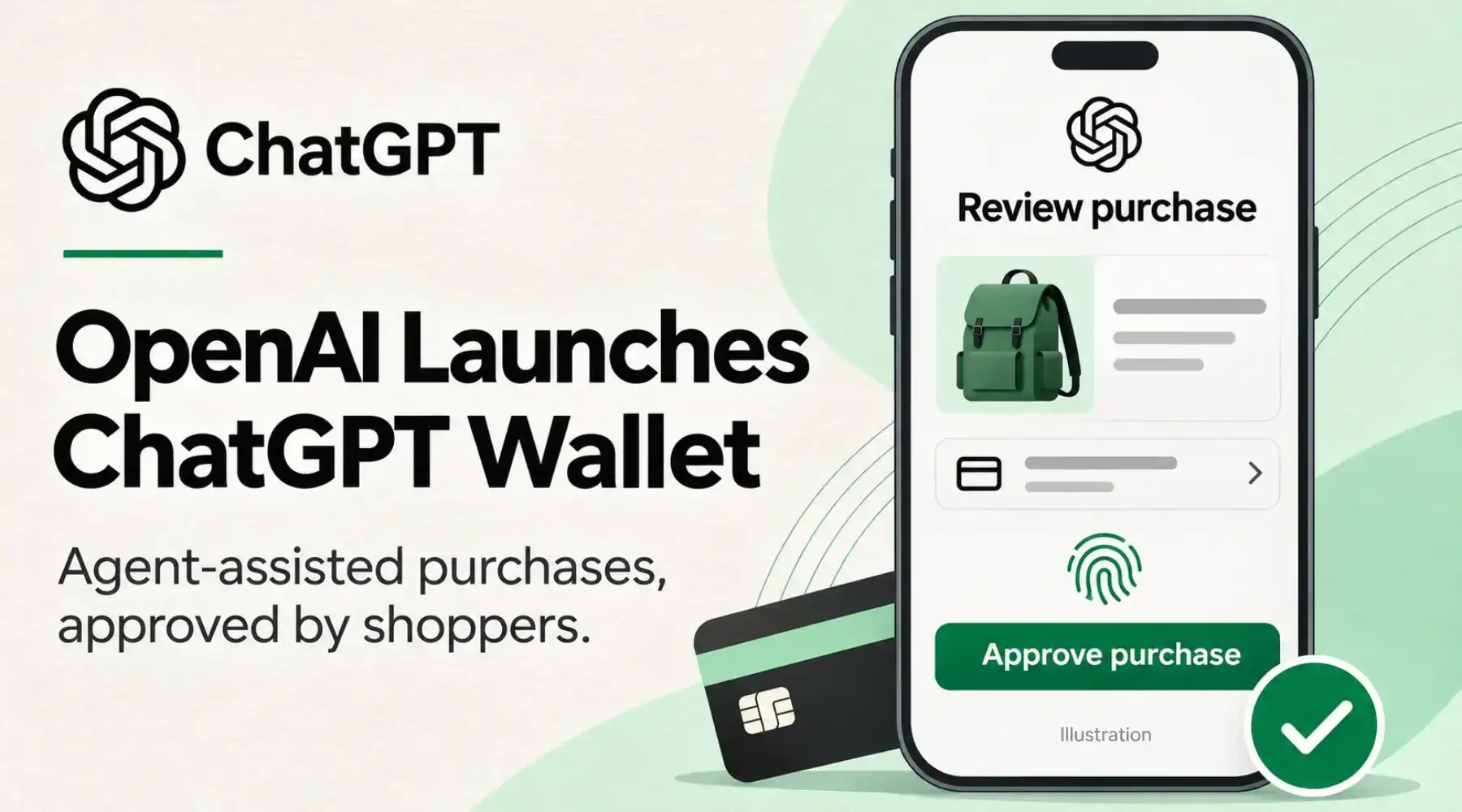
OpenAI began rolling out ChatGPT Wallet on November 13, 2026, allowing eligible US subscribers to approve purchases made by its agents using saved payment cards. Developed with American Express, Chase, Mastercard, and Visa, the service starts in its dots assistant for ChatGPT Pro users aged 18 and older with eligible US-issued cards, according to OpenAI’s launch announcement. For affiliate teams, the launch raises questions about how referrals are recorded when an agent completes checkout.
Key Takeaways From the ChatGPT Wallet Launch
- The rollout starts with eligible US Pro users. Access is gradual, and shoppers need an eligible US-issued card and a US billing address.
- Shoppers approve each purchase. They review the order and authorize payment using biometric verification on a supported device.
- Retailers process the sale through their own checkout. OpenAI says existing payment forms can accept Wallet without a dedicated integration.
- Affiliate attribution remains an open question. The launch announcement does not specify how publisher referrals or commissions are handled.
How Shoppers Approve a ChatGPT Wallet Purchase
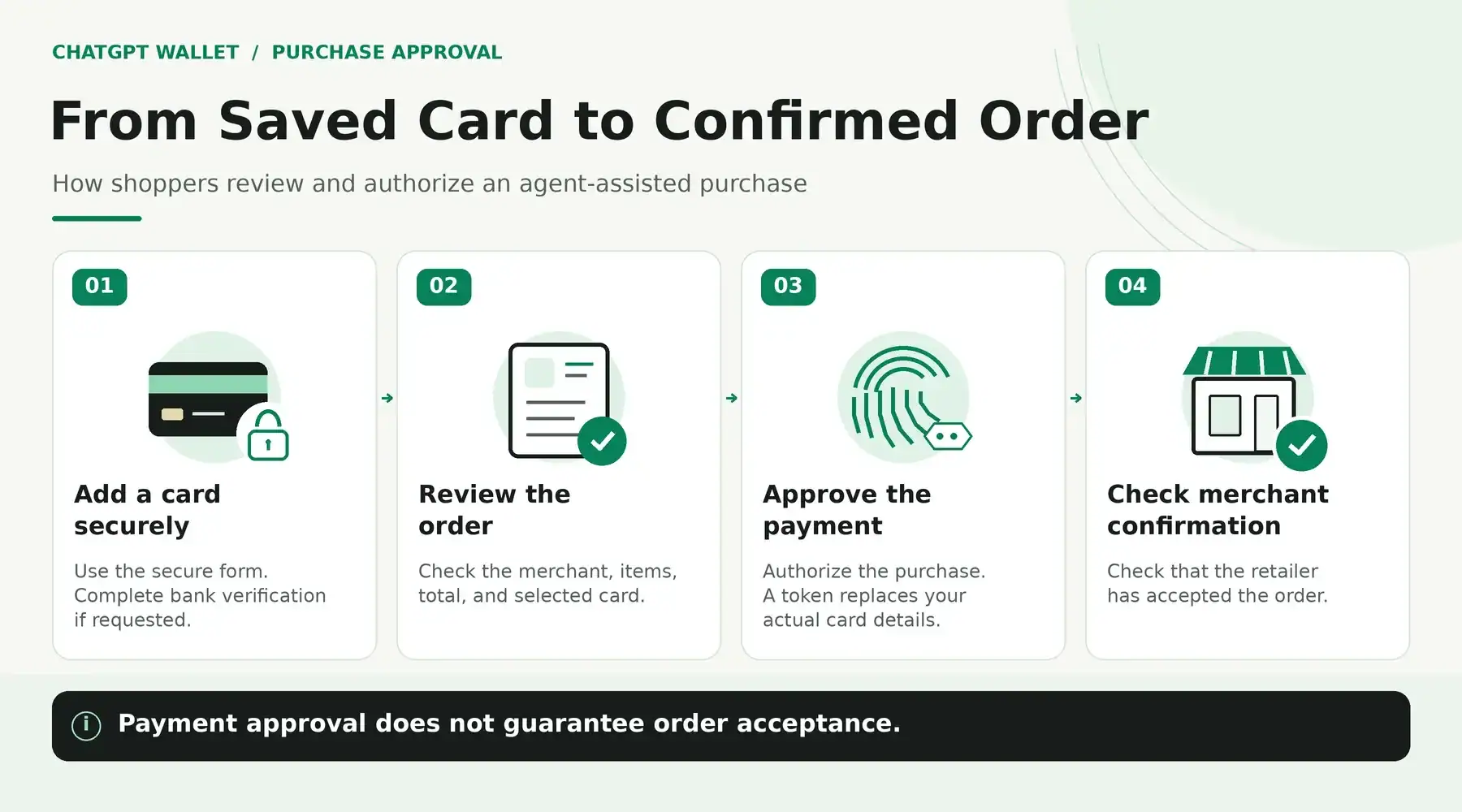
When Wallet becomes available, users can ask their dot to add a card or open Wallet in Settings. They enter payment information through a secure form and complete any verification requested by their bank. Cards stored in Wallet are separate from the payment method used for a ChatGPT subscription.
At checkout, the shopper reviews the merchant, items, total, and selected card before authorizing the purchase. A payment token substitutes for the actual card details, allowing the agent to submit payment without receiving those details.
Approval does not guarantee that a retailer will accept the order. OpenAI tells users to check the merchant’s confirmation after checkout. The retailer remains the seller, sets prices, and handles shipping, returns, and customer service.
OpenAI describes fully delegated purchases, governed by advance permissions such as spending limits or permitted categories, as a future development. The launch flow requires approval for each purchase.
What Retailers Need to Check Before Accepting Agent Purchases
OpenAI’s payment guidance for merchants says ChatGPT Wallet works with existing checkout pages and payment forms. Retailers can also continue using their existing authorized saved-card arrangements.
Compatibility still depends on the systems surrounding checkout. Fraud tools may interpret a cloud browser’s IP address or browser characteristics as suspicious and decline a legitimate purchase. OpenAI says it is rolling out additional user signals for risk providers to assess these transactions.
Site access is another consideration. Retailers can review whether their firewall interrupts verified ChatGPT browser visits. OpenAI provides instructions for recognizing signed agent requests while retaining other security controls. Product feeds and plugins are optional for browser access.
For an affiliate manager, this creates a reason to involve ecommerce and payment teams in testing. A failed checkout and an untracked referral require different investigations. Testing should establish whether the order completed before examining whether the correct partner received credit.
Product Discovery and Payment Use Different Parts of the Journey
OpenAI’s commerce playbook describes how ChatGPT can find offerings through public web pages, private integrations, and merchant product feeds. When a customer decides to buy, the journey can continue through the retailer’s website or a plugin where supported.
Businesses can manage their profiles and product information through the ChatGPT Business Hub. Its website-click reporting helps businesses assess traffic from ChatGPT, but a click count alone cannot establish which publisher influenced a purchase or earned commission.
Affiliate networks are also developing routes into AI shopping. Affiverse’s reporting on CJ’s Channel3 integration describes catalog distribution to shopping applications and referrals through tracked links. That arrangement illustrates why affiliate teams need to examine the tracking attached to each shopping experience.
What ChatGPT Wallet Means for Affiliate Attribution
Wallet gives an agent a way to pay. Whether a publisher receives commission still depends on the referral evidence available to the retailer and the rules of its affiliate program. The announcement provides no basis for concluding that Wallet automatically preserves or removes that credit.
Consider a shopper who discovers a product through an affiliate review, then asks an agent to complete the purchase. The merchant would need evidence connecting the eventual order with the earlier referral to credit the publisher under its program’s terms. If the agent instead finds the product independently, the evidence and any attribution claim could be different. These are scenarios for testing, rather than reported outcomes from Wallet.
The distinction fits the questions raised by the IAB’s AI-Era Attribution Blueprint, which examines who initiated a purchase, shaped the product choice, and completed the order.
Affiliate teams assessing the new flow can focus on three checks:
- Referral continuity: Does the order retain an eligible publisher or click identifier when an agent completes checkout?
- Commission rules: How does the network treat a prior affiliate referral when another shopping service becomes involved?
- Order validation: Can teams reconcile the recorded referral with a confirmed order and subsequent refunds or cancellations?
Early tests can give advertisers and networks evidence to discuss with their publishing partners. Recording the path from referral to confirmed order would help establish where tracking works, where information is missing, and which commercial terms need clarification as agent-assisted purchasing expands.
Everflow
Connect
Tradedoubler
Connect
1win Partners
Connect
Shopnomix, a Nomix Group Company
Connect
Huffson Group
Connect
Kawaii Partners
Connect
Trackdesk
Connect
Share your expertise and expand your reach and become a content contributor with us today!
Contact Us To Find Out More