IAB Publishes Blueprint for Attributing Sales Influenced by AI
The Interactive Advertising Bureau (IAB) published its AI-Era Attribution Blueprint on November 12, 2026. The framework classifies purchases by who sparked the shopper’s interest, who made the product choice, and who completed the order. Those roles help determine who can make an attribution claim and what evidence would support it, according to IAB’s announcement.
A merchant may see a purchase recorded under search or direct traffic even when an assistant helped the shopper decide. The blueprint follows that path to the sale, building on IAB’s August guidelines for measuring visibility in AI answers.
Key Takeaways From the IAB Attribution Blueprint
- Three purchase pathways. IAB classifies conversions as human-owned, AI-assisted, or AI-executed.
- Publisher contributions can support a claim. A review that informed an AI recommendation can give a publisher grounds to seek credit. Evaluating the claim requires evidence that connects the recommendation to a commercial outcome.
- 44% of ad buyers use indirect measures. In IAB’s September Outlook Study, that share said they use branded search and direct traffic as proxies for AI influence they cannot track directly.
How IAB Classifies a Purchase
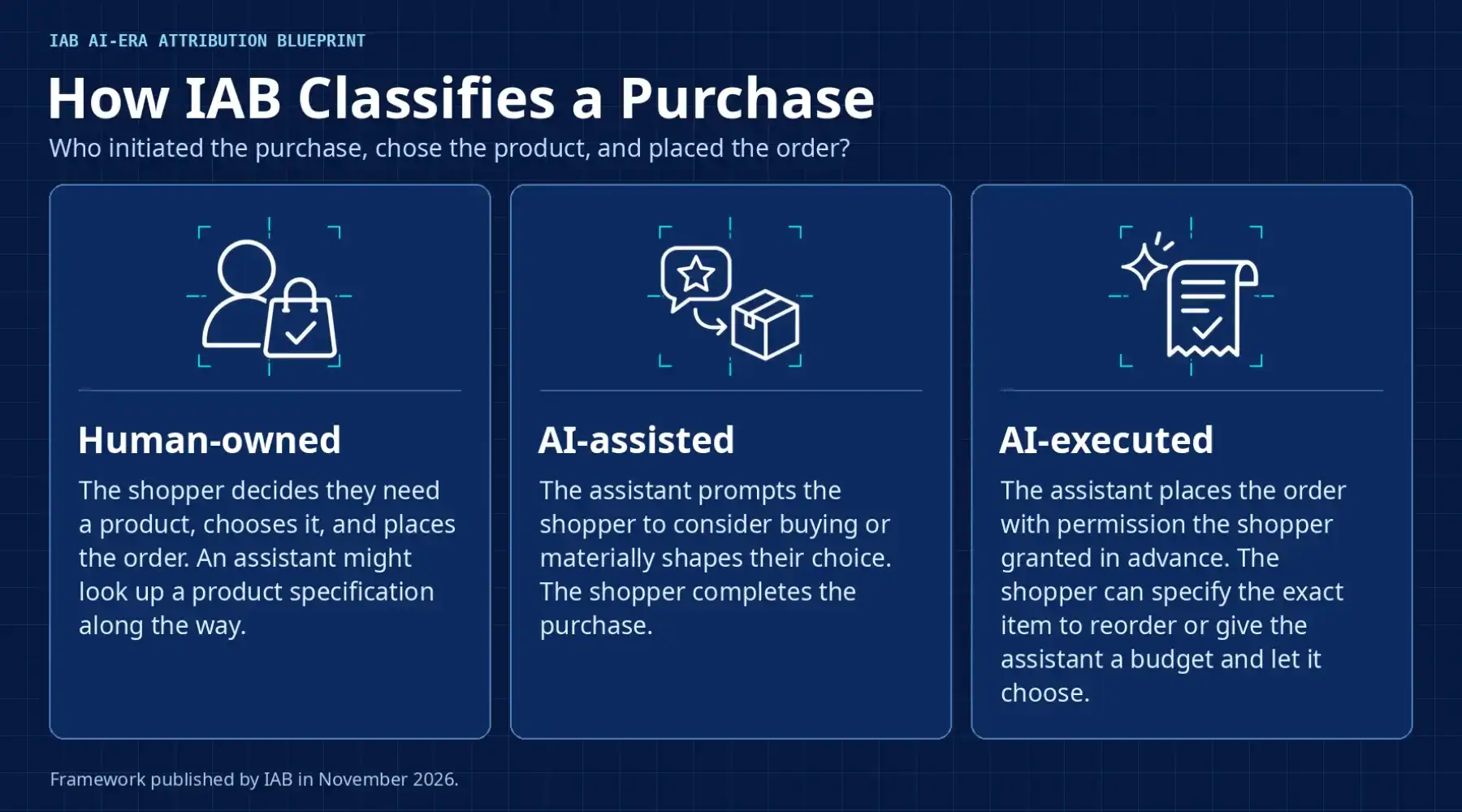
IAB classifies a purchase by looking at who or what sparked the intent to buy, who chose the product, and who placed the order. The blueprint defines three pathways and splits AI-assisted purchases into two types based on how the assistant influenced the shopper.
- Human-owned. The shopper decides they need a product, chooses it, and places the order. An assistant might look up a product specification along the way.
- AI-assisted. The assistant prompts the shopper to consider buying or materially shapes their choice. The shopper completes the purchase.
- AI-executed. The assistant places the order with permission the shopper granted in advance. The shopper can specify the exact item to reorder or give the assistant a budget and let it choose.
The source of the product choice matters even when an assistant handles checkout. An order record may show that an assistant placed the order. Evaluating its role in the decision may require seeing whether the shopper named the product or asked the assistant to select it.
What Counts as Evidence for an Attribution Claim
An AI system that determines the final product choice may make a decision claim. A party whose content or data informs the recommendation may make a contributory claim. The party evaluating the claim weighs the evidence before awarding credit. The criteria are set out in IAB’s published blueprint.
Referral data can show that a shopper followed a link from an AI answer. A retailer’s transaction record can confirm the sale. Connecting those events becomes harder when shoppers return through another channel. In a June study of ChatGPT recommendations in finance, travel, and beauty, 55.9% of visits to recommended brands in the following week came through search, according to Similarweb’s analysis.
IAB calls on AI platforms to say which sources informed a recommendation, indicate whether it was paid or organic, and label traffic that originates in their tools. It also asks agencies to distinguish platform-reported claims from those they can verify independently.
What the Blueprint Means for Affiliate Publishers
Suppose a shopper asks an AI assistant to recommend a carry-on bag that meets an airline’s size limits. The assistant cites an affiliate publisher’s comparison guide and recommends a model. The shopper later searches for the model by name and buys it from the retailer. In that AI-assisted purchase, the citation shows the guide appeared in the answer. The merchant may record the visit as a search and see the purchase in its order data. The publisher would need evidence linking those events to substantiate its contribution.
Publishers can compare the AI referrals they can identify with outbound affiliate clicks and credited sales over the same period. The AI Assistant channel can help identify those referrals, as explained in Affiverse’s guide to tracking AI traffic in GA4. To reconcile a commission on a specific order, the program manager needs a record that ties the purchase to the publisher under the program’s attribution rules.
Everflow
Connect
Tradedoubler
Connect
1win Partners
Connect
Shopnomix, a Nomix Group Company
Connect
Huffson Group
Connect
Kawaii Partners
Connect
Trackdesk
Connect
Share your expertise and expand your reach and become a content contributor with us today!
Contact Us To Find Out More