Google Expands AI Mode Ads to 10 More Countries and US Follow-Up Queries
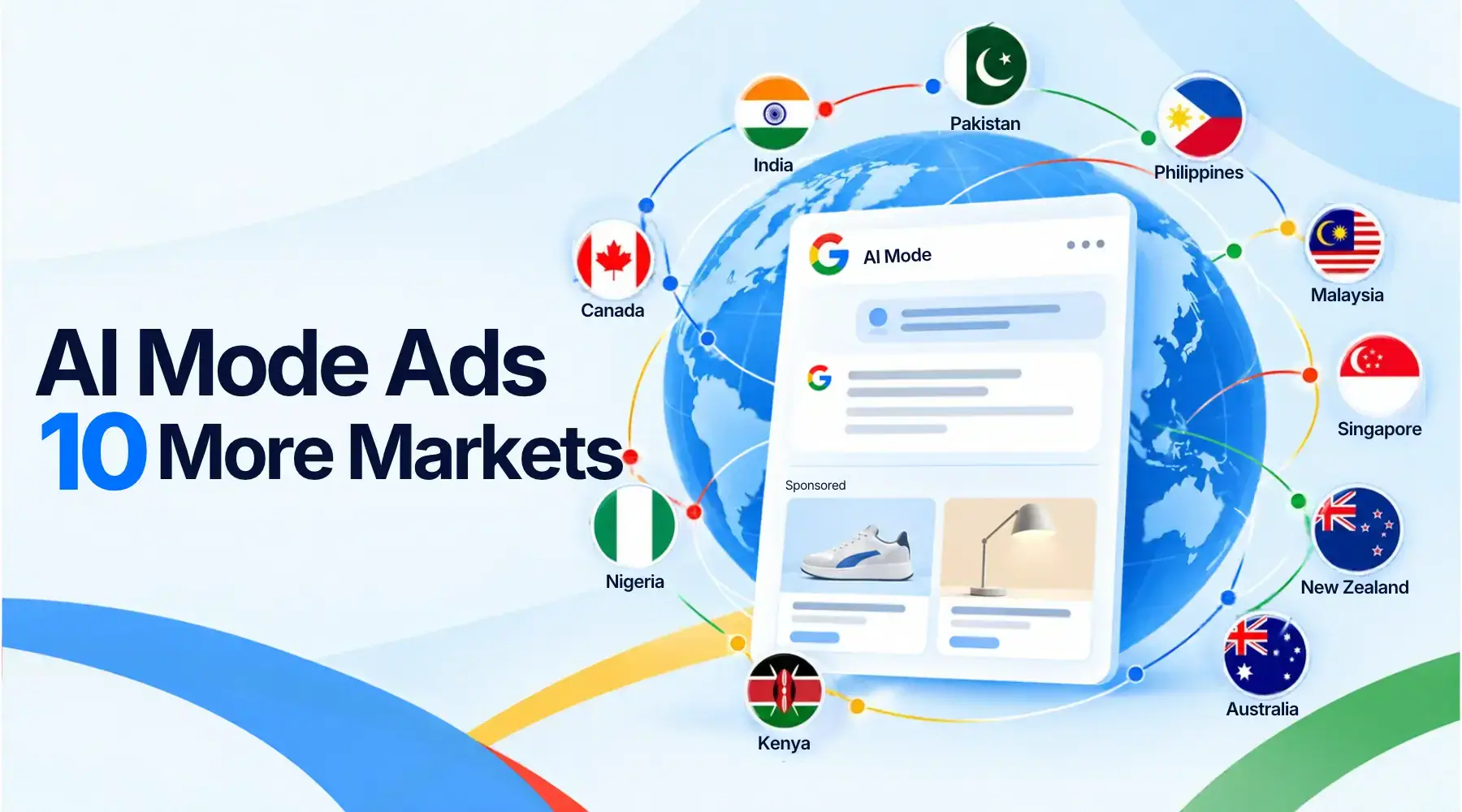
Google is expanding AI Mode ads to 10 additional countries, including Canada, Australia, and India, according to its October 28 announcement. It is also launching ads in responses to follow-up questions in US AI Mode conversations.
For performance advertisers, the expansion raises a practical measurement question: how can teams assess these placements when their results sit within wider campaign totals?
Key Takeaways: Google AI Mode Ads Expansion
- 10 more countries: The rollout extends beyond the US, with further markets planned for Q4.
- US follow-up queries: Ads can appear as users continue an AI Mode conversation.
- Existing campaigns qualify: Search, Shopping and Performance Max can participate.
- Reporting stays aggregated: Results feed into standard campaign and search-term reports.
Where Google Is Expanding AI Mode Ads
The new countries are Australia, Canada, India, Kenya, Malaysia, New Zealand, Nigeria, Pakistan, the Philippines and Singapore. Google plans further expansion in Q4 2026, including Brazil, Mexico and the UK.
Google’s help documentation currently lists English for these placements, with text ads only in Pakistan.
The US update adds advertising opportunities later in a conversation, when someone asks another question after receiving an initial answer. Google says ads will carry a Sponsored label.
Google also says AI Mode queries average three times the length of traditional searches, citing a May 2026 US report. Longer questions give advertisers a reason to examine how their messaging addresses detailed needs; they do not establish that those users will convert more readily.
Which Campaigns Are Eligible for AI Mode Ads?
Google’s current campaign guidance distinguishes between direct query matching and contextual matching against both the query and AI response.
| Campaign setup | Matching eligibility |
|---|---|
| Search using exact or phrase match | Queries expressing direct commercial intent. |
| Search using broad match or AI Max | Direct query matching and contextual matching. |
| Shopping and Performance Max | Direct query matching and contextual matching. |
No new campaign or separate budget is required. Advertisers cannot target AI Mode exclusively or opt out separately. Existing negative keywords and brand exclusions still apply.
For teams deciding whether to change their setup, the distinction matters: access to some AI Mode inventory does not require adopting broader matching. Any change should have its own performance rationale.
Affiverse’s analysis of Google’s AI ad tools explores the wider questions around automation and evidence of commercial value.
How AI Mode Ads Appear in Reporting
Google says impressions, clicks, conversions and costs are aggregated in campaign reporting. Triggering queries also feed into the standard search terms report.
The measurement implication is that a change in campaign return on ad spend cannot, by itself, establish AI Mode’s contribution. Teams would also need to account for budget changes, bidding, promotions, seasonality and the mix of searches being reached.
Search-term analysis has another limitation. Google’s search terms documentation says some low-volume queries are omitted for privacy. A visible query can help assess relevance, but conversational wording alone does not prove that an impression occurred in AI Mode.
Advertisers should also allow for conversion lag when reviewing recent results. Google notes that recent reporting periods are more affected by delayed conversions than older ones.
Affiverse Take: Assess Campaign Outcomes Before Assigning Placement Credit
For performance and affiliate teams, a useful starting point is to record a campaign baseline and keep a dated log of targeting, budget, bidding and creative changes. That makes later comparisons easier to interpret, especially during the holiday trading period.
Reviews should focus on business outcomes: approved sales, qualified leads, acquisition costs and customer value. Where paid search and affiliate partners touch the same purchase, teams should reconcile order records and apply agreed commission rules before comparing channel returns.
Affiverse’s coverage of the AI search affiliate attribution gap examines the broader challenge of recognizing publisher influence when it is not captured by a tracked referral.
Advertisers seeking evidence of additional sales should define a suitable incrementality test around a controllable campaign change, with appropriate comparison groups and sufficient data. Such a test can assess that change; it should not be presented as an isolated AI Mode placement test. Affiverse’s guide to incrementality in affiliate marketing explains how this differs from counting attributed conversions.
Everflow
Connect
Tradedoubler
Connect
1win Partners
Connect
Shopnomix, a Nomix Group Company
Connect
Huffson Group
Connect
Kawaii Partners
Connect
Trackdesk
Connect
Share your expertise and expand your reach and become a content contributor with us today!
Contact Us To Find Out More