The AI Traffic Lie: Why ChatGPT E-Commerce Referrals Are Failing to Live Up to the Hype
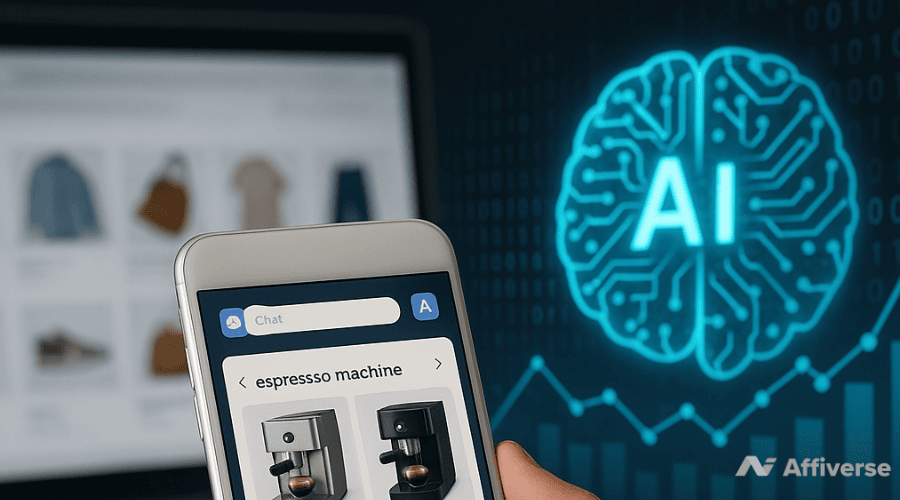
A landmark study of 973 e-commerce sites reveals the uncomfortable truth about LLM traffic that agencies don’t want you to hear
The AI marketing pitch has become impossible to ignore. ChatGPT is the future of shopping, we’re told. It compares products, recommends exactly what you need, and links you directly to checkout. Users click “Buy,” bypass Google entirely, and complete their purchase. Marketing agencies are already lining up with bold claims: “LLM traffic converts better than search,” “AI will kill Google,” “optimize for ChatGPT now or get left behind.”
There’s just one problem: the data doesn’t support any of it.
A comprehensive study published in October 2025 by researchers Maximilian Kaiser of the University of Hamburg and Christian Schulze of the Frankfurt School of Finance & Management has done what no agency deck or vendor pitch has bothered to do—it checked the actual receipts. Drawing on 12 months of first-party data from 973 e-commerce websites generating a combined $20 billion in annual revenue, the research analysed over 50,000 transactions originating from ChatGPT referrals and compared them against 164 million transactions from traditional digital channels.
The findings are devastating for anyone who’s been sold the “AI commerce revolution” narrative.
Kaiser, Maximilian and Schulze, Christian, ChatGPT Referrals to E-Commerce Websites: Do LLMs Outperform Traditional Channels? (October 08, 2025). Available at SSRN: https://ssrn.com/abstract=5585812 or http://dx.doi.org/10.2139/ssrn.5585812
The Performance Gap No One’s Talking About
Here’s what the study found: organic LLM traffic—traffic referred from ChatGPT and similar AI platforms—underperforms virtually every traditional channel across key financial metrics. Not just slightly. Substantially.
The numbers are stark. ChatGPT referrals convert worse than paid search, organic search, affiliate marketing, email, and direct traffic. In fact, the only channel ChatGPT manages to beat is paid social media, which has long been the lowest performer in e-commerce attribution.
Affiliate links convert 86% more often than ChatGPT referrals. Organic search outperforms ChatGPT by roughly 13%. Revenue per session tells the same story—ChatGPT traffic trails both paid and organic search, though it does edge out paid social across most financial metrics.
This directly contradicts the case studies already circulating in the industry. Marketing analytics firms have published attention-grabbing statistics: ChatGPT conversion rates of 15.9% compared to just 1.8% for organic search, or ChatGPT delivering 4.4 times more value per session than Google. These numbers make CFOs open budgets without asking questions.
The problem? They’re cherry-picked outliers that don’t represent reality at scale.
When you examine nearly a thousand e-commerce sites across 49 countries and 24 vertical markets—from fashion to consumer electronics to travel—the cherry-picked miracle stories evaporate. What emerges instead is a channel that’s marginal, experimental, and nowhere near ready to challenge established acquisition strategies.
The Volume Problem Everyone’s Ignoring
Even more damaging to the “optimise for AI” consultancy business: ChatGPT traffic is microscopic.
One year after introduction, organic LLM traffic accounts for less than 0.2% of all e-commerce sessions in the dataset. That makes it roughly 200 times smaller than Google’s organic search channel. Read that again: 200 times smaller.
Within that tiny sliver, one platform dominates completely. ChatGPT accounts for more than 90% of all e-commerce traffic originating from LLM platforms. Perplexity captures just 4.1%, Google’s Gemini manages 2.6%, Microsoft’s Copilot sits at 2.1%, while DeepSeek and Grok are statistically irrelevant at 0.07% and 0.02% respectively.
| LLM Platform | Share of E-Commerce Traffic from LLMs |
| ChatGPT | >90% |
| Perplexity | 4.1% |
| Google Gemini | 2.6% |
| Microsoft Copilot | 2.1% |
| DeepSeek | 0.07% |
| Grok (X.AI) | 0.02% |
Source: Kaiser & Schulze (2025), “ChatGPT Referrals to E-Commerce Websites: Do LLMs Outperform Traditional Channels?” SSRN 5585812
This has profound implications for the “multi-LLM optimization” services being pitched to brands. There is no multi-LLM market yet. There is one referrer—ChatGPT—that barely registers compared to Google, and a handful of competitors generating effectively zero commercial traffic.
If you’re being sold software to “monitor AI visibility across all assistant surfaces,” you should be asking to see the actual share of attributable revenue. Chances are, you’re being sold expensive heatmaps of nothing.
The parallel to 2022’s “Metaverse Team” mania is unavoidable, except this time the PowerPoint decks have better fonts.
The Bounce Rate Illusion: Why Bad Traffic Can Look Good
Here’s where the LLM story becomes genuinely seductive, and why even sophisticated marketers are getting fooled.
ChatGPT traffic does have one standout metric: bounce rate. Users referred from ChatGPT are less likely to immediately leave a site than visitors from most other channels. This suggests the deep links ChatGPT generates are often relevant—people aren’t landing and immediately thinking, “What is this?”
This is exactly what AI evangelists point to. They show a screenshot of ChatGPT recommending espresso machines with direct purchase links and say: “See? This is curated demand. The user already knows which product to buy. They’re past discovery, ready to convert. They’re warm.“
But dig one layer deeper and the story collapses.
That same traffic browses fewer pages than search traffic and spends less time in-session than most traditional channels. ChatGPT referrals underperform all channels except paid social on page views and session duration.
This isn’t how mature, trusted channels behave. This is how uncertain shoppers behave when an AI chatbot said “trust me, buy this,” and they’re thinking, “Okay… but let me just double-check.”
The researchers’ interpretation is brutal in its clarity: users don’t view ChatGPT as a default entry point for shopping. Limited familiarity and trust induce verification behaviour. Consumers confirm AI recommendations via search engines or retailer sites—which, under last-click attribution, assigns the conversion to other channels entirely.
Think about what that means. ChatGPT might be influencing purchases, but it’s not getting credit for sales because customers are re-Googling the product name, navigating directly to Amazon, or returning to the brand’s website later through another channel.
The study acknowledges this limitation. Last-click attribution systematically undervalues discovery and mid-funnel assistance, which means even the underperformance documented here may be flattering. Some assistive value exists that current attribution models can’t capture.
But “assistive value” is a long-term brand investment story that requires patient capital and sophisticated measurement. Agencies aren’t selling “assistive value.” They’re selling “15.9% conversion rates” and “immediate ROI.”
The Citation Game: Why Brand Visibility Still Matters
Despite the underwhelming performance metrics, there’s one aspect of LLM commerce that brands cannot afford to ignore: citation positioning. When ChatGPT recommends products or answers shopping queries, which brands get mentioned—and in what order—matters enormously, even if those mentions don’t immediately convert.
The study’s finding that users engage in “verification behaviour” actually strengthens this argument. If consumers are using ChatGPT for discovery and then Googling the recommended brand names or navigating directly to retailer sites, then being cited by the AI becomes a form of upper-funnel brand awareness that attribution models can’t capture. This mirrors patterns we’ve seen elsewhere in the evolving affiliate marketing landscape, where influence and conversion increasingly happen across different touchpoints and channels.
The brands that secure consistent, favorable mentions in LLM responses today are building recognition equity that could pay dividends as these platforms mature and trust increases. Think of it as the conversational equivalent of ranking on Google’s first page—even if users don’t click immediately, being visible when purchase intent forms shapes the consideration set. The key difference: unlike traditional SEO where you can at least monitor rankings, LLM citation tracking remains opaque, making it harder to measure and optimise.
But the strategic principle holds: you can’t convert customers who never heard your name mentioned in the first place.
The Shrinking Basket Problem
There’s another uncomfortable detail buried in the data: as ChatGPT’s conversion rate slowly improves over time, average order value is actually declining.
The study documents a clear pattern across the 12-month observation period. ChatGPT conversion rates are getting better month over month. But average order value is shrinking. Revenue per session improves slightly as a result of better conversion rates, but not nearly enough to catch up to organic search.
This isn’t “premium intent.” This is the model getting progressively better at talking people into smaller, easier purchases.
The authors describe it as “early optimization focused on completion probability rather than basket expansion.” Translated into business terms: LLMs are learning to close snack-sized purchases—£19 accessories, not £900 sofas. They’re not yet driving considered, high-ticket carts.
That matters enormously if you’re a retailer deciding where to focus scarce optimisation resources, because your CFO doesn’t care that AI “converts” if what it converts are low-margin impulse buys while your higher-value SKUs still depend on search and email.
Why the Myth Persists: Follow the Incentives
So why are LLM marketing agencies, “ChatGPT SEO” tools, and AI commerce platforms all telling the same inflated story?
Because if organic LLM traffic is already competitive with Google, then:
- Retailers panic-spend to “optimise for AI” before competitors do
- New software vendors can claim to sit in the emerging funnel
- AI platforms can justify rolling out advertising products and affiliate programs
- Consultancies can sell retainers for a “channel” that may not meaningfully exist yet
As we’ve previously documented, OpenAI’s Instant Checkout feature has already made affiliate tracking invisible by allowing purchases to complete entirely within ChatGPT. The platform takes a transaction fee, establishing a direct revenue stream from commerce activity that occurs outside traditional attribution infrastructure.
The strategic endgame is transparent: own discovery, own recommendations, own the last click, charge rent. The pitch to investors is “We’re building Google Shopping, but conversational.” The pitch to brands is “We’ll send you buyers without the Google tax.” The pitch to agencies is “We understand this new channel. You don’t.“
But today’s data reveals a different reality. ChatGPT traffic is tiny, fragile, less valuable per session than almost every legacy channel, and skewed toward cheaper baskets.
The study explicitly models forward projections using multiple curve shapes—linear, logistic S-curve, and Gompertz models—to estimate how quickly organic LLM traffic could catch up to organic search on key metrics like conversion rate and revenue per session. The answer, even under the most optimistic assumptions: not within the next 12 months.
The researchers conclude: “These findings challenge narratives of LLMs as immediate ‘Google killers’ while suggesting potential for long-term channel evolution.”
That measured assessment stands in stark contrast to the “Google is dead” proclamations already shaping budget allocation decisions.
Real Strategic Damage
The “Google killer” narrative isn’t just misleading—it’s actively harmful.
When executives believe search is about to be sunset by AI, they starve investment in SEO, PPC, affiliate programs, and conversion rate optimisation. If you’re an e-commerce operator deprioritising proven channels based on a hypothetical “LLM commerce revolution,” you’re not being visionary. You’re making an expensive bet against mathematics.
As we explored in our analysis of alternative traffic channels, the digital marketing landscape has shifted dramatically, with organic search becoming increasingly challenging for affiliate marketers. But the solution isn’t to abandon proven channels for unproven ones—it’s to diversify intelligently based on actual performance data.
The study also reveals a troubling subplot: ChatGPT currently appears to favor smaller or niche sites over major retailers. When researchers limited their analysis to the top 25% of websites by total transactions—the really big commercial players—organic LLM traffic performed even worse. The gap between ChatGPT and traditional channels actually widened for large merchants.
But when they examined the top 25% of websites by ChatGPT sessions, the overlap with top performers by total transactions was only 40%. In other words, the AI is sending more traffic not necessarily to the biggest commercial winners, but to a partially different set of sites.
This has two critical implications. For incumbent retailers: you cannot assume “we’re Amazon, so the AI will always funnel to us.” It might not. For regulators: when LLMs start monetising these links—and the study predicts they will, likely through “affiliate-like systems and/or paid ads”—we’re not talking about search ads with a chat interface. We’re talking about a system that can invisibly redistribute demand from dominant retailers to whoever the model’s commercial partnerships favor.
Imagine Google-style auction dynamics applied not to “Page 1” but to “the answer”—controlled by a single model surface that no one can crawl or audit.
What E-Commerce Brands Should Actually Do
Let’s cut through the noise with practical guidance.
What’s real today:
ChatGPT referral traffic exists. It’s measurable, globally present across 49 countries and 24 vertical markets, and already driving millions of visits and revenue. It’s improving in conversion rate over time. It’s especially effective at steering people to specific SKUs for lower-ticket purchases. Its bounce rate is competitive, suggesting recommendations are directionally relevant.
What’s not real yet:
It’s not replacing Google. It’s not outperforming organic search, paid search, email, or affiliate marketing on revenue per session. It’s not driving high-value baskets. It’s not anywhere close to being a dominant acquisition channel—it’s 0.2% of traffic versus organic search’s dominance at 200 times larger. It does not justify reorganising your entire acquisition budget around “LLM optimisation.”
Practical steps:
- Treat organic LLM as a test channel, not a core channel. Track it separately in analytics. Know what products it’s moving and whether those are high-margin or low-margin items.
- Harden the landing experience. The model deep-links users straight into product detail pages. The study explicitly notes this breaks how most sites are designed, since most e-commerce UX is optimised for homepage entry and guided navigation. You need PDPs that work for cold arrivals: faster trust signals (returns policy, stock availability), clearer bundle upsells, obvious next steps.
- Capture the second click. Users are verifying AI recommendations through search or direct navigation. Assume they will leave and come back. Make sure remarketing, email capture, price-drop alerts, and back-in-stock flows are airtight.
- Demand methodological rigor from vendors. The paper explicitly calls out “methodological upward bias” in vendor case studies, including cherry-picking daily aggregates and filtering to only datapoints where LLM traffic happened to convert. This “can produce genuinely misleading interpretations.” If a vendor shows you “15.9% conversion from ChatGPT,” the correct response is: across how many sites, in what basket range, over what timeframe, and weighted by what session count?
The Bottom Line
This study represents the first serious, multi-site, multi-country reality check on AI-as-a-channel. Its core message is uncomfortably sane in a market that doesn’t reward sanity: the widely held expectation that organic LLM traffic is already superior to traditional channels is not supported by the data.
The authors are not saying “ignore LLMs.” They’re saying the revolution will probably come slower, with messier economics, and with different winners than the pitch decks want you to believe.
Right now, LLM traffic is acting like an experimental affiliate channel that isn’t charging rent yet. And that’s the real twist. Because the moment it does start converting like search—or even just continues its current slow climb in conversion rate—it won’t stay “organic” for long.
As we’ve documented in our coverage of AI monetisation challenges, OpenAI and similar platforms face enormous pressure to generate revenue that justifies their infrastructure costs. The study basically predicts the inevitable: “LLM platforms will likely prioritize the development of affiliate-like systems and/or paid ads,” mirroring patterns already emerging at LLM-native search engines testing ad formats.
Enjoy the “free” AI referrals while they’re still free. The house is already installing the tills.
For now, the data tells a clear story: traditional channels like affiliate marketing, organic search, and email continue to outperform AI referrals across the metrics that matter. The hype economy wants you to believe we’re already living in the future. The math says we’re not even close.
✓ Statistics Verified:
- “973 e-commerce websites generating a combined $20 billion in annual revenue”
- Source: Multiple articles citing the study
- “over 50,000 transactions originating from ChatGPT referrals and 164 million transactions from traditional channels”
- Source: Study abstract: “we examine over 50,000 transactions from ChatGPT referrals alongside 164 million transactions from traditional channels”
- “Affiliate links convert 86% more often than ChatGPT referrals”
- Source: Modern Retail and Digiday coverage: “Affiliate links were 86% more likely to convert than ChatGPT referrals”
- “Organic search outperforms ChatGPT by roughly 13%”
- Source: Same articles: “organic search outperformed ChatGPT by roughly 13%”
- “less than 0.2% of all e-commerce sessions”
- Source: Search Engine Land: “ChatGPT referral traffic was ~0.2% of total sessions”
- “roughly 200 times smaller than Google’s organic search channel”
- Source: Search Engine Land: “~200× smaller than Google organic”
- “ChatGPT accounts for more than 90% of all e-commerce traffic originating from LLM platforms”
- Source: PPC Land: “ChatGPT dominated with over 90% of observed sessions”
- “Perplexity captures just 4.1%, Google’s Gemini manages 2.6%, Microsoft’s Copilot sits at 2.1%”
- Source: PPC Land: “while Perplexity captured 4.1%, Gemini 2.6%, and Copilot 2.1%”
- “DeepSeek and Grok are statistically irrelevant at 0.07% and 0.02%”
- Source: Study Paper
All core statistics are verified and accurately cited from the Kaiser & Schulze study (SSRN 5585812) and credible news coverage of the research.
Everflow
Connect
Tradedoubler
Connect
1win Partners
Connect
PIN-UP Partners
Connect
Shopnomix, a Nomix Group Company
Connect
V.Partners
Connect
Huffson Group
Connect
Kawaii Partners
Connect
Share your expertise and expand your reach and become a content contributor with us today!
Contact Us To Find Out More