Affiliate Marketing’s Transformation in the AI Era: From Honey to ZeroClick
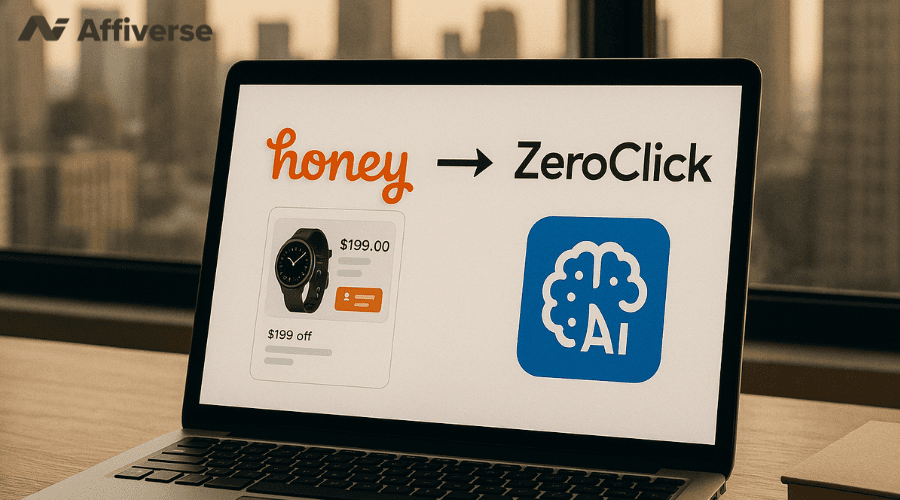
The affiliate marketing world was shaken when Ryan Hudson sold Honey to PayPal for $4 billion in 2020. Now, Hudson is back with a new venture—and this time, he’s betting everything on artificial intelligence.
His new venture, ZeroClick, represents a fascinating pivot from traditional affiliate marketing browser extensions to AI-powered advertising networks. But the journey from Honey’s massive success to ZeroClick’s ambitious AI play is anything but straightforward.
Hudson’s pivot from traditional affiliate marketing to AI advertising reflects broader industry trends that are reshaping how marketers reach consumers. The shift toward AI-powered search and answer engines creates both challenges and opportunities for affiliate marketers who have traditionally relied on click-through traffic.
This behavioural shift forces marketers to reconsider their strategies. Traditional affiliate models depend on directing users to merchant websites, but AI platforms encourage zero-click interactions where users get information without leaving the AI interface. ZeroClick’s model attempts to bridge this gap by monetising the AI interaction itself rather than the click-through.
The Honey Legacy: Success Shadowed by Controversy
Honey became the poster child for affiliate browser extensions, helping users find coupon codes and cashback offers while generating substantial revenue through affiliate commissions. The Chrome extension achieved significant growth before PayPal’s acquisition.
But Honey’s success story took a controversial turn when allegations emerged about the platform’s business practices. Late last year, creators who had promoted Honey through their channels filed lawsuits against PayPal, claiming the extension was systematically replacing their affiliate marketing links with its own, effectively stealing commissions that should have gone to content creators.
The controversy sent shockwaves through the affiliate marketing community, with many questioning whether browser extensions could be trusted partners or if they were essentially sophisticated commission hijacking tools. The allegations painted a picture of an extension that appeared to help users while secretly redirecting revenue away from the very creators who had built their audiences around promoting it.
Hudson has publicly defended Honey’s practices, including hosting an AMA on Reddit earlier this year where he attempted to debunk the claims. “This will resolve favorably for PayPal Honey and for all of the other browser extensions in the same space that do the same thing,” he stated, suggesting the practices were industry-standard rather than uniquely problematic.
The Birth of ZeroClick: When Google Says No
Hudson’s path to AI advertising wasn’t initially planned. After Honey, he developed Pie Shopping, a Chrome extension that was positioned as something of a spiritual successor to his previous venture. The Pie ecosystem expanded to include both Pie Shopping and Pie Adblock—a unique ad blocker that pays users for viewing selected advertisements, achieving over one million users within months of launch.
Pie also created PieGPT, a custom ChatGPT integration that analysed AI searches and paired them with shopping offers, sharing affiliate revenue with consumers. However, Google threw a wrench into Hudson’s plans. The search giant’s policies prevented Pie from building an ad blocker that offered rewards to users who permitted certain ads. “That was a reset moment for us,” Hudson explained. “OK, we need to think more strategically about what we’re building.”
That strategic rethinking led to a revelation: the technology powering PieGPT could be repurposed as something much bigger—an ad network specifically designed for AI conversations.
“It’s an enrichment server that matches context with what the user’s working on and adds additional content,” Hudson said, describing ZeroClick’s core functionality.
Understanding the ZeroClick Model: “Reasoning-Time” Advertising
ZeroClick operates what it calls a “reasoning-time ad network” that analyses the context of AI chatbot conversations, identifies relevant advertisers, and inserts paid responses directly into the dialogue. Unlike traditional display advertising, ZeroClick weaves advertiser-provided context into the AI’s actual thinking process, allowing artificial intelligence to consider commercial information as it formulates responses.
The system works through several key steps: intent interpretation, campaign matching, contextual weaving, and optional rewards integration. As the AI detects user intent, ZeroClick pulls privacy-safe summaries into its platform where brands compete to supply the most relevant context for answer enrichment. The winning contextual information is then added to the AI’s consideration sources, allowing it to be naturally integrated into responses.
The platform allows AI applications to monetise their user interactions without requiring subscription fees—addressing what Hudson sees as a critical funding gap in the AI ecosystem. “So that AI developers can build experiences that don’t just ask you for $20 a month to use,” Hudson explained, highlighting the monetisation challenge facing countless AI startups struggling with high inference costs.
The name “ZeroClick” serves dual purposes. It references the “zero-click” search behavior that AI platforms encourage—where users get answers without clicking through to external websites, a trend that has significant implications for traditional affiliate marketing strategies. But it’s also a deliberate nod to DoubleClick, Google’s foundational ad tech platform that built the internet’s largest advertising business after its 2008 acquisition.
The AI Advertising Land Grab: A Competitive Battlefield
ZeroClick isn’t operating in isolation. The company faces intense competition in the rapidly emerging AI advertising space, with multiple startups racing to solve AI monetisation. Key competitors include Koah and Kontext, with the latter recently securing $10 million in funding and claiming its ad format boosts revenue for AI apps by 66%. Other players in this space include OpenAds.AI, Abotify, and Prompt Ads, though most remain smaller companies with limited funding and traction.
The competitive landscape also includes major technology companies like Google, Meta, Microsoft, and TheTradeDesk, though these incumbents currently lack real-time ad generation capabilities for third-party advertisements within AI chatbots. Industry experts argue that adapting existing ad tech infrastructure to support real-time creative generation while maintaining brand safety around AI-generated content presents significant barriers for established players.
The urgency in this space is palpable—with major AI platforms like ChatGPT, Perplexity, and Google’s AI Mode still developing their advertising strategies, there’s a narrow window for third-party solutions to establish market position before the platforms develop their own monetisation systems.
The opportunity became tangible when ads began appearing on ChatGPT through third-party browser extensions. Paul Nguyen, CMO of UptimeRobot, documented an Upwork ad that appeared in his ChatGPT session via Koah AI’s extension. Upwork confirmed it was “running a pilot with Koah as part of our broader paid acquisition strategy,” illustrating how brands are already experimenting with AI advertising channels despite platform owners not yet having official solutions.
OpenAI’s Chief Product Officer Kevin Weil quickly clarified that the ad didn’t originate from ChatGPT itself, but the incident highlighted how the AI advertising ecosystem is developing whether platform owners are ready or not.
The Ethical Debate: Ads vs. AI Integrity
Hudson’s venture enters a contentious space where the fundamental question isn’t technical—it’s philosophical. Critics argue that paid content integration could compromise AI’s perceived impartiality and trustworthiness. The concern is straightforward: if AI responses are influenced by advertising dollars, how can users trust the information they receive?
“It returns interesting content on behalf of advertisers,” Hudson said in a piece on Adage, emphasising that “the AI decides whether or not to include, or which pieces of information to include [from advertisers], in the response.”
This approach attempts to maintain AI agency in content selection while opening revenue streams, but it’s a delicate balance. OpenAI CEO Sam Altman has expressed skepticism about advertising integration, telling Stratechery’s Ben Thompson, “There’s a tasteful way we can do ads, but I don’t know. I kind of just don’t like ads that much.”
The Zero-Click Search Revolution and Its Market Impact
The broader shift toward zero-click search represents a fundamental transformation in how consumers interact with information online. Recent research from Bain & Company reveals that approximately 60% of searches now end without users clicking through to destination sites, with this trend accelerating across all demographics. Even among users skeptical of generative AI, about half report that most of their queries are answered directly on search pages.
This behavioural change is creating significant challenges for businesses that have traditionally relied on search traffic for customer acquisition. B2B and DTC marketers are already seeing measurable impacts, with some companies reporting 5% drops in paid search click-through rates and 20% decreases in organic search CTR among younger demographics.
Platforms like ChatGPT and Perplexity are rapidly gaining market share in this new landscape. ChatGPT saw a 44% traffic boost in November 2024, while Perplexity reached 15 million monthly users by late 2024. Industry surveys suggest that up to 58% of consumers have replaced traditional search engines with AI tools for certain use cases, with 35.8% of Americans now using ChatGPT regularly.
For affiliate marketers, this represents both an existential challenge and a potential opportunity. The traditional model of driving traffic to merchant websites becomes less relevant when AI provides direct answers, but new models like ZeroClick’s contextual integration could create alternative revenue streams that monetise the interaction itself rather than the click-through.
The Market Opportunity: Learning from Historical Ad Platform Valuations
The potential market size for AI advertising infrastructure becomes clearer when viewed through the lens of previous platform transitions. Historical advertising infrastructure acquisitions provide compelling context: Google’s AdSense achieved a $300 billion valuation, TheTradeDesk reached $70 billion, and AppLovin attained $110 billion market capitalisations during their respective platform cycles.
The current $140 billion open web advertising market provides additional context for positioning as AI applications increasingly compete for user attention and engagement across digital platforms. Industry analysts suggest that as AI consumer applications like ChatGPT, Character.ai, and Perplexity achieve mainstream adoption, they represent advertising infrastructure opportunities similar to previous platform transitions.
ZeroClick’s competitive advantage lies in what it calls “text-based creative optimisation,” which fits naturally with AI platform economics and enables ad-supported free tiers that can offset the high inference costs that plague many AI applications. This approach differs from traditional display advertising by integrating commercial context directly into the AI’s reasoning process rather than interrupting the user experience with separate ad units.
Investor Confidence and The $55 Million Validation
ZeroClick recently announced securing $55 million in funding from a notable investor group including Anthos, Ludlow, Anfa, Wonder, Protagonist, and founder Ryan Hudson himself. Significantly, this is the same investor group that previously backed Hudson as he grew Honey to its $4 billion PayPal acquisition—suggesting they maintain confidence in his ability to build transformative consumer products despite recent controversies.
The platform is already showing early traction, with ZeroClick claiming it connects more than 10,000 advertisers with millions of users through internally developed products. This funding represents validation for Hudson’s strategic pivot, but it also intensifies scrutiny. Given the ongoing Honey controversy, ZeroClick will need to demonstrate that AI advertising can be implemented transparently and ethically—qualities that critics argue were missing from Hudson’s previous venture.
The Bigger Picture: Redefining Digital Advertising
Hudson’s journey from affiliate browser extensions to AI ad networks illustrates the rapid evolution of digital advertising. The shift from traditional search to AI-powered answers represents a fundamental change in how consumers discover and evaluate products and services.
For affiliate marketers, this transformation presents both existential challenges and new opportunities. The traditional model of driving traffic to merchant websites becomes less relevant when AI provides direct answers, but new models like ZeroClick’s contextual integration could create alternative revenue streams.
The success or failure of ventures like ZeroClick will likely determine whether AI platforms develop advertising models that benefit creators and marketers, or whether they’ll primarily serve platform owners and large advertisers.
Looking Ahead: The AI Advertising Frontier
As ZeroClick scales its operations and more competitors enter the space, several key questions will determine the future of AI advertising:
- Can contextual AI ads maintain user trust while generating meaningful revenue?
- Will AI platforms embrace third-party advertising solutions or develop competing internal systems?
- How will regulatory frameworks evolve to address AI advertising transparency?
Hudson’s track record suggests he understands both the opportunities and pitfalls of building advertising-dependent consumer products. Whether ZeroClick can avoid the controversies that shadowed Honey while establishing AI advertising as a legitimate industry will likely define both the company’s success and the broader ecosystem’s development.
For now, ZeroClick represents the affiliate marketing industry’s adaptation to an AI-dominated future—one where the traditional click-through model gives way to contextual, conversational commerce. Whether this evolution serves users, creators, and advertisers equally remains to be seen.
What are your thoughts on the shift from traditional affiliate marketing to AI-powered advertising? The implications extend far beyond any single company—they could reshape how we discover, evaluate, and purchase products in an AI-first world.
Everflow
Connect
Tradedoubler
Connect
1win Partners
Connect
PIN-UP Partners
Connect
Shopnomix, a Nomix Group Company
Connect
V.Partners
Connect
Huffson Group
Connect
Kawaii Partners
Connect
Share your expertise and expand your reach and become a content contributor with us today!
Contact Us To Find Out More